Newborn Care Basics: What the Research Behind Each Rule Says

The hospital gave you a folder. It said "keep the cord dry" and "back to sleep." What it didn't say: researchers tested both of those rules in randomized trials, and the numbers behind them are considerably more specific (and in one case more surprising) than the instruction alone suggests. Newborn care basics look deceptively simple from the outside. The mechanics of each one turn out to have a study behind them, and sometimes the study changes how you'd do the thing.
- The cord stump reversal story — what changed, and why antiseptics turned out to be the wrong answer in hospital settings
- Why fewer baths per week is not a shortcut but a skin-barrier decision backed by measurable data
- What the diaper rash research says about prevention versus reaction
- The two separate safety concerns inside swaddling, and why one of them multiplies risk dramatically depending on a single variable
- The biology behind newborn temperature regulation — and what overheating has to do with sleep safety
- Nails, nose, and the small tasks that trip up more new parents than almost anything else
If the one-sentence answer is enough, you’ve got the gist. If you want the mechanism behind each piece, keep reading.
The Cord Stump: Why "Keep It Dry" Is a More Specific Instruction Than It Sounds
The standard hospital discharge instruction — keep the cord stump clean and dry, avoid submerging in water, let it fall off on its own — is correct for families who deliver in hospital settings in high-resource countries. But understanding why it replaced antiseptic care, and what "dry" means in practice, is more useful than the rule alone.
The reversal happened because of evidence. For decades, hospitals recommended applying rubbing alcohol to the cord stump. The rationale was infection prevention. Then researchers started testing whether this practice held up, and the answer turned out to depend entirely on the setting.
A 2004 Cochrane systematic review by Zupan, Garner, and Omari analyzed 21 trials covering nearly 9,000 newborns, almost all from high-income hospital birth settings. The finding was consistent: antiseptics offered no advantage over dry cord care for preventing mortality or systemic infection in these populations. Dry care was at least as effective. What antiseptics did, measurably, was delay stump separation. The Cochrane update in 2026 puts that delay at roughly 1.6 days compared to dry care. A cord kept slightly moist by alcohol dries more slowly. That is the opposite of what the treatment was trying to accomplish.
The World Health Organization reached the same conclusion in their 2014 postnatal care recommendations: clean, dry cord care is the standard for facility births and low-mortality settings. The evidence for antiseptics like chlorhexidine comes from a different context. Large randomized trials in Nepal (Mullany and colleagues, 2006, The Lancet) and Pakistan (Soofi and colleagues, 2012, The Lancet) enrolled populations where most births happened at home and baseline newborn mortality was high. In those settings, chlorhexidine application reduced cord infections by roughly 75% and lowered neonatal mortality substantially. The biology is the same; the baseline contamination risk is not.
For a hospital-born infant in the United States, "dry cord care" means: don't put anything on it. Fold the front of the diaper down to keep urine away from the stump. Stick to sponge baths until it falls off, which typically happens within one to three weeks. If the base of the stump becomes red, warm, or swollen, or if the surrounding skin develops redness, that is worth a call to your pediatrician. A stump that smells slightly is generally normal; pus or spreading redness is not.
The cord stump is also not the obstacle to your first real bath that many new parents assume. That comes next.
Bathing: Less Is a Medically Supported Decision
Almost every newborn care guide tells new parents to bathe the baby two to three times per week rather than daily. The reasoning is usually vague ("more frequent bathing may dry out the skin") and rarely quantified. It turns out there is a specific finding behind this recommendation.
A 2020 study from the EAT (Enquiring About Tolerance) Study Team, published in the Journal of Allergy and Clinical Immunology: In Practice, followed a large cohort of infants and examined bathing frequency in relation to skin barrier function at three months of age. The researchers measured transepidermal water loss — a standard marker for how well the skin is retaining moisture and functioning as a barrier. Infants who were bathed daily were roughly four times more likely to show elevated water loss compared to infants bathed once per week or less — a difference that held after controlling for other variables.
This does not mean daily bathing causes permanent damage. It means that newborn skin, which is still completing its adaptation to life outside the uterus, is not designed to be washed every day. Newborn skin pH starts above 6 at birth and falls toward the mildly acidic range of around 4.95 within the first four days — a process described by dermatologist Blume-Peytavi and colleagues in a 2016 European expert roundtable published in Pediatric Dermatology. That acidic surface layer, sometimes called the acid mantle, is part of the skin's natural defense system. Frequent washing can disrupt its development.
Two to three baths per week is a reasonable default. When you do bathe your baby, the 2016 European roundtable recommends keeping water temperature at 37 to 37.5°C (a bath thermometer is genuinely useful here, not just a gadget) and limiting the session to around five to ten minutes. Room temperature around 21 to 22°C helps prevent the baby from becoming chilled before or after.
On the question of wash versus water: a 2013 randomized controlled trial by Lavender and colleagues at the University of Manchester, published in JOGNN, enrolled 307 term infants and compared a soap-free wash product with water alone over 14 days, measuring transepidermal water loss at the end of the study. Neither group came out ahead — the two performed comparably on skin barrier outcomes. A gentle, fragrance-free, pH-balanced cleanser designed for newborns is as good as plain water, and plain water is as good as the cleanser. What matters more is frequency than product.
One timing detail from the research that often surprises new parents: a 2013 study by Preer and colleagues, published in Breastfeeding Medicine, found that delaying the first bath to at least 12 hours after birth was associated with breastfeeding initiation being roughly 166% more likely in the delayed-bath group. The likely mechanism is that newborns retain vernix (the waxy coating present at birth) which carries the mother's scent, and that delaying the bath preserves conditions that support skin-to-skin contact and early breastfeeding. This is primarily relevant for the hospital stay rather than home care, but it is worth knowing if you have a choice.
Diapers and Skin: What Prevents a Rash vs. What Treats One
Diaper rash is common (studies estimate that the majority of infants experience it at some point in the first year), and the prevention logic is straightforward enough that it does not require much elaboration: wet or soiled skin in contact with moisture and friction for extended periods creates conditions for irritation and breakdown.
The practical principles are consistent across dermatology and pediatric nursing literature: change diapers frequently (especially after stools), allow brief air exposure when possible, and use a barrier cream during diaper changes — particularly before sleep when the interval between changes is longer.
On the question of which barrier preparations are effective, a 2025 systematic review and meta-analysis published in Cureus, covering six studies, found that barrier creams reduced the occurrence of diaper dermatitis overall, with zinc oxide paste identified as one of the most effective preparations. The review also found that antifungal combinations like clotrimazole were effective for cases involving fungal involvement. The key point the research supports is the use of a barrier at each change as a preventive measure, rather than waiting for a rash to appear before applying anything.
At each diaper change, after cleaning with unscented wipes or warm water, apply a thin layer of zinc oxide paste to the diaper area before closing the fresh diaper. This is not a treatment — it is a layer between the skin and moisture. If a rash appears and does not improve within a few days of consistent barrier care and more frequent changes, or if the rash has raised bumpy borders or bright red satellite lesions (patterns associated with fungal involvement), that warrants a check-in with your pediatrician.
For a guide to early tummy time techniques and how to build up from day one, our tummy time guide covers safe starting positions from the first weeks.
Swaddling: Two Separate Safety Variables, and Why Position Is the Critical One
Swaddling is one of the more technique-sensitive practices in newborn care, and it has two distinct safety considerations that are often discussed separately when they are better understood together: hip position and sleep position. Both are supported by research, and they interact in ways that matter.
Hip position. The International Hip Dysplasia Institute (IHDI) has published a formal position statement on swaddling that addresses the biomechanics of the wrapped leg position. When a swaddle keeps a baby's legs extended and pressed together, it holds the femoral head in a position that can stress the acetabulum (the hip socket), particularly in infants with any natural laxity in the joint. The IHDI describes observing, in ultrasound imaging, that tight straight-leg swaddling was able to dislocate a loose hip in real time in a way that a hip-healthy swaddle technique did not. The recommendation: the legs should be able to bend up and out at the hips, and the knees should be able to flex. A swaddle that wraps the torso and arms snugly while leaving the lower half room to move is what the IHDI calls "hip-healthy" wrapping.
Swaddling and sleep. There is a documented physiological reason why swaddled newborns tend to sleep longer stretches — and why arms-in wrapping specifically accounts for much of the effect. In the first three to four months of life, infants have an active Moro reflex (also called the startle reflex): a sudden whole-body response to perceived loss of support that throws the arms outward and typically triggers crying. A 2002 clinical trial by Gerard, Harris, and Thach published in Pediatrics (PMID 12456937) monitored 26 healthy infants using EEG during alternating swaddled and unswaddled sleep periods. The study found that swaddling significantly inhibited the progression of brainstem arousals into full cortical arousals during quiet sleep, and reduced spontaneous arousals overall. Infants were able to return to sleep without fully waking. A 2022 systematic review by Dixley and Ball in Frontiers in Pediatrics (PMC9748185), synthesizing six studies published from 2007 to 2022, confirmed the pattern: swaddling increases quiet sleep duration and decreases arousal frequency. The practical implication is straightforward — if your baby wakes from arm movements rather than hunger, a proper swaddle addresses the mechanism directly.
Sleep position. A 2016 meta-analysis by Pease and colleagues published in Pediatrics, covering four studies and 760 SIDS cases, examined the interaction between swaddling and infant sleep position. Overall, swaddled infants had a moderately elevated SIDS risk compared to unswaddled infants — but that elevation was not evenly distributed. On the back: roughly double the risk of an unswaddled baby in the same position. On the side: roughly three times. Prone — on the stomach: approximately thirteen times.
The reason the prone figure is so much higher is mechanical: a swaddled infant cannot use arms to push up and reposition if the baby rolls or ends up face-down. The swaddle removes the escape route. This is also why the guidance from the AAP is to stop swaddling once an infant shows any sign of attempting to roll, which can happen as early as two months. A baby who is developing rolling ability is a baby who might roll into a position the swaddle does not allow them to escape from.
Put together: swaddle with the hips able to flex and abduct, place the baby on the back, and transition out of swaddling before rolling attempts begin. The 2022 AAP safe sleep policy statement (Moon and colleagues, Pediatrics, e2022057990) also addresses the sleep surface directly: firm, flat, non-inclined is the standard. Inclined sleepers (the category that prompted a major recall in recent years) place infants at an angle that can cause the head to fall forward and restrict the airway, particularly once muscle tone decreases in sleep. The AAP's updated guidance is specific that any surface that inclines more than 10 degrees is not appropriate for infant sleep.
Temperature and Dressing: The Biology Behind "One More Layer"
The common guidance for dressing a newborn — one more layer than you would wear — is a heuristic, not a measurement derived from a controlled trial. But the reasoning behind it is grounded in well-documented newborn physiology.
Newborns do not shiver. The shivering response (involuntary muscle contraction that generates heat) is the primary adult mechanism for responding to cold. In newborns, it is either absent or severely limited. Instead, neonates generate heat through a process called non-shivering thermogenesis, described in a foundational 1965 paper by Dawkins and Scopes published in Nature: brown adipose tissue, located primarily between the shoulder blades and around the kidneys, releases heat when stimulated by noradrenaline. This mechanism works, but it is metabolically expensive and finite. It also means that newborns cannot easily signal cold by behavior in the way older infants can — they may become quiet and lethargic rather than fussing in ways that alert a caregiver.
The flip side of this is that newborns also cannot efficiently dissipate heat. They do not sweat in the same way adults do, and their heat regulation overall is less precise. An overdressed baby in a warm room can become overheated without obvious signs.
This matters for sleep safety. A 2022 narrative review by Franco and colleagues, published in Frontiers in Pediatrics, examined hyperthermia as a risk factor for SIDS and found that thermal stress, primarily from excessive clothing and bedding, impairs the infant's arousal response. The mechanism involves the brainstem circuits that allow a sleeping infant to wake when experiencing respiratory difficulty. When those circuits are heat-stressed, the arousal response is blunted. The review authors describe hyperthermia as mainly resulting from excessive clothing and bedding insulation. This is the physiological basis for why overheating during sleep is on the AAP's list of modifiable SIDS risk factors.
Dress your newborn in roughly the same weight of clothing you are wearing, plus one light layer. A firm, flat sleep surface with no loose blankets, no sleep positioners, and no soft objects in the sleep space — consistent with AAP 2022 recommendations — removes the most common sources of excess insulation during sleep. Room-sharing (baby in the same room but not the same bed) for at least six months, ideally up to a year, is part of the same updated guidance.
On room temperature specifically: the AAP does not name a single target number, but recommends dressing the baby appropriately for whatever the ambient temperature is. Pediatric sleep specialists and the AAP 2022 technical report consistently reference 68–72°F (20–22°C) as the range that supports comfortable sleep while reducing overheating risk. A simple digital room thermometer is more reliable than guessing. On humidity: dry air is a direct contributor to the nasal congestion that disrupts feeding in the early weeks. Pediatric sources, referencing EPA indoor air quality guidelines, put the useful humidity range at 30–50%. Below that, nasal mucus dries into crusts that block a nose-breathing newborn's airway; above 50%, the environment becomes hospitable to mold and bacteria. A basic cool-mist humidifier in the sleep space — cleaned regularly per manufacturer instructions — addresses both concerns without any risk associated with warm-mist models.
For what to do during your baby's alert wake windows, including activities calibrated to newborn vision and sensory development, our guide covers the first weeks in detail. During those same alert periods, what your baby can actually see week by week is worth understanding. The High Contrast Flashcards 0–3m are designed for the visual system that is most active during those early calm-awake windows.
Nails, Nose, and the Small Mechanics New Parents Ask About
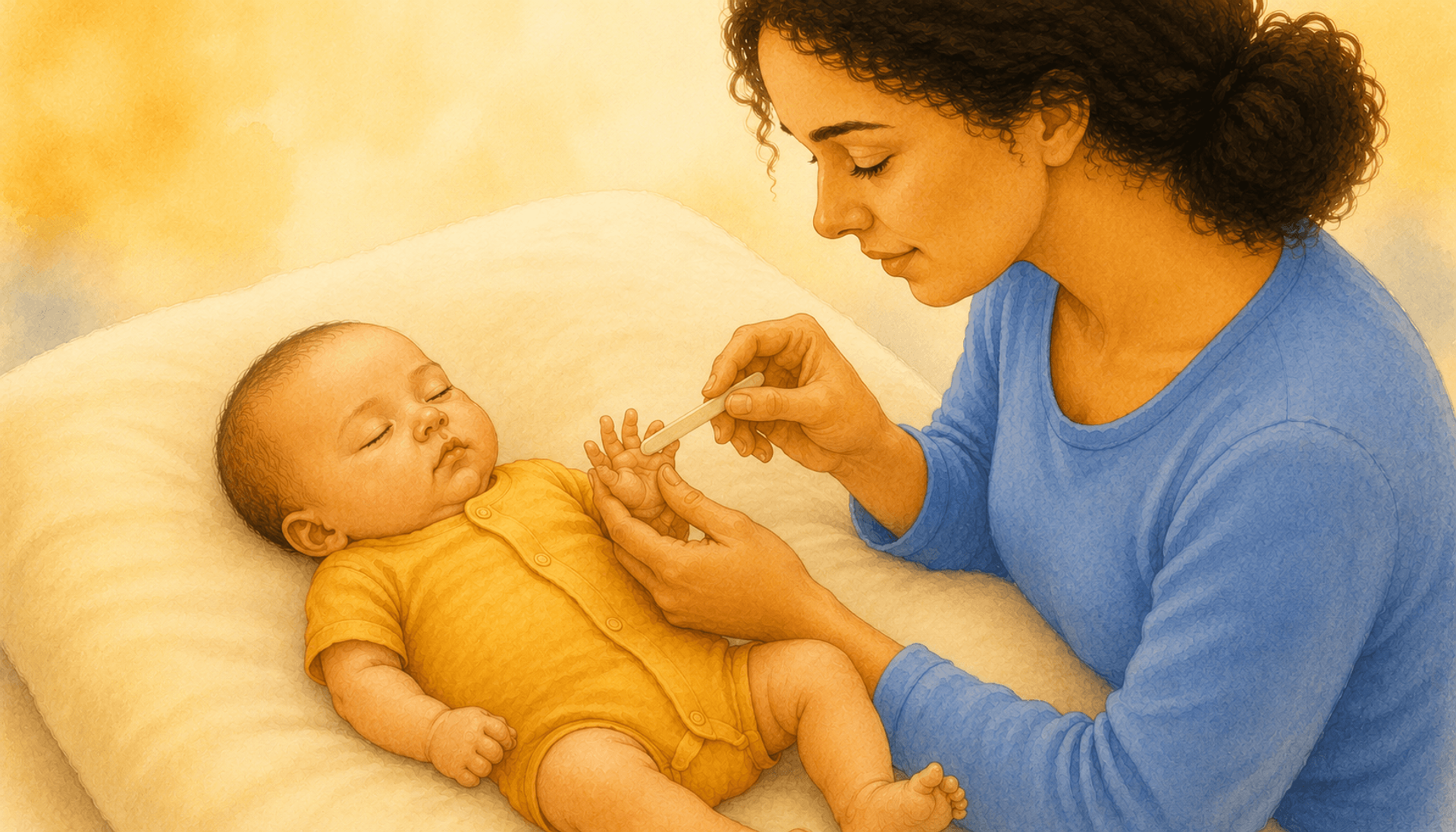
Nails. Newborn nails are surprisingly sharp, grow quickly, and are soft enough that the tip of a newborn's finger can be accidentally nicked if scissors are used without care. The AAP guidance via HealthyChildren.org recommends using either baby nail clippers with a safety guard or an emery board (nail file), and doing it when the baby is asleep or calm. Press the finger pad gently downward and away from the nail, then trim or file straight across. The biting-off or peeling technique is a transmission route for bacteria and is not recommended. There is no minimum age requirement or "wait until two weeks" rule — that is parenting folklore without an evidence basis. Trim when the nails are long enough to scratch, using whichever tool you are most comfortable with. Many parents find a file the lowest-anxiety entry point because it cannot nick skin even if the hand moves. Fingernails typically need trimming more often than toenails, sometimes once or twice a week in the early weeks. For a fuller picture of what the first month of alert windows actually looks like in practice, the activities for a 1 month old guide maps what a newborn can do and respond to week by week.
Nose. Newborns are obligate nose-breathers; they breathe primarily through their nose, not their mouth. A congested nose can interfere with feeding in ways that are distressing for both the baby and the parent. Dry air and normal mucus production account for most newborn nasal congestion; illness is less common as a cause in the very early weeks. Saline drops (preservative-free, formulated for infants) loosen mucus, and a bulb syringe or nasal aspirator can clear the nostrils before feeds. Suction gently and not repeatedly, as excessive suctioning can irritate the nasal lining. If your baby has significant difficulty breathing, is breathing rapidly, has flaring nostrils, or shows visible effort with each breath, that is a symptom to report promptly rather than manage at home. Our guide to the first week home covers what those breathing patterns mean alongside other early warning signs like jaundice and weight loss thresholds.
Frequently Asked Questions
In a hospital-born infant in a high-resource country, no. A 2004 Cochrane review by Zupan, Garner, and Omari found that antiseptics provided no advantage over dry care in hospital birth settings, and a 2026 Cochrane update found that antiseptic application delays stump separation by approximately 1.6 days. The WHO 2014 postnatal care guidelines reserve chlorhexidine for high-mortality, home-birth settings. Keep the stump dry, fold the diaper front down to avoid contact with urine, and use sponge baths only until it falls off, typically one to three weeks.
Two to three times per week is well-supported by the evidence. A 2020 study from the EAT Study Team (Marrs and colleagues, Journal of Allergy and Clinical Immunology: In Practice) found that daily bathing was associated with roughly a fourfold increase in the likelihood of elevated transepidermal water loss — a marker of impaired skin barrier function — at three months of age, compared to bathing once per week or less. Newborn skin is still completing its transition to the outside environment and benefits from less frequent washing. When you do bathe your baby, water alone or a gentle, fragrance-free, pH-balanced cleanser both work (Lavender and colleagues, 2013, JOGNN, found no measurable difference between the two).
Swaddling is safe with two specific conditions met. First, the legs must be able to flex upward and apart at the hips and the knees must be able to bend — the International Hip Dysplasia Institute has documented that tight straight-leg swaddling can stress the hip joint. Second, the swaddled baby must always be placed on the back. A 2016 meta-analysis by Pease and colleagues in Pediatrics found that swaddled infants placed prone had approximately thirteen times the SIDS risk of unswaddled infants on their backs. Stop swaddling at the first signs your baby is attempting to roll, which can happen as early as two months.
The common guidance — roughly what you would wear plus one light layer — is a pragmatic convention, not a figure from a controlled trial. The underlying principle is grounded in neonatal physiology: newborns generate heat through brown adipose tissue rather than shivering (Dawkins and Scopes, Nature, 1965) and cannot efficiently shed excess heat. A 2022 narrative review by Franco and colleagues in Frontiers in Pediatrics found that thermal stress from excessive clothing and bedding impairs the infant's arousal response during sleep — the mechanism by which overheating is associated with increased SIDS risk. Firm, flat surface, no loose bedding, comfortable room temperature, and approximately the same weight of clothing you are wearing gives you a reasonable starting point.
Trim when the nails are long enough to scratch. AAP guidance via HealthyChildren.org recommends baby nail clippers with a safety guard or an emery board, used when the baby is asleep or calm. Press the fingertip pad down and away from the nail and trim straight across. Biting or peeling is not recommended due to infection risk. Fingernails grow faster than toenails and may need trimming once or twice per week.
This article is for educational and entertainment purposes only. It is not a substitute for professional medical advice. Always consult your pediatrician with questions about your baby's health, development, or care.
- Blume-Peytavi, U., Lavender, T., Jenerowicz, D., Ryumina, I., Stalder, J. F., Torrelo, A., & Cork, M. J. (2016). Recommendations from a European roundtable meeting on best practice healthy infant skin care. Pediatric Dermatology, 33(3), 311–321.
- Dawkins, M. J. R., & Scopes, J. W. (1965). Non-shivering thermogenesis and brown adipose tissue in the human new-born infant. Nature, 206, 201–202.
- Dixley, A., & Ball, H. L. (2022). The effect of swaddling on infant sleep and arousal: A systematic review and narrative synthesis. Frontiers in Pediatrics, 10, 1000180. PMC9748185.
- Franco, P., Kato, I., Richardson, H. L., & Horne, R. S. C. (2022). Hyperthermia and heat stress as risk factors for sudden infant death syndrome: A narrative review. Frontiers in Pediatrics, 10, 816136.
- Garcia Bartels, N., Mleczko, A., Schink, T., Proquitté, H., Wauer, R. R., & Blume-Peytavi, U. (2009). Influence of bathing or washing on skin barrier function in newborns during the first four weeks of life. Skin Pharmacology and Physiology, 22(5), 248–257.
- Gerard, C. M., Harris, K. A., & Thach, B. T. (2002). Spontaneous arousals in supine infants while swaddled and unswaddled during rapid eye movement and quiet sleep. Pediatrics, 110(6), e70. PMID 12456937.
- Imdad, A., Mullany, L. C., Baqui, A. H., El Arifeen, S., Tielsch, J. M., & Bhutta, Z. A. (2026). Umbilical cord antiseptics for preventing sepsis and death among newborns. Cochrane Database of Systematic Reviews, CD008635.
- International Hip Dysplasia Institute. (n.d.). Swaddling statement. Retrieved from https://hipdysplasia.org/swaddling-statement/
- Lavender, T., Bedwell, C., O'Brien, E., Cork, M. J., Turner, M., & Hart, A. (2013). Randomized, controlled trial evaluating a baby wash product on skin barrier function in healthy, term neonates. Journal of Obstetric, Gynecologic, and Neonatal Nursing, 42(2), 203–214.
- Marrs, T., Perkin, M. R., Logan, K., Craven, J., Radulovic, S., Lack, G., & Flohr, C. (2020). Bathing frequency is associated with skin barrier dysfunction and atopic dermatitis at three months of age. Journal of Allergy and Clinical Immunology: In Practice, 8(8), 2820–2822.
- Moon, R. Y., Carlin, R. F., & Hand, I. (2022). Sleep-related infant deaths: Updated 2022 recommendations for reducing infant deaths in the sleep environment. Pediatrics, 150(1), e2022057990.
- Mullany, L. C., Darmstadt, G. L., Khatry, S. K., Katz, J., LeClerq, S. C., Shrestha, S., Adhikari, R., & Tielsch, J. M. (2006). Topical applications of chlorhexidine to the umbilical cord for prevention of omphalitis and neonatal mortality in southern Nepal: A community-based, cluster-randomised trial. The Lancet, 367(9514), 910–918.
- Pease, A. S., Fleming, P. J., Hauck, F. R., Moon, R. Y., Horne, R. S. C., L'Hoir, M. P., Ponsonby, A. L., & Blair, P. S. (2016). Swaddling and the risk of sudden infant death syndrome: A meta-analysis. Pediatrics, 137(6), e20153275.
- Preer, G., Pisegna, J. M., Cook, J. T., Henri, A. M., & Philipp, B. L. (2013). Delaying the bath and in-hospital breastfeeding rates. Breastfeeding Medicine, 8(6), 485–490.
- Soofi, S., Cousens, S., Imdad, A., Bhutto, N., Ali, N., & Bhutta, Z. A. (2012). Topical application of chlorhexidine to neonatal umbilical cords for prevention of omphalitis and neonatal mortality in a rural district of Pakistan: A community-based, cluster-randomised trial. The Lancet, 379(9820), 1029–1036.
- Timokhina, E. P., Torchinov, A. M., Umakhanova, M. M., Radzinsky, V. E., & Chechneva, M. A. (2025). Clinical effectiveness of barrier preparations in the management of diaper dermatitis: A systematic review and meta-analysis. Cureus, 17, e12937271.
- World Health Organization. (2014). WHO recommendations on postnatal care of the mother and newborn. World Health Organization.
- Zupan, J., Garner, P., & Omari, A. A. (2004). Topical umbilical cord care at birth. Cochrane Database of Systematic Reviews, CD001057.
Related Products

More Articles

Parallel Play in Toddlers: Why Side-by-Side Is the Social Work
Your toddler spent the entire playdate building separate towers, and nobody shared a single block. That counted — more than it looked. A 2025 longitudinal study found that playing beside a specific child consistently predicted later social play with that same child, but not the other way around. Here's what parallel play in toddlers actually is, why the science calls it strategic rather than passive, and what it means for how you run a playdate.

When Do Babies Point: Why It Matters for Language
Most milestone articles treat pointing as a box to check around 12 months. The research tells a different story — one that starts months earlier, runs through the infant brain, and traces back to how much the parent is pointing. Here's what the last fifteen years of research actually found, and what it means for everyday interactions.

When Do Babies Wave Bye-Bye: Why Your Baby Needs You to Wave First
Most baby milestones unfold on a biological schedule — waving isn't one of them. A 2023 study found that babies develop imitation ability because their caregivers imitate them first, and waving is named directly as a cultural gesture learned through that loop. Here's what the research says about the 9–12 month window, why the first wave looks nothing like a wave, and what helps it arrive.