What to Do with a Newborn All Day: A Science-Backed Guide for New Parents

You brought your baby home. The house is quiet. Your newborn is awake, staring at you with those wide, unfocused eyes — and your brain whispers: What am I supposed to be doing right now?
If you've typed "what to do with newborn all day" into a search bar at 3 a.m., you're not alone. It's one of the most common questions new parents ask, and the silence around it is strange, because the answer is both simpler and more powerful than most people expect.
Here's the truth: your newborn doesn't need a packed schedule. What your baby needs is you — your voice, your face, your response. And the science behind why that matters is remarkable.
- How much awake time a newborn actually has — and why that changes what "doing enough" means
- What serve-and-return looks like in a normal day — and why it's already happening without a plan
- Why talking to your baby matters before they understand words — and what the AAP's 2024 literacy policy says
- How to do tummy time in the first weeks without making it a battle
- What newborns can actually see — and how to use high-contrast input during alert moments
- What you genuinely don't need to do — and why overstimulation is a real risk in the newborn stage
If the one-sentence answer is enough, you’ve got the gist. If you want the mechanism behind each piece, keep reading.
Your Newborn's Day Is Mostly Sleep (and That's Normal)
Before we talk about what to do when your little one is awake, let's start with how much awake time you're actually looking at.
Every baby is different, but on average, newborns sleep somewhere around 14 to 17 hours a day (CHOP, Sleep Guidelines). That sounds like a lot of rest — until you realize it comes in tiny, unpredictable chunks, and you're awake for most of them. In the first few weeks, a typical wake window — the stretch between one nap and the next — is only about 30 to 60 minutes (Cleveland Clinic, 2024). By two to three months, that extends to roughly 60 to 90 minutes.
That tiny window includes feeding, diaper changes, and everything else. So if you feel like you barely have time to do anything meaningful before your little one drifts off again — you're completely on track. The brain is doing enormous work during sleep: building new neural connections, processing sensory input from those brief awake moments, growing.
What matters is not how you fill the day — it's what you do with those 45 minutes that counts.
The Single Most Important Thing: Responding
Researchers at Harvard's Center on the Developing Child have spent decades studying what builds healthy brain architecture in the first years of life. Their answer comes down to one concept: serve and return.
Here's how it works. Your baby "serves" — a coo, a cry, a gaze, a wiggle. You "return" — by making eye contact, talking back, touching, responding. This back-and-forth exchange is what strengthens the neural circuits your child will use for everything: language, emotional regulation, learning, relationships (Harvard Center on the Developing Child).
These interactions aren't just helpful for early development — the brain is wired to expect them. When a baby consistently receives responsive, attuned care, those circuits grow stronger. If that responsiveness is absent, the stress response system kicks in, because the developing brain reads silence as a danger signal (Shonkoff & Bales, 2011).
So the best thing you can do during a wake window is also the most ordinary one: notice what your baby is paying attention to, and respond.
Your little one looks at you — you smile and say something. Your newborn fusses — you pick up, soothe, name what might be happening. Your baby stares at the light on the ceiling — you narrate: "You see that light, don't you?"
That's it. That counts. That's building a brain.
Talk to Your Baby (Even Though It Feels Silly)
Your newborn can't understand words yet. But the sound of your voice is already shaping language circuits in real time.
In late 2024, the AAP published an updated policy on literacy promotion — the first revision in a decade. It reviewed extensive evidence confirming that talking and reading aloud to babies from birth supports neural development for language, social-emotional growth, and parent-child attachment (AAP, Pediatrics, December 2024). The recommendation is clear: start reading to your baby from the very first days.
You don't need to sound eloquent. Narrate your routine: "Now I'm changing your diaper. It's a cold wipe, I know. And now we're putting on a clean outfit." Describe what you see. Sing. Hum. Read a board book — not because your newborn follows the plot, but because your voice, your rhythm, and your closeness are the input that matters.
One finding from the research stands out: the number of back-and-forth exchanges between a parent and child predicts language development more strongly than the sheer quantity of words a child hears (Romeo et al., 2018). Conversational turns matter more than volume. So pause after you speak. Wait for a coo, a wiggle, a facial expression — and then respond again. That pause is where the learning happens.
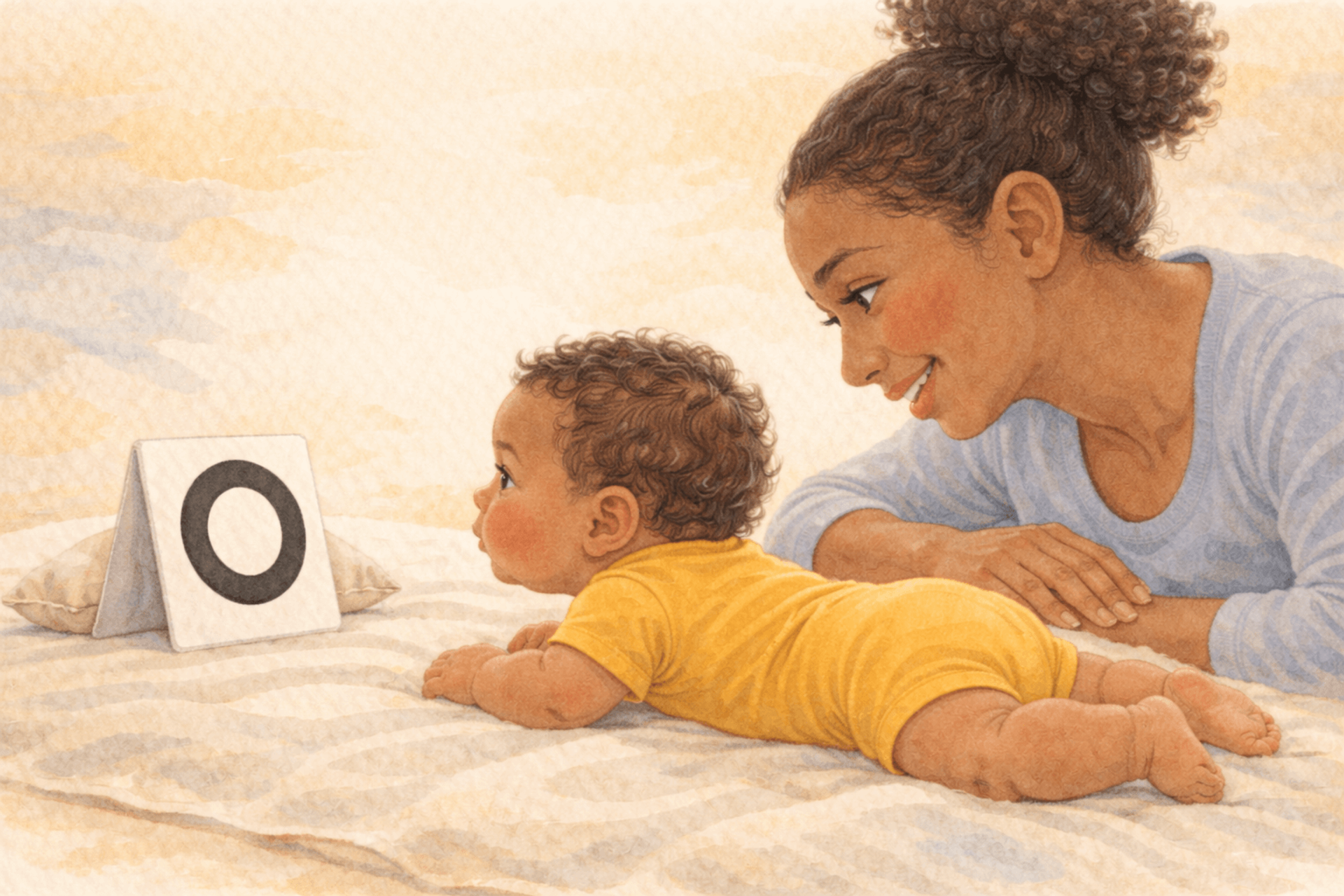
Tummy Time (Start Small, Start Early)
The AAP recommends supervised tummy time beginning soon after hospital discharge, building up to at least 15 to 30 minutes total per day by around 7 weeks (AAP Safe Sleep Guidelines, 2022). It strengthens the neck, shoulders, and arms — and it's one of the few structured activities that's genuinely evidence-based for this age.
If your baby protests (most do at first), you don't have to push through five minutes of screaming. Chest-to-chest counts. Laying your little one across your lap while you gently rub the back counts. Even 30 seconds on a firm surface before scooping your baby back up counts.
We have a whole article for you on this — evidence-backed, as always: My Baby Hates Tummy Time: 7 Tips That Actually Work. The short version: start with positions that feel safe and close, and build from there.
Give Your Baby Something to Look At
Newborn vision is blurry, limited, and built for one thing: high contrast. In the first weeks, your baby sees best at about 8 to 12 inches — roughly the distance from the crook of your arm to your face. Bold patterns with strong edges are far easier for the developing visual system to process than soft pastels or busy scenes.
Classic research on infant visual preferences (Fantz, 1961) showed that newborns are drawn to patterned images over plain ones — and that the visual cortex forms its connections through exactly this kind of structured input.
During a wake window, try holding a high-contrast image at your baby's focal distance and watching for a response: a fixed gaze, a slow head turn, wider eyes. That moment of focused attention is the visual system actively building itself.
What doesn't work is showing random images without any thought behind the sequence or timing. A structured, age-appropriate approach — where patterns progress alongside your baby's maturing vision — makes a real difference. If you're curious about what exactly to look for in a good set of cards, we break down the science here: High Contrast Cards for Babies: Why They Work and How to Use Them.
We also know you don't have time to read through dozens of research papers right now — so we did it for you. Here's everything about what your newborn actually sees, broken down week by week: What Can Newborns Actually See? A Week-by-Week Guide.
Skin-to-Skin and Holding
Holding your baby isn't downtime. It's active development.
Skin-to-skin contact — placing your newborn, dressed only in a diaper, against your bare chest — helps regulate heart rate, breathing, and body temperature. It supports bonding, lowers stress hormones in both parent and child, and has been linked to improved breastfeeding outcomes (Moore et al., Cochrane Review, 2016).
But even beyond skin-to-skin, simply carrying your baby in different positions — upright against your shoulder, cradled in your arms, semi-reclined on your lap — gives the vestibular system varied input. That system, responsible for balance and spatial orientation, is one of the first sensory systems to come online.
You don't need to be "doing something" while you hold your baby. Holding is the something.
Go Outside
There's no minimum age for taking your baby outdoors, though your pediatrician may suggest waiting a few weeks — especially during flu season, extreme cold or heat, or for preemies. Always follow individual guidance. But when conditions are right, fresh air and a change of scenery benefit both you and your little one.
Natural light helps set the circadian rhythm — the internal clock that teaches your baby the difference between day and night. The sound of wind in the trees, the sensation of a breeze, shifting patterns of light and shadow — all of this is gentle sensory input the brain quietly processes and learns from.
A walk around the block, sitting on a porch with your newborn in a carrier, even opening a window on a mild day — all of these count.
What You Don't Need to Do
You don't need to fill every wake window with activities. You don't need a rigid schedule. You don't need to entertain your newborn every waking second — and you definitely don't need to feel guilty about the quiet moments.
Overstimulation is real. If your baby turns away, arches the back, fusses, or zones out — that's a signal that the current level of input is too much. The best response is to dial back: dim the lights, reduce noise, hold quietly, or simply pause and wait.
The research keeps pointing in the same direction: a few minutes of genuine, responsive interaction during each wake window does more for your child's development than an hour of elaborate activities done without that back-and-forth connection.
A Simple Wake Window, Start to Finish
If it helps to see what a single wake window might look like in practice:
Your baby wakes up. You pick up, make eye contact, say good morning. You feed — breast or bottle, either way you're close and present. You change the diaper, narrating as you go. You spend a minute or two on tummy time — maybe on your chest, maybe on a blanket. You hold a high-contrast card at the right distance and watch your little one's eyes track it. You talk, sing, or read a few pages of a board book. Your baby starts to look away, blink slowly, fuss a little. You soothe, settle, and lay your newborn down.
The whole thing took 40 minutes. And every part of it — the feeding, the talking, the holding, the looking — was building the brain.
You're doing more than you think.
Frequently Asked Questions
Talk during feeding and diaper changes, do short tummy time sessions, hold your baby skin-to-skin, show high-contrast images during alert moments, and step outside for fresh air. A newborn's wake windows are only 45–60 minutes, so even small interactions count as meaningful stimulation.
Yes. Newborns sleep 16–17 hours a day and have very short alert periods. It is completely normal for parents to feel understimulated or bored during this stage. You are not doing anything wrong — the monotony is part of the newborn phase.
This article is for educational and entertainment purposes only. It is not a substitute for professional medical advice. Always consult your pediatrician with questions about your baby's development.
- National Scientific Council on the Developing Child (2004). "Young Children Develop in an Environment of Relationships." Working Paper No. 1. Harvard University, Center on the Developing Child.
- Shonkoff, J. P. & Bales, S. N. (2011). "Science Does Not Speak for Itself: Translating Child Development Research for the Public and Its Policymakers." Child Development, 82(1), 17–32.
- Klass, P. et al. (2024). "Literacy Promotion: An Essential Component of Primary Care Pediatric Practice." Pediatrics, 154(6), e2024069090.
- Romeo, R. R. et al. (2018). "Beyond the 30-Million-Word Gap: Children's Conversational Exposure Is Associated With Language-Related Brain Function." Psychological Science, 29(5), 700–710.
- AAP (2022). "Back to Sleep, Tummy to Play." HealthyChildren.org.
- Children's Hospital of Philadelphia (CHOP). "Healthy Sleep Habits." CHOP.edu.
- Cleveland Clinic (2024). "How Long Babies Should Be Awake Between Naps." Health.ClevelandClinic.org.
- Fantz, R. L. (1961). "The Origin of Form Perception." Scientific American, 204(5), 66–72.
- Moore, E. R. et al. (2016). "Early Skin-to-Skin Contact for Mothers and Their Healthy Newborn Infants." Cochrane Database of Systematic Reviews, (11), CD003519.


More Articles

Parallel Play in Toddlers: Why Side-by-Side Is the Social Work
Your toddler spent the entire playdate building separate towers, and nobody shared a single block. That counted — more than it looked. A 2025 longitudinal study found that playing beside a specific child consistently predicted later social play with that same child, but not the other way around. Here's what parallel play in toddlers actually is, why the science calls it strategic rather than passive, and what it means for how you run a playdate.

When Do Babies Point: Why It Matters for Language
Most milestone articles treat pointing as a box to check around 12 months. The research tells a different story — one that starts months earlier, runs through the infant brain, and traces back to how much the parent is pointing. Here's what the last fifteen years of research actually found, and what it means for everyday interactions.

When Do Babies Wave Bye-Bye: Why Your Baby Needs You to Wave First
Most baby milestones unfold on a biological schedule — waving isn't one of them. A 2023 study found that babies develop imitation ability because their caregivers imitate them first, and waving is named directly as a cultural gesture learned through that loop. Here's what the research says about the 9–12 month window, why the first wave looks nothing like a wave, and what helps it arrive.