High Contrast Cards for Babies: Why They Work and How to Use Them
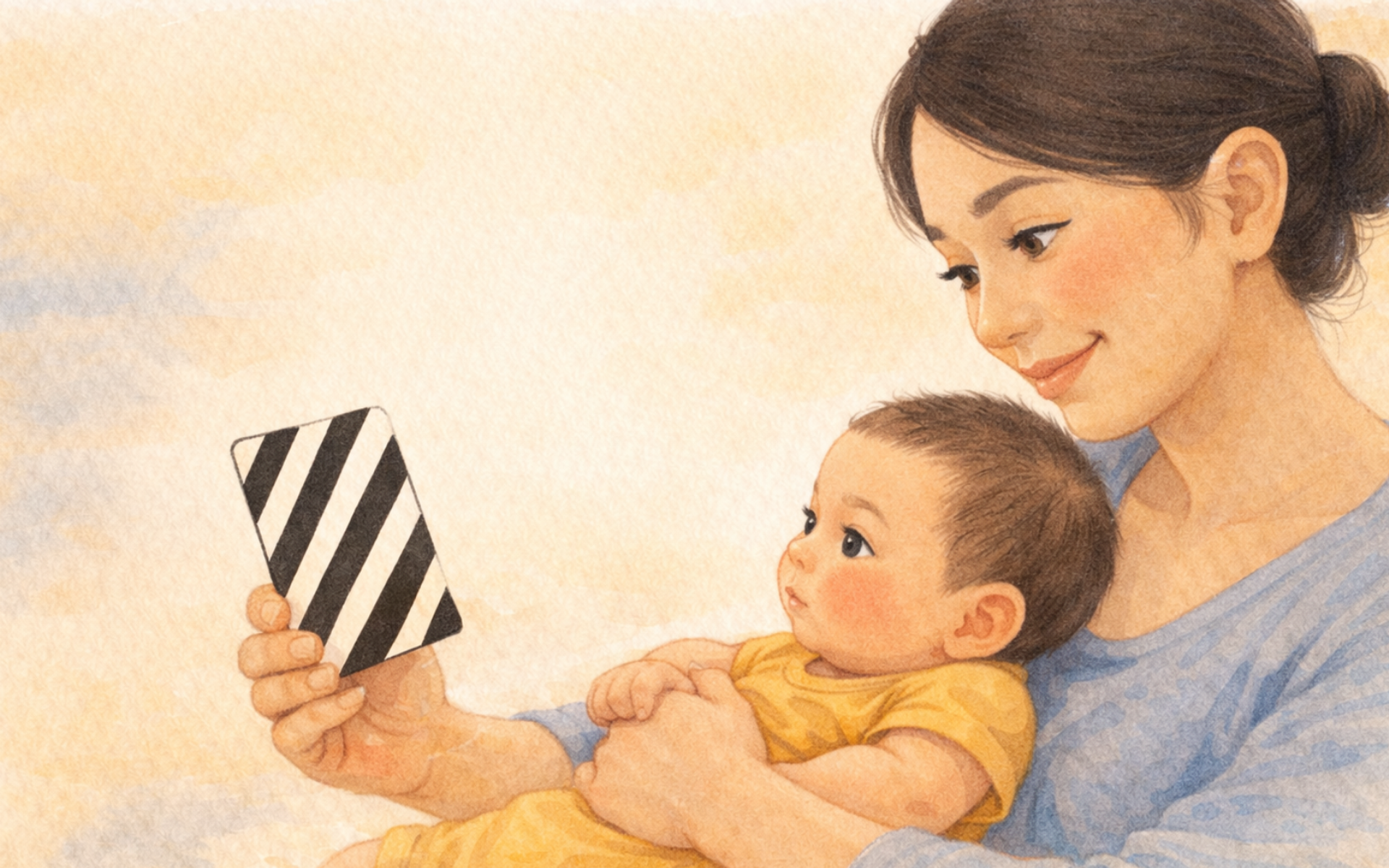
If you've spent any time shopping for newborn products, you've probably come across high contrast cards. Black-and-white images, bold patterns, sometimes with a splash of red. They're on Etsy, Amazon, Instagram — everywhere.
But here's what most product listings won't tell you: the specific patterns matter, the sequence matters, and the way you use the cards matters a lot more than just waving one in front of your baby.
- Why a newborn's visual system needs contrast specifically — and what "high contrast" actually means for the developing retina
- What the research from Fantz to Huttenlocher shows about pattern preference and synaptogenesis
- What to look for in a card set — pattern complexity, progression, face-like shapes, and color timing
- How to use cards correctly: distance, session length, reading engagement and overstimulation cues
- Why complexity needs to increase over time — and when to switch from black-and-white to color
If the one-sentence answer is enough, you’ve got the gist. If you want the mechanism behind each piece, keep reading.
What "High Contrast" Means (and Why Babies Need It)
Your newborn's visual system is dramatically different from yours. At birth, the retina is still developing, and the photoreceptors that detect color (cones) aren't fully functional yet. The cells that detect light and dark (rods) are more mature — which is why contrast is the strongest visual signal a newborn can process.
Think of it this way: your baby's visual world right now is like a very blurry black-and-white photograph. Low-contrast colors — pastels, soft grays, muted tones — are essentially invisible. Those beautiful sage-green nursery walls? Your baby literally cannot see them.
What your little one can see: sharp boundaries between light and dark. A black circle on a white background. Bold stripes. Strong edges.
And this goes beyond what's visible — it's about what builds the brain. Each time your baby focuses on a high-contrast pattern, new synaptic connections form in the visual cortex. It's active brain development, happening in real time.
The Science: What Research Tells Us
The foundation of high contrast visual stimulation goes back to Robert Fantz's groundbreaking work in the 1960s. He discovered that newborns consistently prefer looking at patterned images over plain ones, and high-contrast patterns over low-contrast ones. Babies aren't passive viewers — even in the first hours of life, the brain actively seeks out the visual input it needs.
More recent research has added important nuance. The visual cortex processes different pattern orientations through separate neural pathways — horizontal, vertical, and diagonal stripes are literally different experiences for your baby's developing brain. This is why varied patterns matter more than repeating the same image.
Huttenlocher and Dabholkar's research on synaptogenesis showed that the visual cortex undergoes its most intense period of synapse formation in the first few months of life. The volume of connections being built is staggering — and visual input is one of the primary drivers.
The takeaway: high contrast cards aren't a gimmick. For newborn visual stimulation, they're one of the simplest, most research-supported tools available.
If you're curious about what exactly your baby can see at each stage, our week-by-week guide to newborn vision covers the full timeline — from birth through the first color.
What to Look for in High Contrast Cards
This is where things get interesting — and where most products fall short.
A random collection of black-and-white images is better than nothing. But a sequenced set that matches your baby's developing visual capabilities is significantly more effective. Here's what that means:
Pattern complexity needs to match visual maturity. A newborn in week one can process a solid circle or thick stripes. A 4×4 checkerboard or concentric circles? Too much information — the brain literally can't resolve it yet. Showing complex patterns too early won't cause harm, but your baby will simply ignore them. You'll think "the cards don't work" when really, it's just the wrong card at the wrong time.
Progression is key. A well-designed set introduces complexity gradually: bold shapes → simple patterns → finer details → first color. This mirrors the natural development of the visual cortex and keeps the brain appropriately challenged at each stage.
Face-like patterns matter. Research by Mark Johnson and others showed that newborns show a preference for face-like configurations from birth — a pattern with two eye-like dots and a mouth-like element consistently attracts more attention than the same features scrambled. Including a simple schematic face (not a detailed portrait — your baby can't see that level of detail) is developmentally meaningful.
Color introduction has a timeline. Most babies begin distinguishing red from other colors around 8–12 weeks, based on research by Davida Teller. Introducing a red element at the right time — not too early, not too late — creates a genuine "first color" experience.
How to Actually Use High Contrast Cards
The science is clear. But what does this look like in practice?
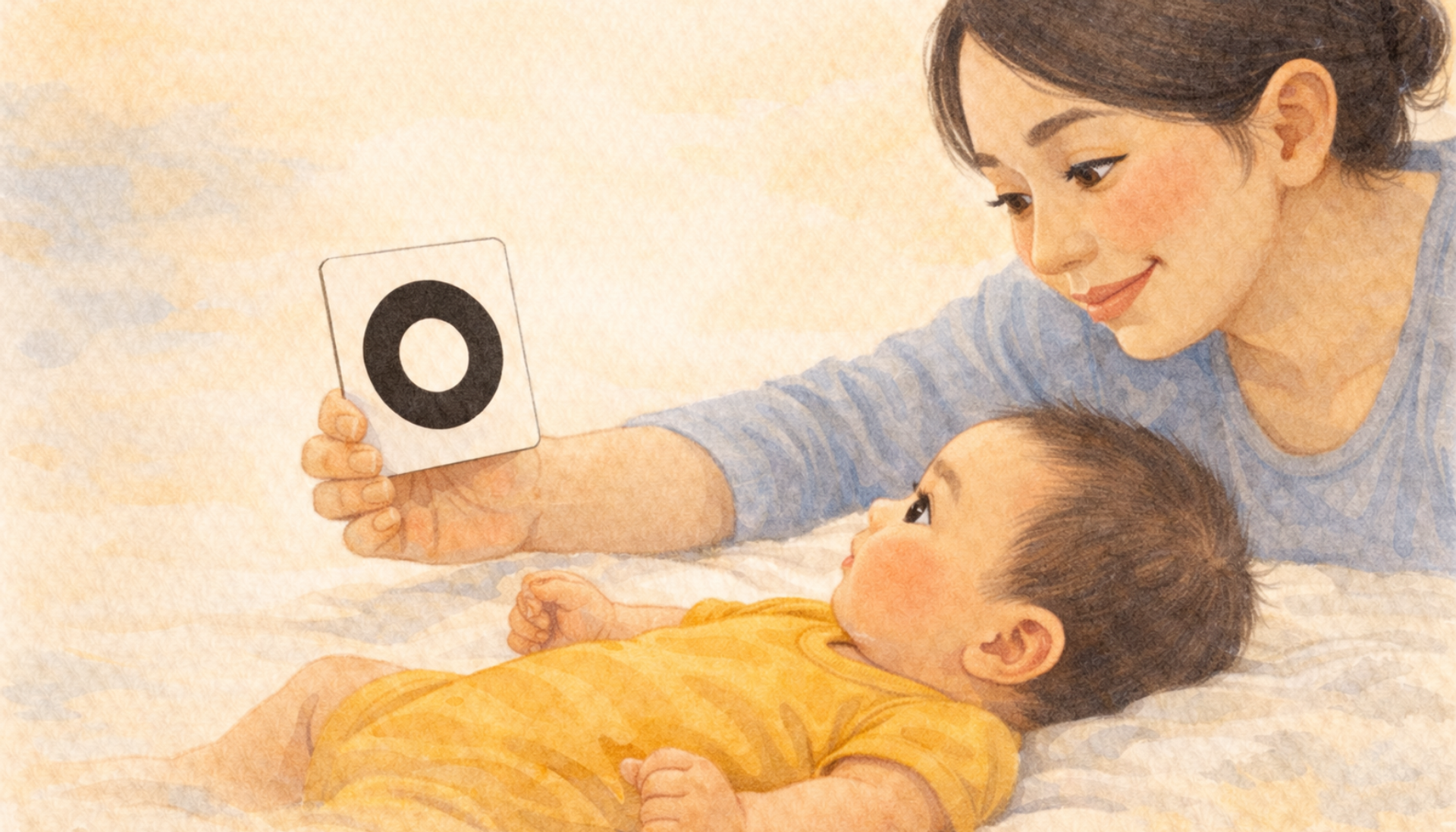
A few basics go a long way. Hold the card about 8–12 inches from your baby's face — roughly the distance from your elbow to your fingertips. That's a newborn's focal range. Anything farther and it's just a blur.
Keep sessions short — 1 to 3 minutes is plenty. Show one or two cards at a time. And always follow your baby's lead: a brief glance counts as engagement, and turning away means "I'm done for now."
Beyond that, the details matter more than you'd expect. Which patterns to start with, when to introduce more complexity, how to read your baby's engagement cues, when to rotate cards vs. repeat them — all of this affects how much your little one actually gets out of the experience. A good parent guide will walk you through it step by step.
One thing worth knowing: high contrast cards also work beautifully during tummy time. Propping a card at eye level gives your baby a reason to lift that heavy head — two developmental wins at once.
What Most Parents Get Wrong
The biggest mistake is simpler than you'd think: holding the card too far away. At arm's length, your newborn can't focus on it at all. That one fix — getting closer — changes everything.
The other common pitfall is giving up too early. In the first few weeks, your baby may barely glance at a card. That doesn't mean nothing is happening — the visual cortex processes input even without a visible reaction. Consistency over time matters far more than any single session.
Growing with Your Baby
Your baby's visual needs change fast in the first three months. What captivates a one-week-old won't hold a two-month-old's attention — and that's a good thing. When your little one starts losing interest in cards that used to hold the gaze, the brain has extracted what it needs and is ready for more.
The key is matching the right level of complexity to the right stage of development. Too simple and the brain gets bored. Too complex and the visual system can't process it, so your baby just looks away. The sweet spot shifts every few weeks — which is why a set designed with a built-in progression makes a real difference compared to a random stack of images.
So what comes after black and white? Around three to four months, your baby's visual system is ready for color — and the same principle applies: structured, progressive input works better than random colorful objects. If you're wondering when that transition happens and what the science behind it looks like, we cover it here: When Do Babies See Color?.
The Bottom Line
High contrast cards work — not because of marketing or trends, but because of fundamental neuroscience. A newborn's visual system is primed for exactly this kind of input. Providing it is one of the easiest, most effective things you can do in the first months.
You don't need expensive toys, a Pinterest-perfect nursery, or hours of free time. You need a few bold patterns, the right distance, and a few minutes of attention.
The brain will do the rest.
Looking for a set that's designed around the research?
Our High Contrast Baby Flashcards for 0–3 Months include 30 cards sequenced across 4 developmental series — from bold shapes in week 1 through the first color introduction at week 8-12. Each series matches what your baby's visual cortex is ready for. Parent guide and milestone tracker included.
Ready for the next step? Our Color Contrast Cards for 3–6 Months continue the same research-backed approach — now in color. Four progressive series designed to match how color vision actually develops.
Frequently Asked Questions
Newborns see best in high contrast because the cells in the retina responsible for detecting light and dark (rods) mature before the cells that detect color (cones). Bold black-and-white patterns match what the visual system can process in the first weeks. Research shows that infants preferentially look at high-contrast patterns over solid colors.
From birth. Hold the card 8–12 inches from your baby's face during alert, calm moments. Sessions can be as short as 30 seconds to 2 minutes. Watch for signs of engagement (focused gaze, stillness) or overstimulation (looking away, fussing).
This article is for educational purposes only and is not a substitute for professional medical advice. If you have concerns about your baby's vision or development, please consult your pediatrician.
- Fantz, R. (1961). "The origin of form perception." Scientific American, 204(5).
- Johnson, M. et al. (1991). "Newborns' preferential tracking of face-like stimuli and its subsequent decline." Cognition, 40(1-2).
- Huttenlocher, P. & Dabholkar, A. (1997). "Regional differences in synaptogenesis in human cerebral cortex." Journal of Comparative Neurology, 387(2).
- Teller, D. (1997). "First glances: The vision of infants." Investigative Ophthalmology & Visual Science, 38(11).
- Atkinson, J. & Braddick, O. (2012). "Visual development." In Cambridge Encyclopedia of Child Development.
- American Academy of Ophthalmology (2024). "Vision development: Newborn to 12 months."
Related Products
More Articles
Parallel Play in Toddlers: Why Side-by-Side Is the Social Work
Your toddler spent the entire playdate building separate towers, and nobody shared a single block. That counted — more than it looked. A 2025 longitudinal study found that playing beside a specific child consistently predicted later social play with that same child, but not the other way around. Here's what parallel play in toddlers actually is, why the science calls it strategic rather than passive, and what it means for how you run a playdate.

When Do Babies Point: Why It Matters for Language
Most milestone articles treat pointing as a box to check around 12 months. The research tells a different story — one that starts months earlier, runs through the infant brain, and traces back to how much the parent is pointing. Here's what the last fifteen years of research actually found, and what it means for everyday interactions.

When Do Babies Wave Bye-Bye: Why Your Baby Needs You to Wave First
Most baby milestones unfold on a biological schedule — waving isn't one of them. A 2023 study found that babies develop imitation ability because their caregivers imitate them first, and waving is named directly as a cultural gesture learned through that loop. Here's what the research says about the 9–12 month window, why the first wave looks nothing like a wave, and what helps it arrive.