Why Your Preschooler Needs a Bedtime Conversation
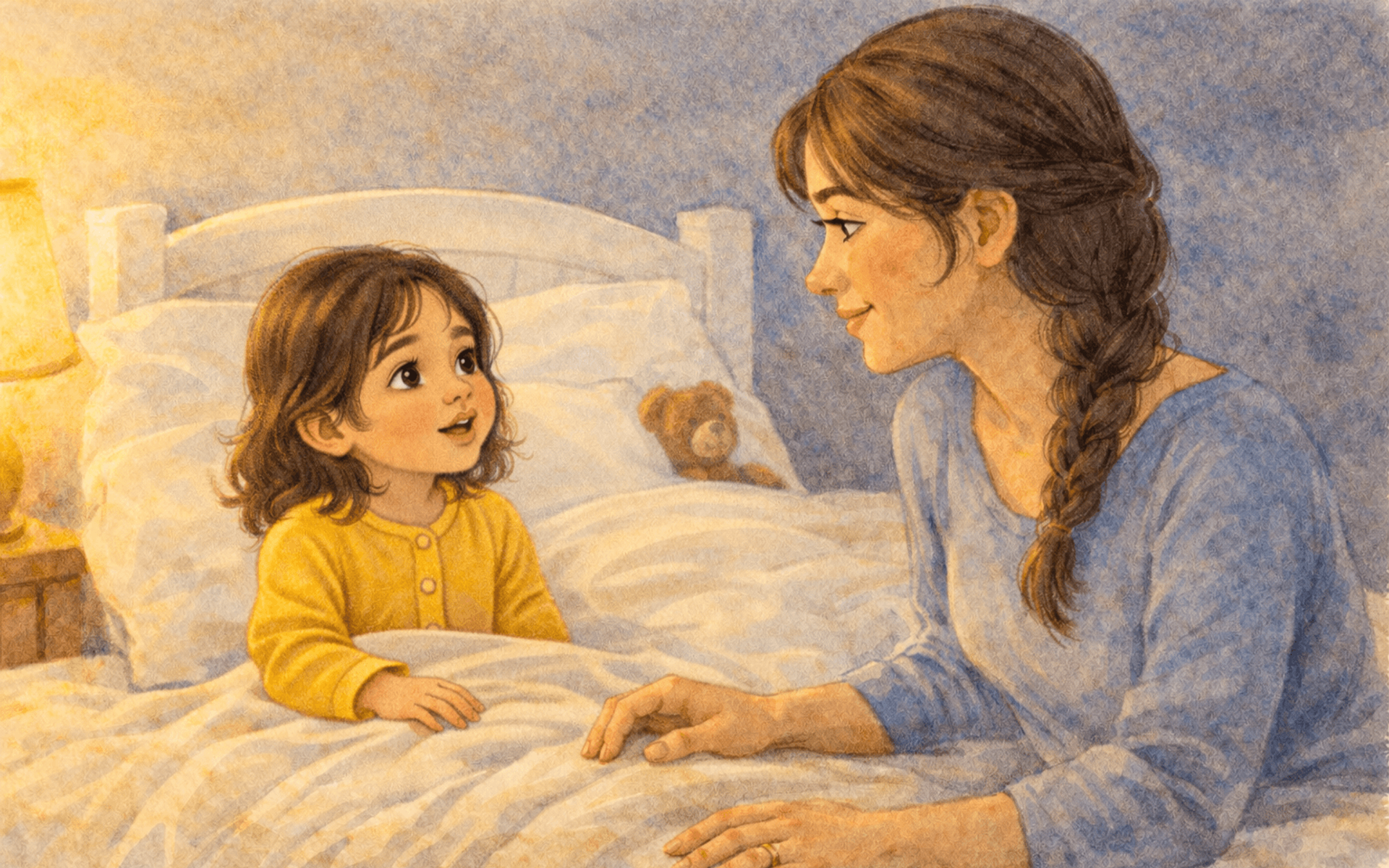
Teeth brushed. Pajamas on. Book read. You're about to say goodnight when your four-year-old hits you with: "Mama, today at the playground, Liam said my drawing was ugly. But I liked it. Was it ugly?"
Do I answer this now? Will this turn into a forty-minute spiral? I just want to sit on the couch.
That question — right there, when you're running on empty — is one of the most developmentally valuable moments in your child's entire day. And it takes about three minutes.
- What elaborative reminiscing is — and what a 30-year body of research shows it builds in a preschooler's brain
- Why bedtime specifically is the best time — how memory consolidation during sleep makes the pre-sleep conversation a filing system
- Three questions that cover positive memory, emotional processing, and perspective — and why this combination works
- Why talking about hard moments matters more than avoiding them at 8 PM
- The difference between interrogating and elaborating — why fewer, open-ended questions produce richer responses
If the one-sentence answer is enough, you’ve got the gist. If you want the mechanism behind each piece, keep reading.
What Happens in Your Preschooler's Brain During a Bedtime Conversation
When a preschooler tells you about something that happened — and you respond with curiosity, not just "oh, that's nice" — a specific process kicks in. Researchers call it elaborative reminiscing: the parent asks open-ended questions, adds emotional detail, and helps the child build a narrative around the experience.
Decades of research show that children whose parents talk about the day this way develop richer autobiographical memories — the kind of detailed, emotionally textured recollections that form the foundation of identity. A longitudinal study followed families from when children were 1.5 years old through age 11. Mothers who were trained in elaborative reminiscing during the toddler years continued using this style through adolescence. And their children, now teenagers, produced more coherent and emotionally rich personal narratives than peers whose parents hadn't received training.
The research behind this goes back over 30 years and spans dozens of studies across multiple countries. Few findings in developmental psychology are this consistent.
Three Bedtime Questions That Build Your Child's Memory

You don't need a script. You don't need training. You need three questions, asked consistently, at bedtime:
What was the best part of today? What was hard? What was funny?
That's it. These three prompts cover positive memory retrieval, emotional processing, and perspective — the three building blocks of autobiographical memory. When your child answers "the best part was the puddle" and you follow up with "what did the puddle feel like on your boots?" — you've just moved from surface recall to sensory detail, which strengthens the memory trace in the hippocampus.
Research on parent-child reminiscing shows that the most effective conversations share three features: open-ended Wh-questions ("what happened next?"), emotional labeling ("that sounds like it made you frustrated"), and positive confirmation of what the child shares ("you remembered that — that's a big detail"). Children who experience these conversations regularly provide more detailed and more accurate memories when talking to researchers, not just to parents.
Why Bedtime Is the Best Time to Talk With Your Preschooler

The timing matters. Memory consolidation — the process by which the brain moves short-term experiences into long-term storage — happens primarily during sleep. When your child recounts the day's events right before sleep, the brain is essentially tagging those experiences for overnight processing.
Think of the bedtime conversation as the brain's filing system. Your child tells you about the puddle. The hippocampus marks it: this one mattered. During sleep, that memory gets integrated into a growing web of related experiences — other puddles, other rainy days, the feeling of wet boots. By morning, the memory is stronger, more detailed, and more connected to the child's sense of self.
A review of reminiscing research found that elaborative reminiscing strengthens not only memory but also language development and socioemotional skills. Children who regularly talk about past experiences with their parents understand emotions better, show more empathy, and maintain stronger relationships with peers and adults. The bedtime conversation builds vocabulary, narrative skill, emotional intelligence, and memory — in three minutes.
Talking About Hard Moments at Bedtime
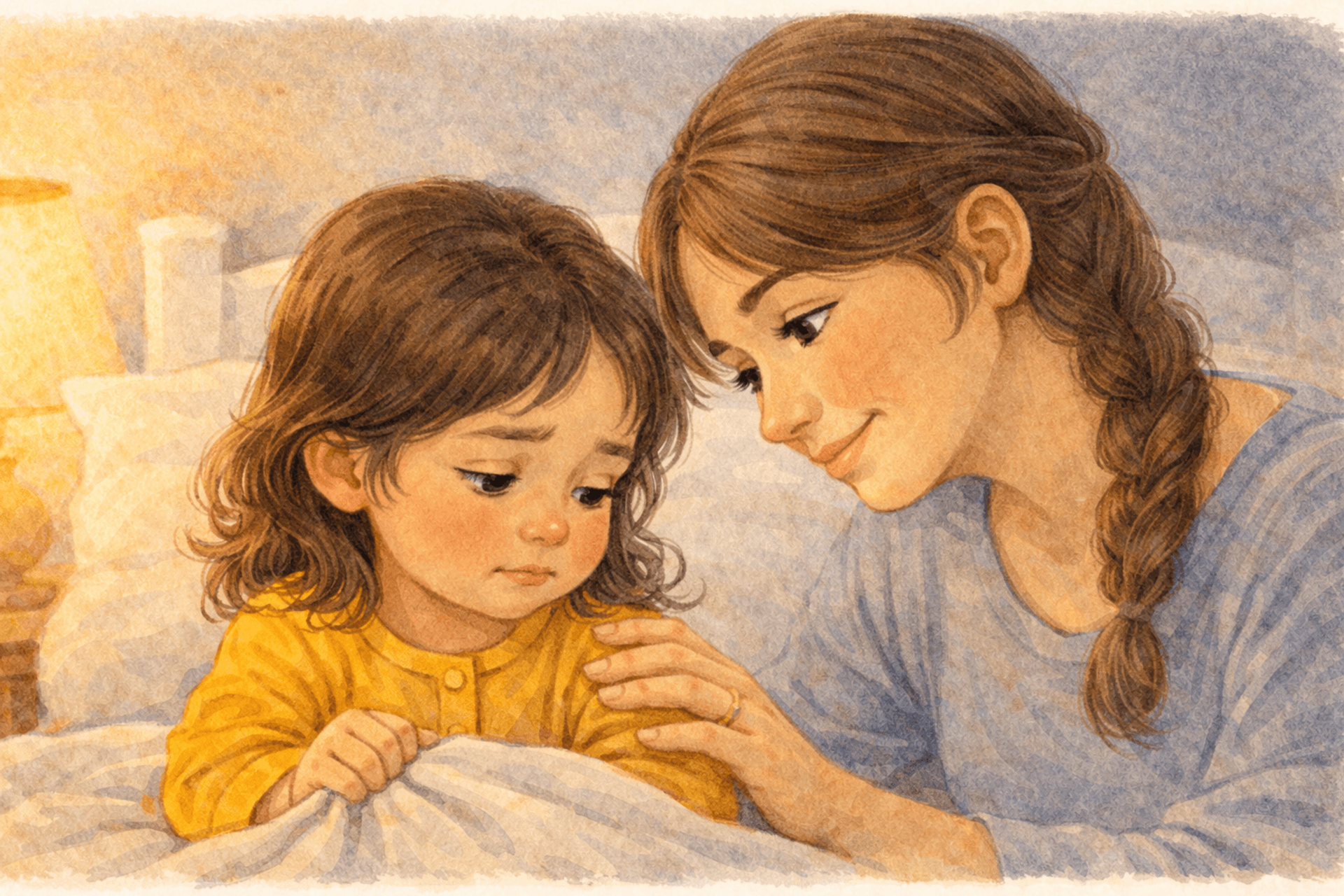
The "what was hard?" question is where many parents hesitate. Do I really want to open that door at 8 PM? But research suggests that talking about negative events is particularly important for a preschooler's emotional development. When a parent helps a child put a difficult experience into words — not fix it, not dismiss it, just name it and hold it — the child learns that hard feelings can be spoken, shared, and survived.
One study found that children of mothers who labeled and discussed emotions during reminiscing developed stronger emotion regulation skills. This held true even in families facing poverty, maltreatment, or other adversity. Elaborative reminiscing about negative events didn't make children dwell on the hard parts. It helped children process and move past them.
"Liam said your drawing was ugly. That hurt your feelings. What did you do?" is better than "Don't worry about it" every single time. Not because you're therapizing your preschooler. Because you're teaching the brain that hard experiences have words, and words make them smaller.
If you've read our article on why toddlers say "no" to everything, the connection is clear: the same developing prefrontal cortex that drives the autonomy battles at age two is the one that, at age four, starts to benefit from structured reflection. The brain is ready for this work — it just needs the invitation.
How to Talk to Your Preschooler Without Interrogating
There's a version of "how was your day?" that shuts kids down. It's the version that sounds like a job interview: "What did you do at school? What did you eat? Did you play with anyone?" Closed questions. Adult agenda. Quick answers that satisfy the parent but don't build anything.
The elaborative version sounds different. It follows the child's lead. If your child mentions the puddle, you stay with the puddle. "Was the water cold? Did anyone else jump in? What sound did it make?" Each follow-up question builds the memory a little more. Each detail the child adds strengthens the narrative pathway in the brain.
Research consistently shows that children respond with more memory detail after open-ended questions and positive confirmations than after closed yes-or-no questions. The most effective parents aren't the ones who ask more questions. They're the ones who ask fewer questions — and then actually listen to the answers.
Adding a Bedtime Conversation to Your Preschooler's Routine
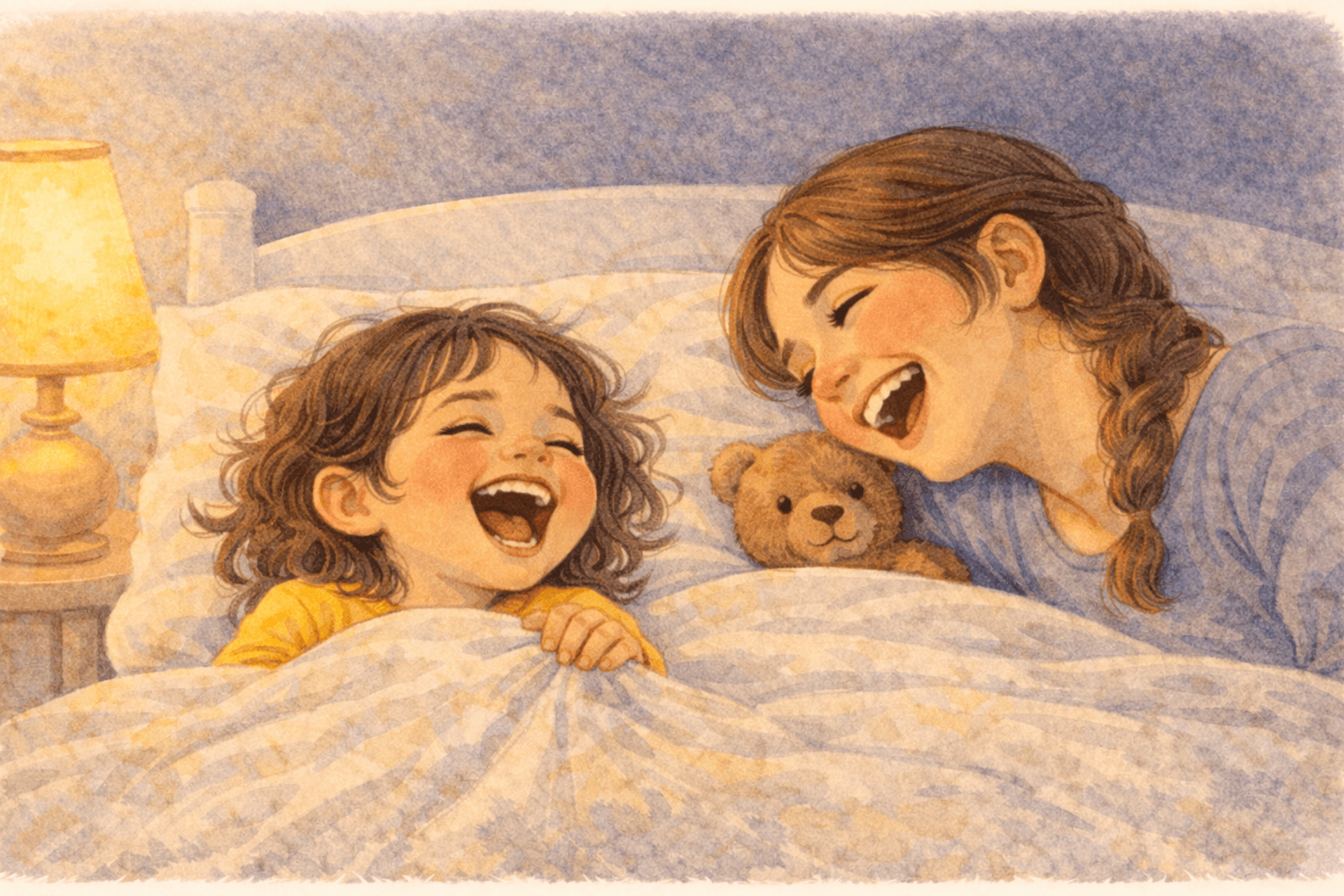
A bedtime conversation works best when it has a predictable place in the evening sequence. Not floating randomly between teeth-brushing and lights-out, but anchored: pajamas → book → talk about the day → deep breaths → sleep.
Our article on why daily routines reduce toddler tantrums explains why that predictability matters at the brain level. The same principle applies here. When the conversation has a consistent slot, the child's brain learns to expect it — and starts preparing. You might notice your child saving up things to tell you. "I have to tell you something at bedtime!" That's the routine doing its job.
We designed the Big Kid Routine Cards with a specific card for this moment: "Talk About the Day — best, hard, funny." It's placed right before "Deep Breaths Together" in the evening sequence — because the brain needs to process before it can settle. The card gives the conversation a visible place in the routine, and the parent guide explains the research behind why it works.
Tonight, after the book, try it. Three questions. Three minutes. You might be surprised what your four-year-old has been waiting to tell you.
Frequently Asked Questions
Talking about the day at bedtime activates elaborative reminiscing — a process where the child builds detailed memories through guided conversation. Decades of research show this strengthens autobiographical memory, emotional understanding, and language skills. Memory consolidation happens during sleep, so recounting events right before bed enhances overnight processing.
Three simple questions cover the key areas: "What was the best part of today?" (positive memory), "What was hard?" (emotional processing), and "What was funny?" (perspective and joy). Follow up with curiosity, not interrogation — "What did that feel like?" works better than "Why did you do that?"
For educational and entertainment purposes only. Not a substitute for professional medical or developmental advice. If you have concerns about your child's behavior or development, consult your pediatrician.
- Fivush, R., Haden, C. A., & Reese, E. (2006). Elaborating on elaborations: Role of maternal reminiscing style in cognitive and socioemotional development. Child Development, 77(6), 1568–1588.
- Reese, E., & Newcombe, R. (2007). Training mothers in elaborative reminiscing enhances children's autobiographical memory and narrative. Child Development, 78(4), 1153–1170.
- Salmon, K., & Reese, E. (2016). The benefits of reminiscing with young children. Current Directions in Psychological Science, 25(4), 233–238.
- Ornstein, P. A., & Haden, C. A. (2004). Learning to remember: Social communicative exchanges and the development of children's memory skills. Developmental Review, 24, 374–395.
- Reese, E., Myftari, E., McAnally, H. M., Chen, Y., Neha, T., Wang, Q., Jack, F., & Robertson, S.-J. (2019). Coaching in maternal reminiscing with preschoolers leads to elaborative and coherent personal narratives in early adolescence. Journal of Experimental Child Psychology, 189, 104707.
- Fivush, R. (2019). Maternal reminiscing as critical to emotion socialization. Attachment & Human Development, 23(1), 1–17.
- Valentino, K., Comas, M., Nuttall, A. K., & Thomas, T. (2013). Training maltreating parents in elaborative and emotion-rich reminiscing with their preschool-aged children. Child Abuse & Neglect, 37, 585–595.
- Nelson, K., & Fivush, R. (2004). The emergence of autobiographical memory: A social cultural developmental theory. Psychological Review, 111(2), 486–511.
Related Products

More Articles
Parallel Play in Toddlers: Why Side-by-Side Is the Social Work
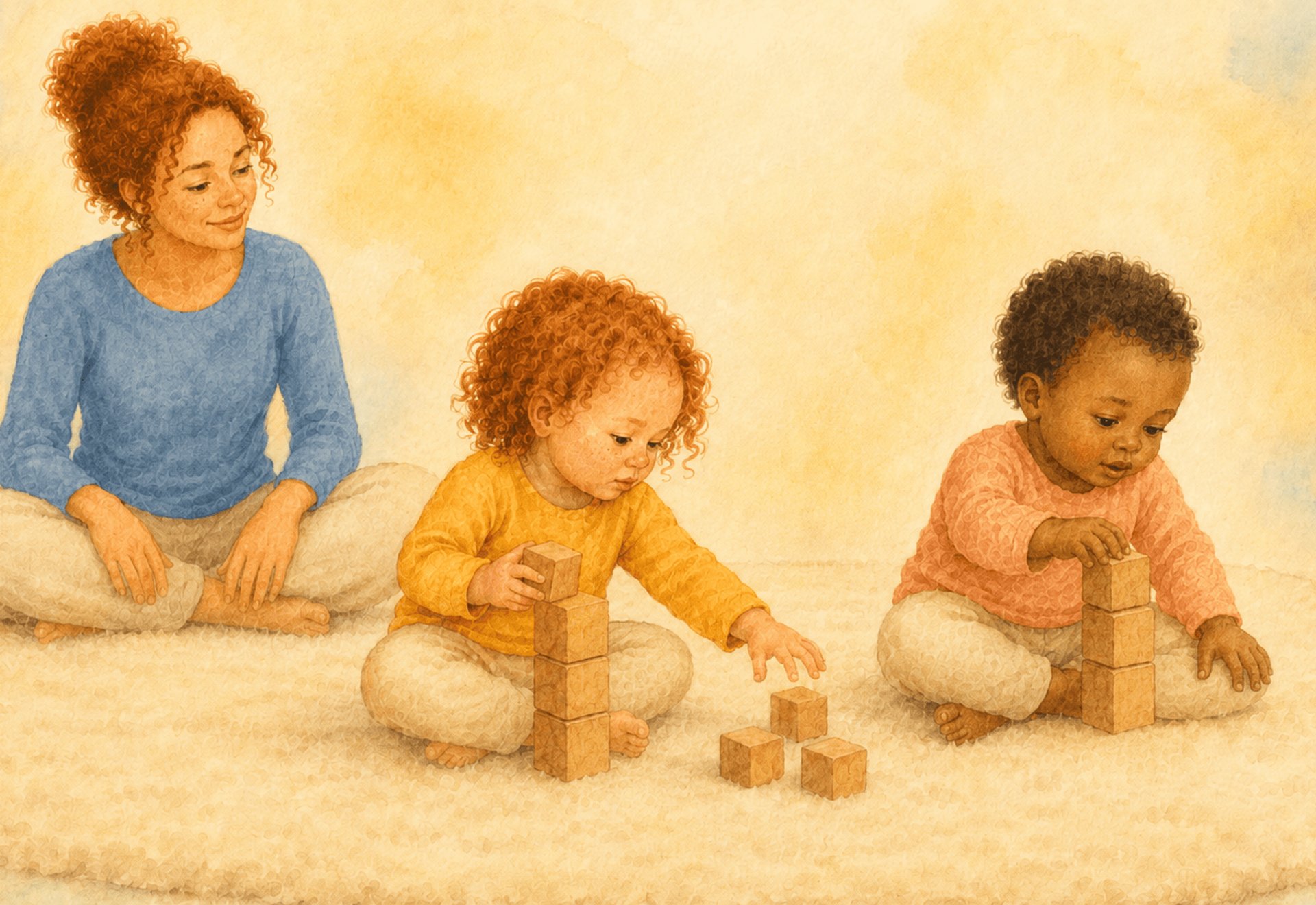
Your toddler spent the entire playdate building separate towers, and nobody shared a single block. That counted — more than it looked. A 2025 longitudinal study found that playing beside a specific child consistently predicted later social play with that same child, but not the other way around. Here's what parallel play in toddlers actually is, why the science calls it strategic rather than passive, and what it means for how you run a playdate.
When Do Babies Point: Why It Matters for Language
Most milestone articles treat pointing as a box to check around 12 months. The research tells a different story — one that starts months earlier, runs through the infant brain, and traces back to how much the parent is pointing. Here's what the last fifteen years of research actually found, and what it means for everyday interactions.
When Do Babies Wave Bye-Bye: Why Your Baby Needs You to Wave First
Most baby milestones unfold on a biological schedule — waving isn't one of them. A 2023 study found that babies develop imitation ability because their caregivers imitate them first, and waving is named directly as a cultural gesture learned through that loop. Here's what the research says about the 9–12 month window, why the first wave looks nothing like a wave, and what helps it arrive.