Hand Eye Coordination Activities for Babies: What's Really Happening
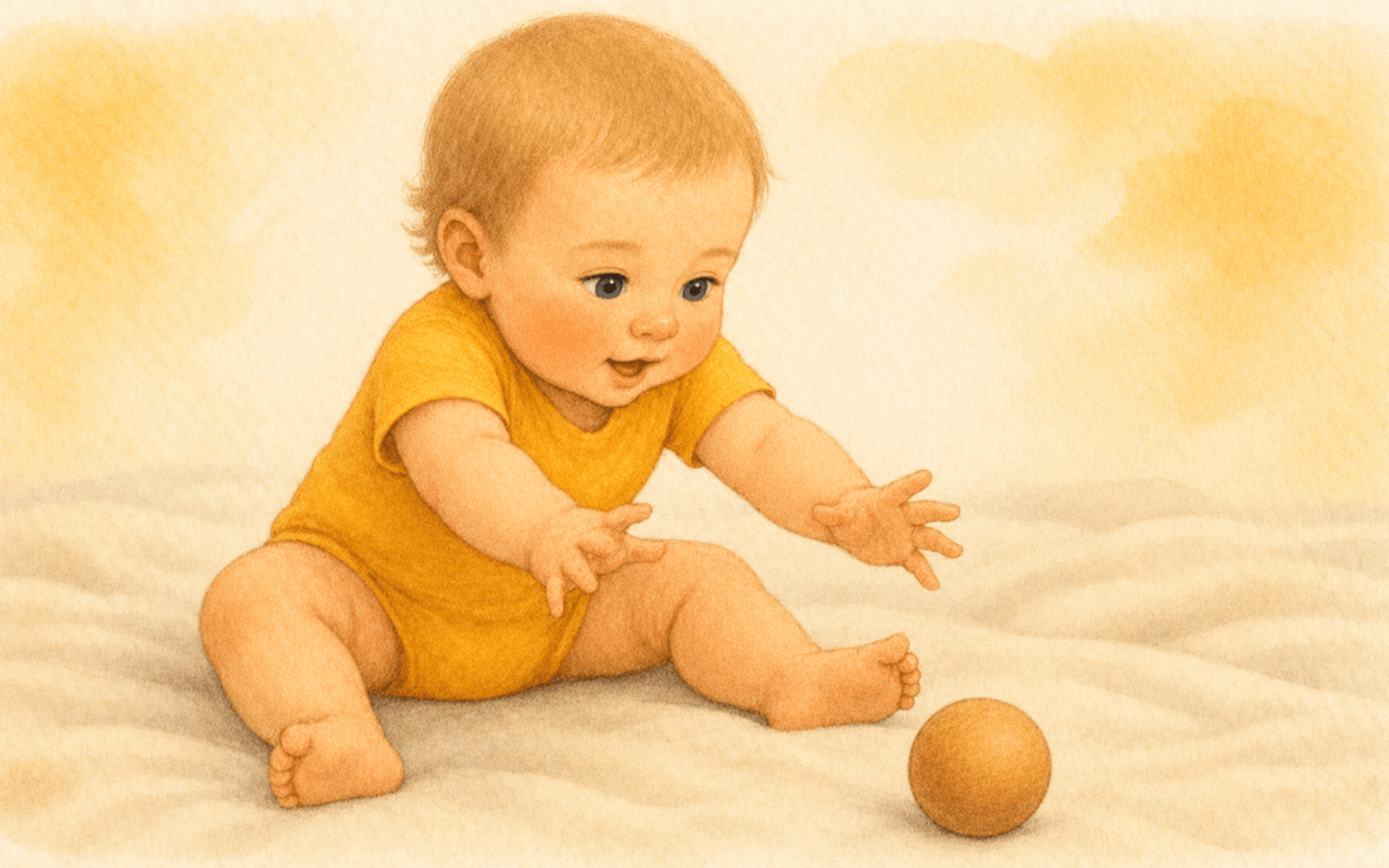
Every toy company selling you a "hand-eye coordination set" is working from the same assumption: that your baby's eyes are in charge, and the hands just follow orders. It's a tidy idea. It's also wrong. When researchers put infants in a completely dark room with a glowing object, twelve-week-olds reached for it, without ever seeing their own hand. The hand knew where to go without the eyes' help. Which means the hand eye coordination activities you're looking for don't start in the eyes at all. The origin is somewhere much harder to see.
- The direction this skill develops in, and why it changes what you do in those first weeks
- What the research says is happening in the brain at 3, 6, 9, and 12 months (and what the CDC milestones are built around)
- Why a moving object does more than a still one, and when that switches
- The one shift between 6 and 12 months that most activity guides completely miss
- Which everyday objects and setups support coordination, and which are mostly atmosphere
- What to mention to your pediatrician — and what's worth waiting on
If the one-sentence answer is enough, you’ve got the gist. If you want the mechanism behind each piece, keep reading.
What the researchers found when they turned off the lights
The version of hand-eye coordination that most people picture goes like this: baby sees object, eyes lock on, hand moves toward it. It sounds obvious because it mirrors how we experience the skill as adults. The problem is that it doesn't describe what babies are doing.
A 1993 study by Clifton and colleagues at the University of Massachusetts tested seven infants repeatedly between six and twenty-five weeks of age. In each session, babies were shown objects in normal light and then objects that glowed or made sound in complete darkness (so dark they couldn't see their own hand moving toward the target). The infants first contacted the object in the dark at 11.9 weeks on average; they first contacted it in the light at 12.3 weeks. They grasped in the dark at 14.7 weeks; in the light, at 16.0 weeks. The differences were statistically negligible. Sight of the hand, it turned out, was not required to begin reaching.
What this tells you is that early reaching runs on proprioception — the body's internal sense of where its own parts are, working alongside the sight or sound of the target. The hand finds its way without needing visual feedback mid-flight. A 2014 tracking study by Corbetta and colleagues at the University of Tennessee followed three infants weekly through the eleven weeks it took them to go from non-reaching to reaching, and the finding was precise: infants don't learn to align their reach toward where they look. They learn to align their look toward where they already reach. The eyes, in the first months, are the followers.
This reframes the whole premise of hand-eye coordination for babies. The skill isn't a visual skill with a motor output. It starts as a motor skill, and vision integrates afterward. Which is why activities that let the hands explore freely (before your baby has precise aim) are doing more developmental work than the activity appears to warrant.
What the milestone map shows, month by month
The CDC's revised 2022 milestone checklist moved to a 75th-percentile standard, which means these are skills 75% of babies have by the listed age. A meaningful portion of healthy babies are still developing any one of them on their own later timeline.
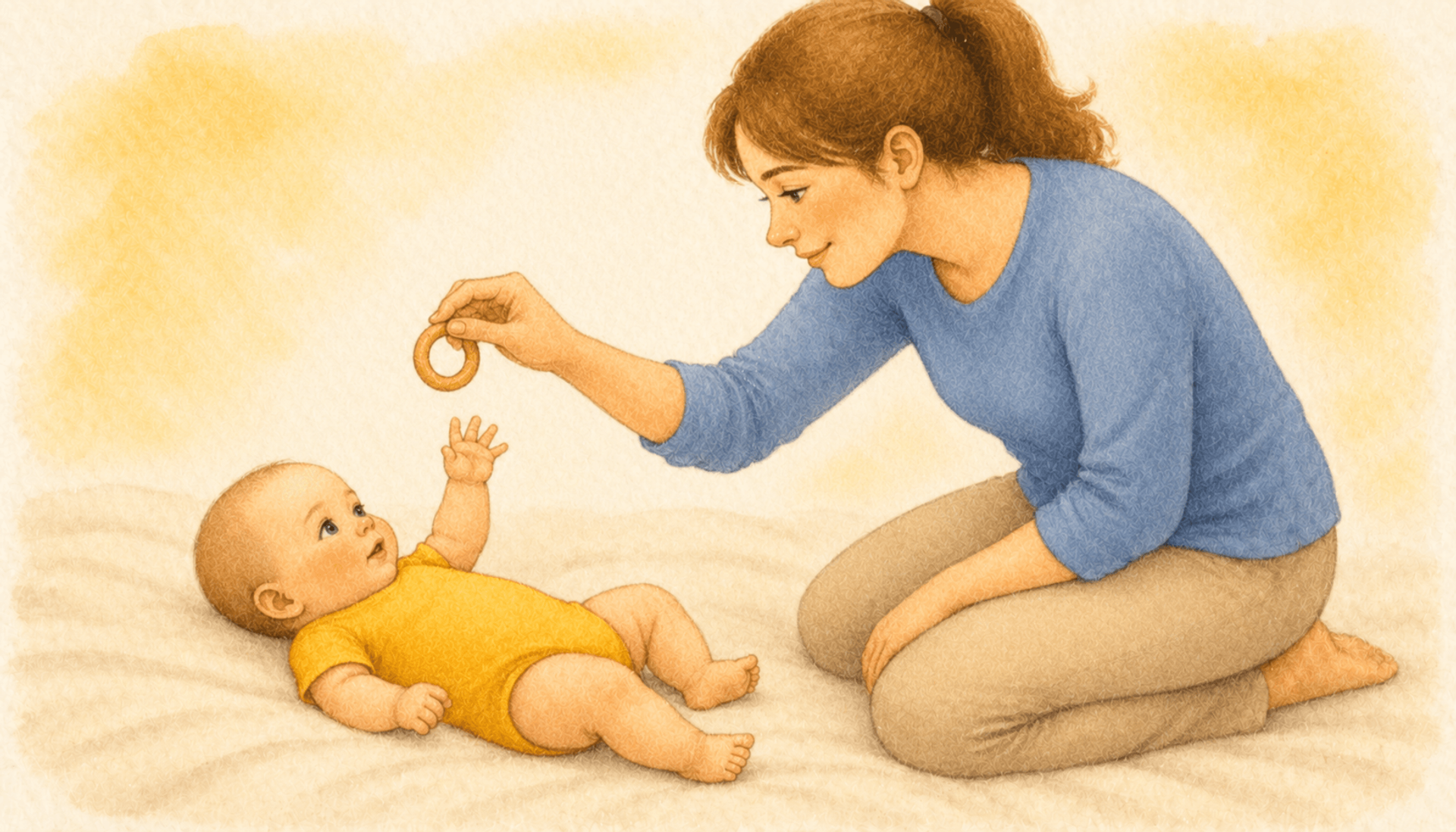
By four months, the CDC expects babies to hold a toy when it's placed in their hand. That's the baseline: passive grasp, grip triggered by touch, not visual targeting. But something is already being calibrated. Research from neuroscientist von Hofsten showed that babies as young as four months track moving objects with their gaze and adjust their arm movements in anticipation — timing a swipe for where the object will be rather than where it was when the reach started. This is called predictive reaching, and it appears far earlier than most parents expect.
By six months, babies reach for nearby objects and may begin transferring an item from one hand to the other. The transfer milestone is easy to underestimate. It means both hemispheres of the brain are sharing information, the hand-to-midline pathway is functional, and the visual system is starting to inform hand shaping before contact rather than only after. Our article on fine motor skills in babies by age covers the mechanics of that transfer in more detail, including why it matters for everything from self-feeding to later writing. The gross motor skills guide covers the larger movement milestones that run alongside this fine work across the same months.
By nine months, the raking grasp gives way to a more precise approach to small objects, and babies begin placing objects into containers with intention. A 2010 study by Berthier and Carrico tested infants at six, nine, and twelve months reaching in light and dark conditions and found that six-month-olds reached faster in the dark, while twelve-month-olds reached faster in the light. The interpretation was that somewhere between those two ages, the brain begins actively using vision of the hand to refine a reach that's already in motion — the role of vision switches from irrelevant to essential by nine months.
By twelve months, the pincer grasp is emerging and self-feeding with finger foods begins. That combination means vision and fine motor are now coordinating with enough precision to pick up something the size of a pea. The visual system is not just guiding the reach; it's shaping the fingers before they arrive.
Why a moving object is the better tool, and when that changes
Before six months, a moving object is more useful than a still one for developing this skill. The reason is predictive control. A baby who tracks a slowly moving object and times a swipe for where it will be is practicing something more sophisticated than passive gaze: the brain is computing a trajectory and coordinating a movement to intercept it. Research published in the late 1980s by von Hofsten showed that even newborns make arm movements in coordination with moving objects, launching forward adjustments that account for velocity. A gently swinging mobile, a slow pendulum toy, or a parent moving a toy at arm's length across the baby's visual field all qualify.
The Sensory Play Cards for babies 0–12 months include tracking activities built around this: prompts for slow movement across the visual field at the distances that match where each age range focuses best.
After six months, stationary objects take on more value because precision matters more than tracking. A baby who is trying to pick up a wooden ring off the floor, or to pull a cloth off a partially hidden toy, is using a more refined version of the skill. The eyes are shaping the fingers before contact now, not just pointing the arm in a general direction. Stationary targets give the visual system a stable reference point for that precision work.
By nine months, babies begin making interceptive movements, launching arm movements based on visual information about where a slow-rolling ball will arrive. Research by von Hofsten and colleagues published in 1998 in Cognition found that this temporal prediction is built on inertia assumptions — babies expect objects to continue moving in the direction they were already going. A ball that stops unexpectedly gets a confused response; one that follows a predictable arc gets a well-timed reach.
The shift between 6 and 12 months that most guides skip
The standard activity recommendation for this age range is "give babies objects to grab." That's true and worth doing. But it misses the change that happens around six to nine months that determines how effective any object is.
Before sitting independently, a baby lying on the back or front has motor resources partially occupied with stabilizing the body. The hands and eyes are sharing the stage with the postural system, and research by Soska and Adolph published in 2014 found that five-to-seven-month-olds explore objects manually, visually, and orally far more when seated than when positioned supine or prone — infants produced significantly more manual, oral, and visual exploration in sitting than in either lying position.
This is worth saying plainly: supported sitting is one of the most useful things you can add to a baby's environment between five and eight months, not because of the sitting itself but because of what it frees up: the hands get full attention, the visual field stabilizes, and the coordination work that those hands and eyes are doing together has room to develop.
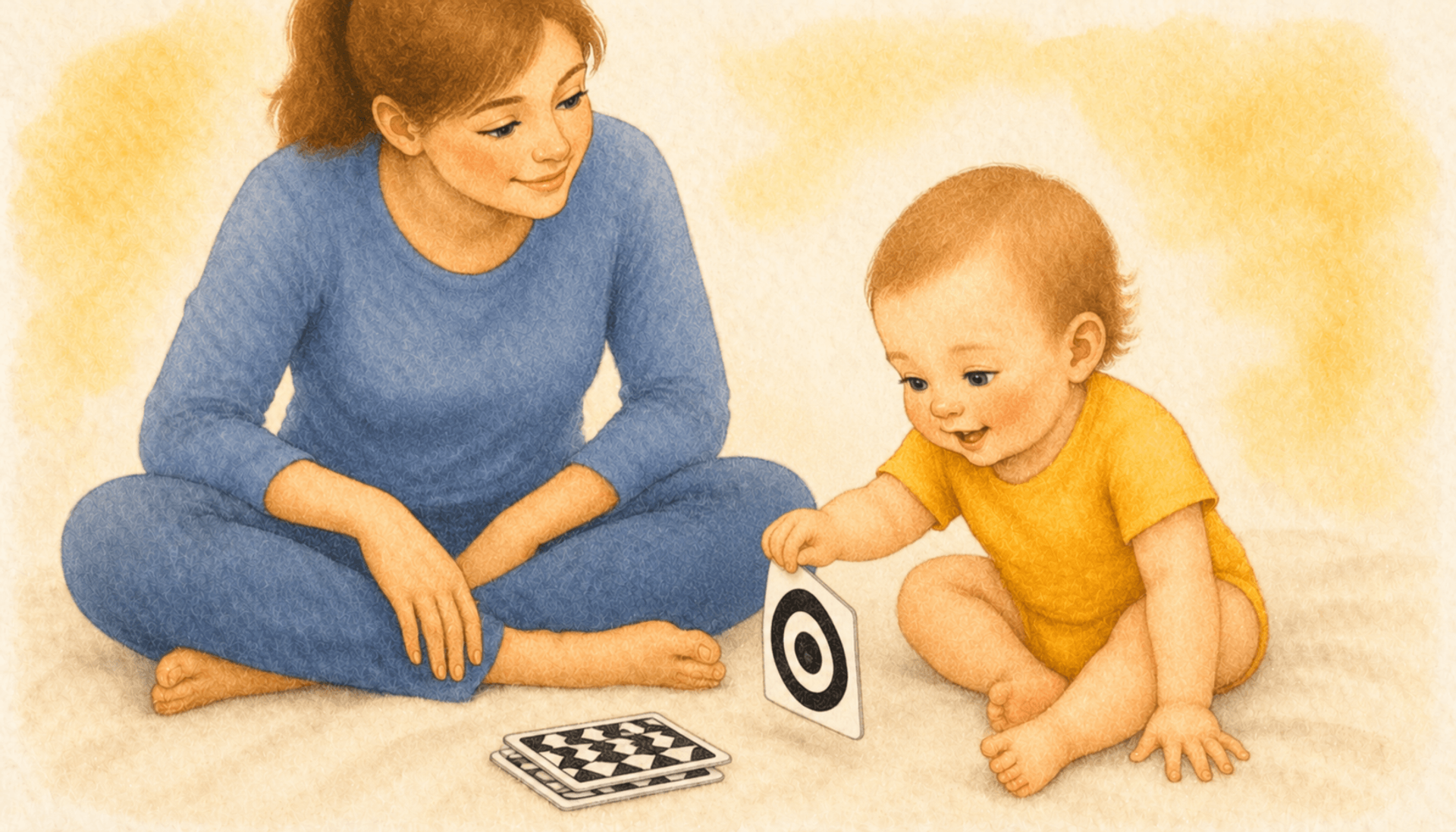
A rolled towel behind the hips, a Boppy, or a lap seat that keeps a baby upright but supported are all options. The activity itself can be simple: a wooden ring, a soft ball, a Color Contrast Card held at arm's length and moved slowly to the side. The setup is doing more work than the object.
Dad note: this is one of the setups that fits the way a lot of dads prefer to play — stable hold, object in hand, no script required. Seated lap play at this age is exactly the right format.
What everyday objects and setups do the work
The research points to three categories of objects that support this skill at different stages, none of which require a specialty product.
Objects with handles or protrusions work well from around four months because they give the fingers something to close around. A wooden ring, a fabric loop, a soft ball with a textured surface. The baby's grasp is initially triggered by contact rather than planned — the hand closes because something touched the palm, but over repeated encounters, that contact-triggered grasp starts to be preceded by a reaching approach. The fine motor skills activities by age guide details how this progression looks week by week for the grasp itself.
Objects that contrast visually with the surface they're resting on are easier for a three-to-six-month-old to track and target. High-contrast patterns (and the Color Contrast Cards were designed for exactly this) give the developing visual system a clear target before color vision has fully come online. A card with a bold black-and-white pattern propped at the right distance during tummy time is a tracking workout before the hands are even in the picture.
Objects that encourage mouthing deserve a note. Oral exploration at this age is not a problem to redirect; it's information-gathering. The mouth provides data about texture, temperature, and shape that the hands are also collecting. Letting a baby mouth a safe, cleanable object while visually examining it feeds two data streams simultaneously to the same developing brain map. Offer varied textures (smooth, ridged, soft, firm) under supervision, and let the combination run.
Everything in the section above applies to floor time, not screen time. Two-dimensional images, regardless of how high-contrast or engaging they are, activate the visual system without giving the hands anything to do. The visual-motor integration this article is about requires a real object that occupies real space and responds differently depending on how the hand approaches it.
What to mention to your pediatrician
Most variation in this skill during the first year falls within a wide normal range, and the 2022 CDC milestone revisions were designed to reflect that. A few patterns are worth raising at a well-child visit if they've persisted across several weeks rather than appearing once.
If a baby past four months consistently keeps one fist closed and doesn't open it to reach, that's worth flagging. If there's no interest in reaching toward objects within arm's reach by five or six months, mention it. If a baby past nine months consistently uses only one hand and seems to avoid using the other, that's the kind of pattern a pediatrician will want to look at; and if you've noticed that the baby doesn't track a slowly moving object smoothly by three months, mention it even if nothing else seems off.
None of these are necessarily signals of anything. They're the list of things worth saying out loud rather than waiting to see if they resolve, which is a different category from urgent. If your gut says something is different — you've been watching this baby every day — that instinct is worth acting on. Your pediatrician would rather hear it than not.
For more on what the activities-for-3-month-old repertoire looks like at the point when visual tracking and early reaching are first emerging, that article covers the developmental window just before the coordination work begins to compound.
Frequently Asked Questions
The foundations of hand-eye coordination are present from birth, but the skill develops in stages across the first year. Newborns make arm movements that respond to objects in their visual field. Predictive reaching (where the hand launches toward where an object will be, not just where it is) is measurable by four months. Transferring objects between hands requires both eyes and hands to coordinate across the midline, and typically appears around five to seven months. The precise finger shaping that lets a baby pick up small objects comes online closer to nine to twelve months.
At this age, the most effective activities involve slow-moving visual targets and real 3D objects rather than flat images. A gently swinging mobile, a toy moved slowly across the baby's visual field, or high-contrast cards positioned at eight to twelve inches during tummy time all give the visual and motor systems something to practice together. Floor time on a firm surface with a few objects within reach (not crowded, not overstimulating) gives the hands room to practice the early swiping that precedes real reaching. Keep sessions short, five to ten minutes, and watch for the early "enough" signals: gaze aversion, turning away, or fussing.
The research on this is real but modest. A 34-year Danish longitudinal study published in 2015 found that earlier motor milestone attainment was associated with higher adult IQ, but the authors noted correlations were generally small and most pronounced for performance-based tasks. Visuomotor integration (the formal measure of how eyes and hands work togethe) does predict academic achievement in later childhood, particularly in reading, writing, and math, but the relationships are correlational. The honest version is that early coordination is one part of a broader developmental picture that includes language, attention, and social engagement, and supporting it in the first year is worth doing for its own sake without leaning too hard on what it predicts.
The patterns worth noting are persistent rather than occasional. A baby past four months who keeps one hand consistently fisted and doesn't reach with it, a baby past five or six months who shows no interest in reaching toward nearby objects, or a baby past nine months who consistently avoids using one hand are all worth raising with a pediatrician. Poor visual tracking (not following a slowly moving object smoothly by three months) is also worth mentioning. These are observations to report, not diagnoses, and a well-child visit is the right place to bring them up.
For educational and entertainment purposes only. Not a substitute for professional medical or developmental advice. If you have concerns about your baby's development, consult your pediatrician.
- Berthier, N. E., & Carrico, R. L. (2010). Visual information and object size in infant reaching. Infant Behavior and Development, 33(4), 555–566.
- Centers for Disease Control and Prevention. (2022). Learn the signs. Act early: CDC's developmental milestones.
- Clifton, R. K., Muir, D. W., Ashmead, D. H., & Clarkson, M. G. (1993). Is visually guided reaching in early infancy a myth? Child Development, 64(4), 1099–1110.
- Corbetta, D., Thurman, S. L., Wiener, R. F., Guan, Y., & Williams, J. L. (2014). Mapping the feel of the arm with the sight of the object: On the embodied origins of infant reaching. Frontiers in Psychology, 5, 576.
- Flensborg-Madsen, T., & Mortensen, E. L. (2015). Infant developmental milestones and adult intelligence: A 34-year follow-up. Early Human Development, 91(7), 393–400.
- Galloway, J. C., & Thelen, E. (2004). Feet first: Object exploration in young infants. Infant Behavior and Development, 27(1), 107–112.
- Needham, A. W., & Nelson, E. L. (2023). How babies use their hands to learn about objects: Exploration, reach-to-grasp, manipulation, and tool use. WIREs Cognitive Science, 14(6), e1661.
- Soska, K. C., & Adolph, K. E. (2014). Postural position constrains multimodal object exploration in infants. Infancy, 19(2), 138–161.
- van der Meer, A. L. H., van der Weel, F. R., & Lee, D. N. (1995). The functional significance of arm movements in neonates. Science, 267(5198), 693–695.
- von Hofsten, C. (1991). Structuring of early reaching movements: A longitudinal study. Journal of Motor Behavior, 23(4), 280–292.
- von Hofsten, C., & Fazel-Zandy, S. (1984). Development of visually guided hand orientation in reaching. Journal of Experimental Child Psychology, 38(2), 208–219.
- von Hofsten, C., Vishton, P., Spelke, E. S., Feng, Q., & Rosander, K. (1998). Predictive action in infancy: Tracking and reaching for moving objects. Cognition, 67(3), 255–285.

More Articles

Parallel Play in Toddlers: Why Side-by-Side Is the Social Work
Your toddler spent the entire playdate building separate towers, and nobody shared a single block. That counted — more than it looked. A 2025 longitudinal study found that playing beside a specific child consistently predicted later social play with that same child, but not the other way around. Here's what parallel play in toddlers actually is, why the science calls it strategic rather than passive, and what it means for how you run a playdate.

When Do Babies Point: Why It Matters for Language
Most milestone articles treat pointing as a box to check around 12 months. The research tells a different story — one that starts months earlier, runs through the infant brain, and traces back to how much the parent is pointing. Here's what the last fifteen years of research actually found, and what it means for everyday interactions.
When Do Babies Wave Bye-Bye: Why Your Baby Needs You to Wave First
Most baby milestones unfold on a biological schedule — waving isn't one of them. A 2023 study found that babies develop imitation ability because their caregivers imitate them first, and waving is named directly as a cultural gesture learned through that loop. Here's what the research says about the 9–12 month window, why the first wave looks nothing like a wave, and what helps it arrive.