Gross Motor Skills Baby: What the Milestones Don't Tell You
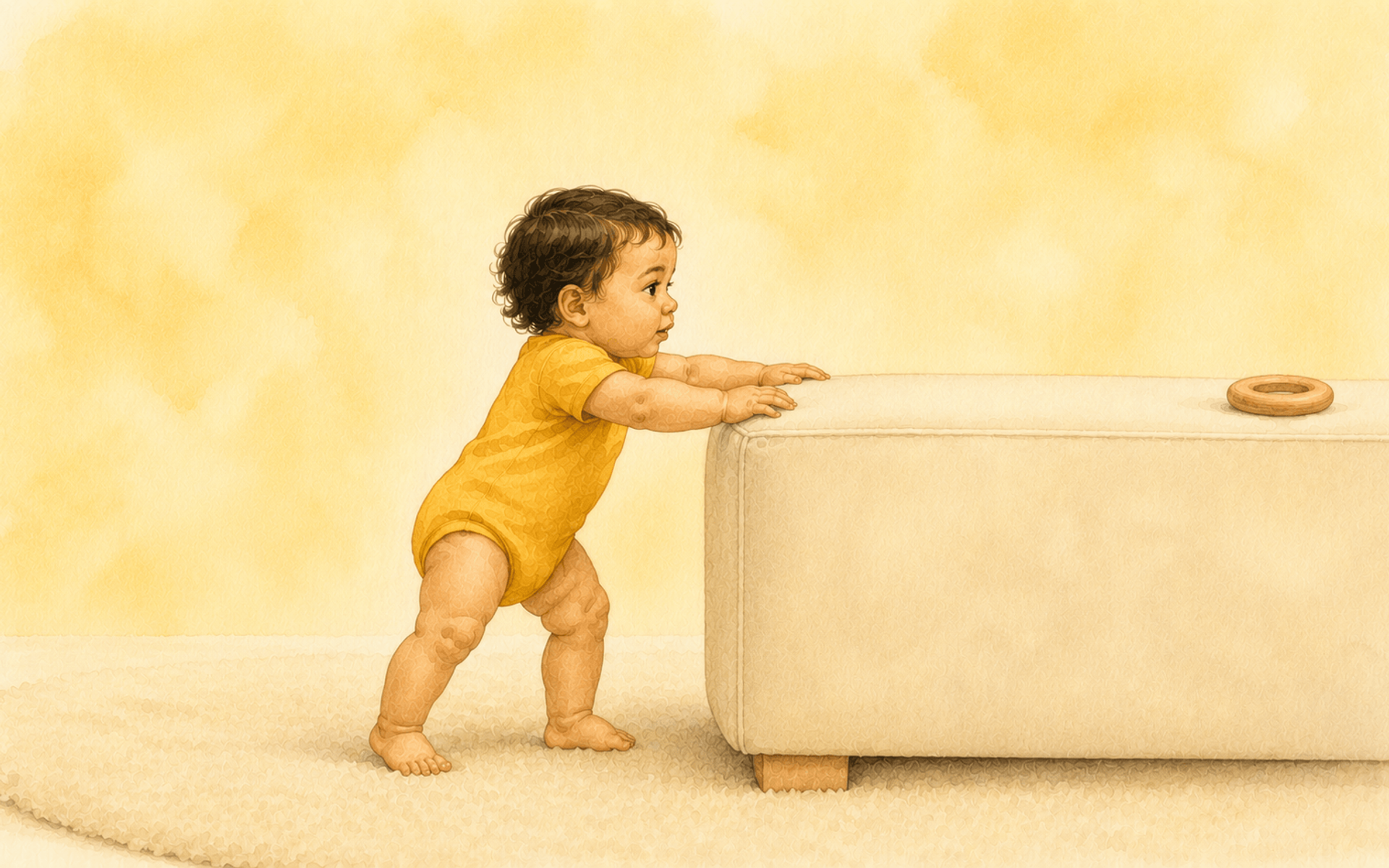
Last year, pediatric researchers put accelerometers on 117 American babies and tracked every minute of their waking day. The average baby spent less than five minutes per hour moving freely on the floor. The rest of the time: car seats, bouncers, swings, high chairs, laps. Six hours a day in devices that hold a baby still while the parents assume development is happening on its own schedule.
It isn't. Gross motor skills in babies don't unfold on a biological clock. They respond to what the baby does with the hours.
- Why gross motor skills are really a story about brain reorganization, not just muscle growth
- The actual milestone windows — wide enough to stop most of the panic
- The six-hours-in-devices problem, and what to do instead
- Why walkers delay development through two different mechanisms (one of which is genuinely weird)
- What crawling does to the brain that no bouncer, no walker, and no amount of supported sitting can replicate
- A by-age playbook built around conditions that move development forward
- The real red flags — soft, specific, and without alarm
If the one-sentence answer is enough, you’ve got the gist. If you want the mechanism behind each piece, keep reading.
What gross motor skills are, and why they matter beyond the living room floor
Gross motor skills involve the large muscle groups: neck, trunk, arms, legs. In the first year, development runs roughly head-to-toe: head control first, then trunk stability, then legs doing actual locomotor work. That sequence is biological. The timing within it is not.
Here's what most milestone articles leave out: every new posture your baby acquires is also a brain event. A 2016 study from the Upstate KIDS project followed 599 children from infancy through age four. Babies who achieved standing with assistance on the earlier end of the normal range scored meaningfully higher on cognitive and adaptive assessments at four years old, even after researchers controlled for a long list of other factors. The same study found that standing with assistance carried more predictive weight than walking date alone, because standing with assistance depends directly on the trunk and postural strength that floor time builds.
The mechanism is not subtle. A baby who cannot yet sit independently has both hands occupied with the work of propping up. A baby who sits without help has both hands free, which opens a qualitatively different kind of object play (rotating things, passing between hands, bringing to the mouth and back out again). The posture is the scaffold. Change the posture and you change what the brain gets to practice.
Gross motor development, in other words, is not just about getting from the playmat to the kitchen. It is how the brain reorganizes what it can learn.
The milestone windows, and why the single numbers in most articles are made up
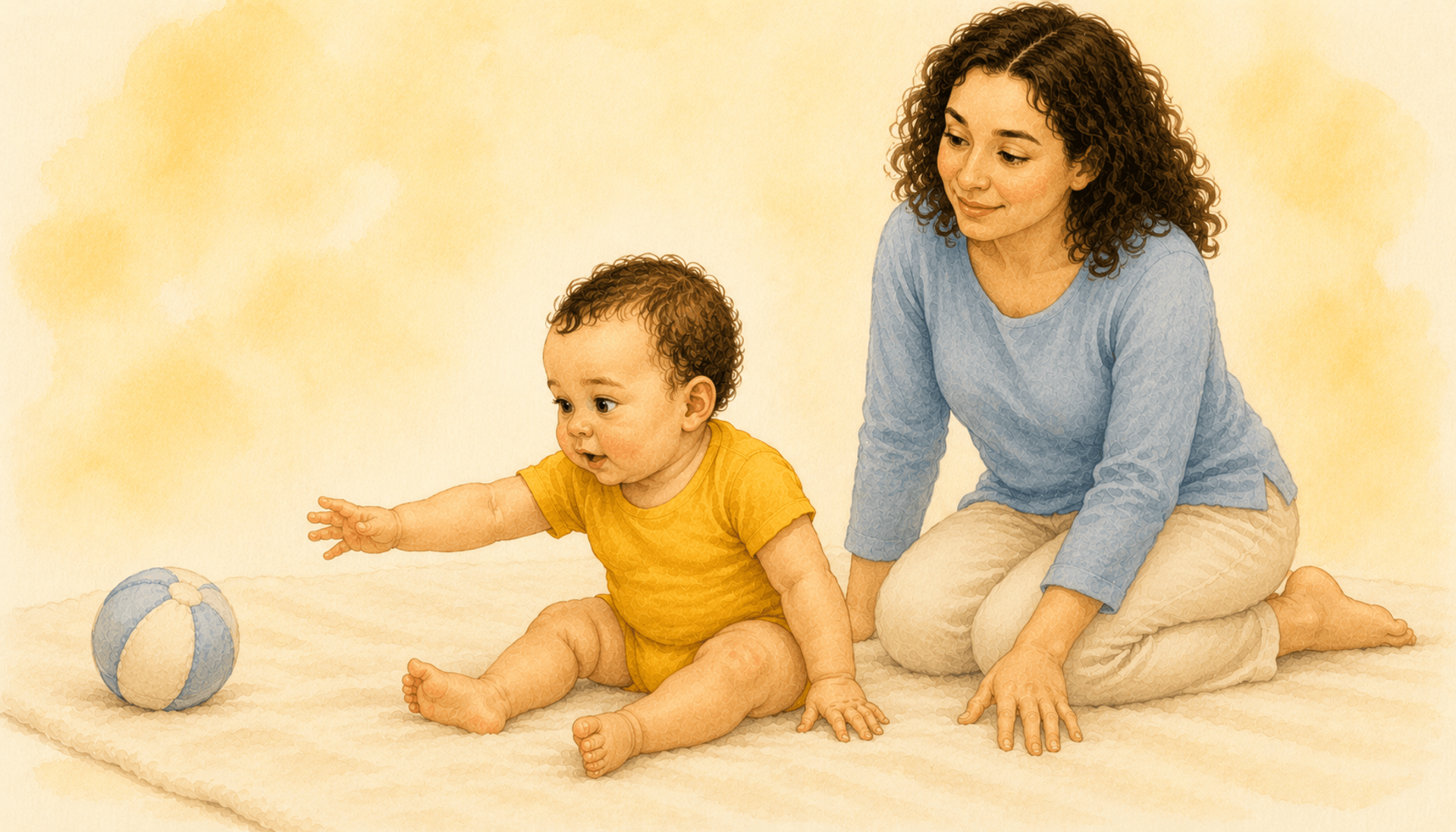
The WHO Multicentre Growth Reference Study followed 816 healthy infants across five countries and produced the most reliable picture we have of how wide the normal windows are. The single numbers that appear on most milestone charts (rolling at 4 months, crawling at 8, walking at 12) are medians, meaning roughly half of healthy babies fall on either side of them.
Head control arrives first. Most babies can lift and hold the head steadily during tummy time by three to four months.
Rolling follows between four and seven months, though the direction a baby rolls first depends more on how alert hours are spent than on any fixed developmental order. Our full guide to rolling milestones gets into this properly.
Sitting without support has the narrowest window of any first-year milestone. The WHO puts the 1st to 99th percentile range at 3.8 to 9.2 months, just over five months. For the three distinct stages of sitting and the balance mechanics behind each one, see our guide to when babies sit up.
Crawling has nearly the widest window of any milestone (over eight months from first to last among healthy infants), which is part of why the CDC removed it from official checklists in 2022. Healthy babies skip it, belly-crawl through it sideways, invent seventeen variations on it, or skip straight to pulling up. The roughly 25 documented crawling styles, and why the textbook diagonal pattern is a minority, are covered in our crawling guide.
Walking arrives somewhere between nine and seventeen months. The median is twelve months, which means a meaningful chunk of healthy babies are not yet walking on their first birthday and there is absolutely nothing wrong with them. Our walking article covers both the cognitive cascade that walking triggers and why the date matters less than what changes the day it starts.
Milestones matter. A milestone date, on its own, tells you almost nothing about what's shaping whether your baby gets there sooner or later within that window. That's what the next sections are about.
Six hours in devices: the number that should change how you set up your day
The AAP has documented that the average American baby spends roughly six hours per day in some kind of device: car seat, bouncer, swing, exersaucer, high chair. This is not an accusation. It is a description of what alert time looks like in most households when you add it up.
A 2020 biomechanics study measured muscle activation across infant positions. Time on the floor in prone (face-down, awake, supervised) uniquely activated the neck extensors, back muscles, and shoulder stabilizers that underlie every gross motor milestone from head control through crawling. Time in baby seats and bouncers, including well-designed ones with good lumbar support, produced dramatically lower activation in those same muscle groups. The baby in a bouncer is not resting these muscles. The baby is simply not using them.
The practical implication is not complicated: each hour in a device is an hour not on the floor, and the floor is where the muscles that produce milestones get trained. The AAP-aligned guidance keeps device time to car travel plus no more than one hour per day in total. Not as a guilt trip, but as a useful reallocation target. That is the hour that you can redirect toward a play mat, a rolled blanket, a patch of carpet, and a baby trying to figure out what to do with gravity.
What walkers do, and the two-mechanism explanation that most articles miss
Baby walkers delay gross motor development through two separate mechanisms, and one of them is genuinely counterintuitive.
The first mechanism is visual. Andrea Siegel and Roger Burton studied 109 infants in 1999 and found that babies who used modern occluding walkers (the kind with a wide opaque tray that blocks the baby's view of the legs) sat, crawled, and walked later than babies without walker experience. They also scored lower on Bayley mental and motor scales. The proposed mechanism: visual feedback about limb movement is necessary for the nervous system to refine motor programs. When the tray hides the baby's moving legs, the baby is deprived of exactly the visual information the brain needs to calibrate stepping. A cross-sectional study by Garrett, McElroy, and Staines, published in the BMJ in 2002, found that walker-using infants crawled, stood alone, and walked independently up to three weeks later than non-users.
The second mechanism involves trunk. A 2021 Turkish study by Bezgin and colleagues compared 29 walker-using infants to 19 non-users and found the walker group scored significantly lower not only on standard motor assessments but specifically on reactive trunk balance: the ability to make automatic postural corrections when the body starts to tip. The walker seat provides external support, which means the baby never has to fire the trunk muscles that sitting and walking depend on. As the researchers put it, the baby in a walker learns to hang in a seat rather than to control a body.
None of this applies to push toys — the kind where the baby stands up and pushes a handle while walking forward. That is weight-bearing, balancing, and full visual-proprioceptive feedback. That is a completely different device. The problems are specific to wheeled seats.
One more thing worth mentioning: before the walker experience kicked in, Joseph Campos and colleagues ran a remarkable experiment in 1992. They showed that pre-locomotor infants who couldn't yet crawl displayed no heart-rate change when lowered over a visual cliff (a see-through drop-off). Infants with even a few weeks of crawling experience showed a significant heart-rate increase, a measurable wariness of depth. What was surprising was that pre-locomotor babies who had been given walker experience also showed this response, even without any real crawling. Self-produced locomotion through space, in any form, reorganizes how the brain processes depth and danger. The walker gets you some of that effect. It skips almost everything else crawling builds.
What crawling does to the brain, and why the floor is irreplaceable
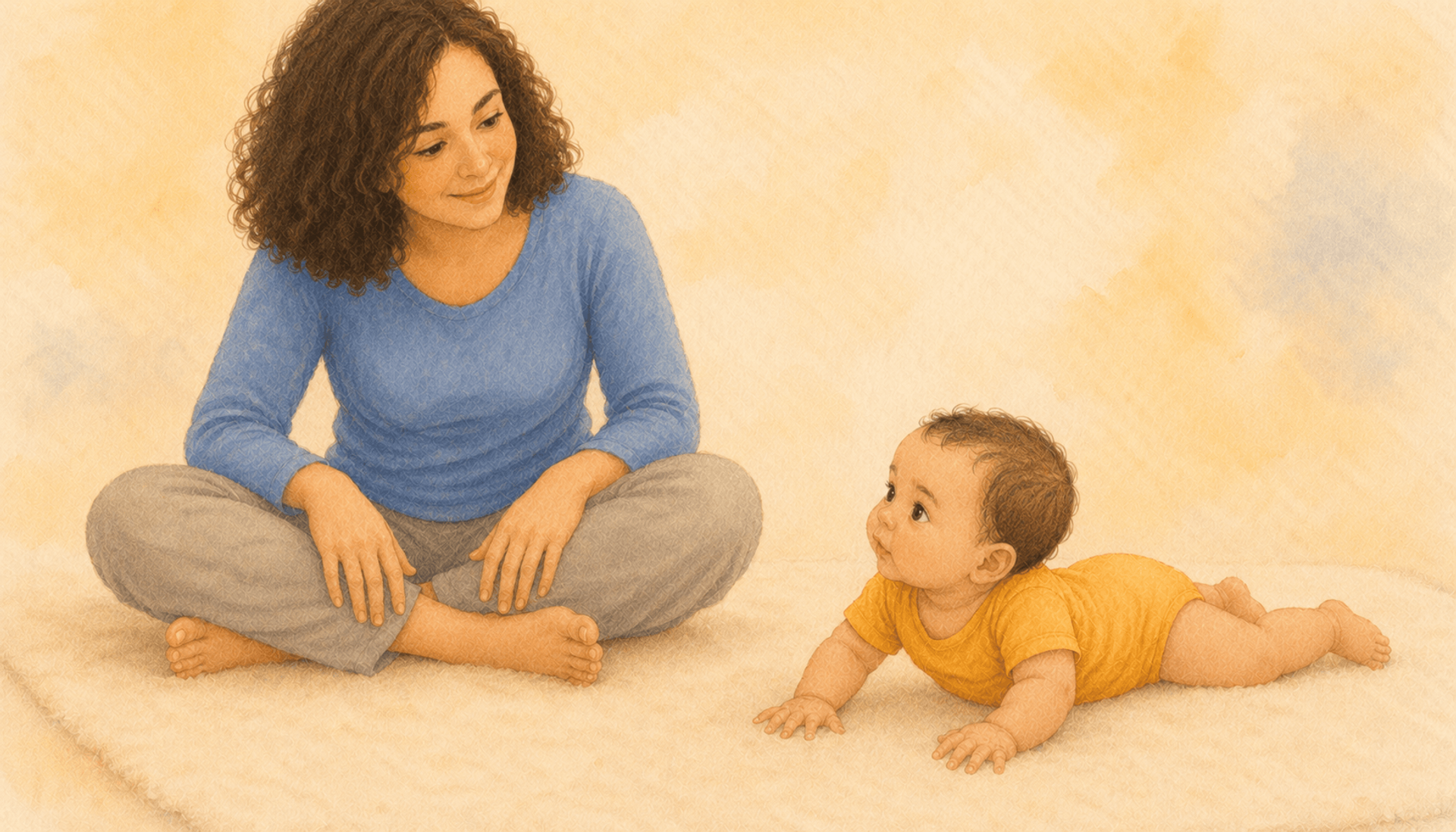
The most important thing that happens when a baby crawls is not the crawling. It is the cascade of changes in what the baby can observe, touch, and receive from the people around, and what the brain does with all of it.
Bell and Fox tracked infants in 1997 by locomotor experience rather than age. Babies with just one to four weeks of crawling experience showed measurably different activity in the frontal regions of the brain (the areas involved in working memory and coordinating responses) compared to same-age babies who hadn't started moving yet. The motor change and the brain change were not sequential. They arrived together.
There is a less-cited finding about how locomotor learning transfers (or doesn't) that matters for the way we think about floor time variety. Karen Adolph's 1997 study followed infants as they learned to navigate slopes while crawling, then tracked what happened when those same babies began walking. Expert crawlers who had figured out how to manage a steep incline made errors and fell all over again as walkers, with no transfer of that perceptual skill. The view from hands-and-knees and the view from upright are different enough that they constitute different problems to solve. This is not a reason to panic about crawling. It is a reason to understand that each posture your baby spends time in is teaching the brain something that the other postures are not.
A 2019 systematic review of 23 studies by Gonzalez, Alvarez, and Nelson confirmed this specifically for language. Gross motor locomotion supports language development not because movement is generally good for brains, but because crawling and walking put the baby in "widely different positions, which reframes what infants are able to observe." A crawler sees the underside of the coffee table and the dog's perspective on life. A walker sees your face at a new angle, the object on the counter, the whole room. Both are building vocabulary. They're doing it from completely different angles of the world.
This is also why the evidence on skipping crawling is more nuanced than the "must crawl or else" messaging you see in some circles. The WHO study found 4.3% of healthy infants never crawled at all. The CDC removed crawling from official milestones precisely because healthy babies arrive at the same developmental destinations via different paths. Our fine motor skills guide gets into the specific relationship between crawling experience and hand skill development.
The activity playbook, by age
The activities that support gross motor skills are less about specific exercises and more about specific conditions. Here's what the research points to, by window.
0–3 months: the neck, the back, and the basics
The foundation of everything that follows is built here, in prone. Face-down on a firm, flat surface while awake and supervised. By the end of this window, aim for 30 or more minutes of tummy time distributed across the day in short sessions. The goal is not endurance but accumulation, because cumulative prone time across the first eighteen months is one of the strongest predictors of earlier milestone achievement across the board.
For babies who treat tummy time like a personal insult from day one, chest-to-chest prone on a reclined parent is legitimate prone time and research-supported as a starting point. Short sessions many times a day build tolerance faster than one long session in the evening after the baby is already tired. The tummy time guide covers seven specific approaches for the resisters.
Back time with free legs is the other underrated activity at this age. No swaddle, no positioning aid. Just a baby on the back kicking whatever leg muscles have opinions about being kicked. It is engaging the hip flexors and core that rolling will later need.
3–6 months: rolling and unrestricted floor space
Between three and six months, most babies are working toward rolling. The condition that makes rolling happen is simple: floor time in any direction, with arms and legs unconfined.
The NonstopMinds Sensory Play Cards work particularly well here. Prop a card slightly to one side during tummy time and the baby will try to track it, which shifts weight toward the direction of the roll. The baby is just trying to look at something interesting. The trunk muscles are doing the actual work without anyone organizing a drill.
Supported sitting can start around four to five months for short sessions, with your legs as the back support or a nursing pillow behind. Place a couple of objects within reach at eye level. The baby reaches, leans slightly, activates the trunk without needing to do it solo. This is not about getting the baby to sit early. It is about giving the trunk muscles a new kind of problem to solve.
6–9 months: the sitting-to-crawling corridor
By six months, most babies can hold a sitting position for a short period with hands free. The temptation at this stage is to set the baby up in supported sitting and walk away. The more useful investment is floor time in multiple positions: sometimes sitting, sometimes prone, sometimes on the back, because the variety itself is what builds the trunk flexibility that crawling will eventually need.
Toys placed just out of reach prompt the shift from sitting to reaching to tipping to some form of forward problem-solving. A low pillow or a rolled blanket creates an obstacle that requires small adjustments to get over or around. These are not elaborate activities. They are just conditions in which the baby has a reason to move and a safe surface to figure it out.
Pulling to stand can begin around eight to nine months. Low, stable furniture gives the baby something to grip. The baby who pulls up, wobbles, adjusts, and tries again is doing exactly the kind of active practice that a 2025 Spanish randomized trial (the only RCT of parent-guided floor-play coaching in healthy term infants) showed produced a 5.5-point advantage on standard motor assessments by nine months compared to a control group.
9–12 months: standing, cruising, and protecting floor time from screens
This is the window where standing with support becomes more developmentally significant than most parents realize — more so, in fact, than the date of the first independent step. A baby pulling to stand, cruising along the couch, reaching sideways for the next handhold, is doing something that a walker-user is not.
Screen time at this age matters in a specific way. A 2023 study in JAMA Pediatrics followed 7,097 Japanese children from infancy through age four. Babies with four or more hours of daily screen time at twelve months showed a dose-response association with developmental delays at age two across multiple domains. The mechanism is not that screens are inherently toxic at this age. Screen time crowds out floor time, and floor time is the irreplaceable input.
Cruising — sideways stepping while holding furniture — is the CDC's twelve-month gross motor indicator. The setup is not complicated: position a toy or yourself at the far end of the couch and wait. The path matters less than the thousands of small balance corrections the nervous system is making along the way. Each one is the brain calibrating what it means to be upright.
When to flag something with your pediatrician
The range of normal is wide enough that a single milestone date is almost never the right reason to call. What actually warrants attention:
A baby who shows no weight-bearing on the legs when held upright (arms supporting the baby, feet touching the floor) is worth mentioning at the next visit. Most babies begin bearing some weight between two and four months. Absence of this through the second half of the first year is a pattern a pediatrician will want to look at.
Persistent asymmetry — one side of the body consistently doing far less than the other, the head always turning the same direction, one arm rarely reaching — is worth flagging. Mild asymmetry in the first weeks is common. Persistent and pronounced asymmetry can indicate torticollis or muscle-tone differences that respond well to early physical therapy.
Loss of a skill that was previously present is the clearest reason to call sooner rather than later. A baby who was rolling reliably and stops, or who was bearing weight and no longer attempts it, falls into the category of motor regression — uncommon, and worth raising promptly rather than watching.
For babies born prematurely, everything above applies to corrected age, meaning chronological age minus weeks of prematurity. A baby born at 32 weeks who is eight months old by the calendar is closer to six months developmentally. Milestone windows apply to corrected age through roughly 24 months.
Frequently Asked Questions
The main sequence: head control while prone (2–4 months), rolling (4–7 months), sitting without support (4–9 months, with a mean around 6), crawling or some other form of floor locomotion (5–13 months, with 4.3% of healthy infants skipping hands-and-knees crawling entirely), pulling to stand (8–10 months), cruising along furniture (9–12 months), and first independent steps (9–17 months, with a median around 12). These are ranges, not deadlines. The CDC's 2022 revision replaced single-age milestones with windows precisely because healthy variation across all of these is this wide.
The most effective single change is more floor time in multiple positions — prone, supine, and supported sitting — distributed across the day rather than packed into one session. A 2025 randomized trial showed that parents who received coaching on how to support active floor movement had babies scoring 5.5 points higher on standard motor assessments at nine months compared to a control group. The specific activity matters less than the conditions: a safe surface, an interesting object slightly out of reach, and a parent who waits before helping.
Late relative to a single milestone date is rarely meaningful when the windows are this wide. Late relative to the far end of the normal window, combined with other signals like asymmetry, no leg weight-bearing, or loss of a previously acquired skill, is worth a conversation with your pediatrician. The more useful question is not "is my baby on schedule?" but "is my baby making progress?" — rolling with more control this month than last, sitting for longer, showing more interest in reaching toward something across the room. Progress within the window matters more than the date.
The research points consistently in one direction. Seated walkers with wheels delay sitting, crawling, and walking through two separate mechanisms: the opaque tray hides the baby's legs, depriving the nervous system of visual feedback; and the seat provides external trunk support that keeps the baby's core muscles disengaged. A 2002 BMJ study found walker-using infants reached standing alone and walking independently up to three weeks later than non-users. Push toys (where the baby stands and controls a bar) are a different device entirely and don't carry these concerns.
For educational and informational purposes only. Not a substitute for professional medical or developmental advice. If you have concerns about your baby's development, consult your pediatrician.
- Adolph, K. E. (1997). Learning in the development of infant locomotion. Monographs of the Society for Research in Child Development, 62(3), 1–158.
- Bell, M. A., & Fox, N. A. (1997). Individual differences in object permanence performance at 8 months: Locomotor experience and brain electrical activity. Developmental Psychobiology, 31(4), 287–297.
- Bezgin, S., Uzun Akkaya, K., Çelik, H. İ., Duyan Çamurdan, A., & Elbasan, B. (2021). Evaluation of the effects of using a baby walker on trunk control and motor development. Turkish Archives of Pediatrics, 56(2), 159–163.
- Campos, J. J., Bertenthal, B. I., & Kermoian, R. (1992). Early experience and emotional development: The emergence of wariness of heights. Psychological Science, 3(1), 61–64.
- Fernández-Sola, L., Cano-Díez, B., Pons-Solaz, Y., Vera-Egido, B., & Moreno-González, S. (2025). Effectiveness of a training program for the acquisition of motor milestones in infants: A randomized clinical trial. Italian Journal of Pediatrics, 51(1), 23.
- Garrett, M., McElroy, A. M., & Staines, A. (2002). Locomotor milestones and babywalkers: Cross sectional study. BMJ, 324(7352), 1494.
- Ghassabian, A., Sundaram, R., Bell, E., Bello, S. C., Kus, C., & Yeung, E. (2016). Gross motor milestones and subsequent development. Pediatrics, 138(1), e20154372.
- Gonzalez, S. L., Alvarez, V., & Nelson, E. L. (2019). Do gross and fine motor skills differentially contribute to language outcomes? A systematic review. Frontiers in Psychology, 10, 2670.
- Hewitt, L., Kerr, E., Stanley, R. M., & Okely, A. D. (2020). Tummy time and infant health outcomes: A systematic review. Pediatrics, 145(6), e20192168.
- Siegel, A. C., & Burton, R. V. (1999). Effects of baby walkers on motor and mental development in human infants. Journal of Developmental & Behavioral Pediatrics, 20(5), 355–361.
- Takahashi, I., Obara, T., Ishikuro, M., Murakami, K., Ueno, F., Noda, A., Onuma, T., Shinoda, G., Nishimura, T., Tsuchiya, K. J., & Kuriyama, S. (2023). Screen time at age 1 year and communication and problem-solving developmental delay at 2 and 4 years. JAMA Pediatrics, 177(10), 1039–1046.
- WHO Multicentre Growth Reference Study Group. (2006). Motor development study: Windows of achievement for six gross motor development milestones. Acta Paediatrica Supplementum, 95(450), 86–95.
- Zubler, J. M., Wiggins, L. D., Macias, M. M., Stephens, I., Martin, L. E., Mendoza, J., & Shaw, J. S. (2022). Evidence-informed milestones for developmental surveillance tools. Pediatrics, 149(3), e2021052138.
Related Products

More Articles
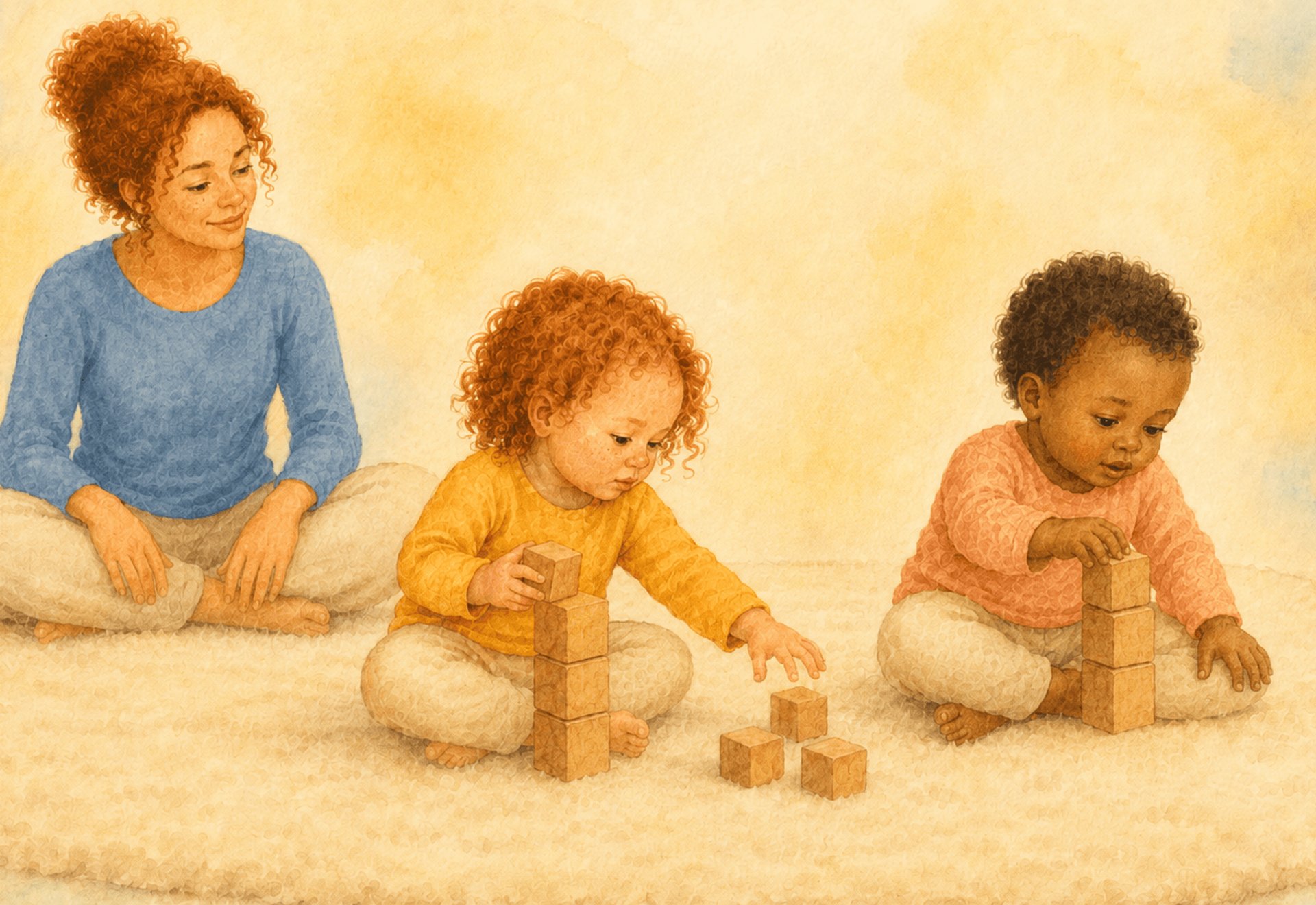
Parallel Play in Toddlers: Why Side-by-Side Is the Social Work
Your toddler spent the entire playdate building separate towers, and nobody shared a single block. That counted — more than it looked. A 2025 longitudinal study found that playing beside a specific child consistently predicted later social play with that same child, but not the other way around. Here's what parallel play in toddlers actually is, why the science calls it strategic rather than passive, and what it means for how you run a playdate.
When Do Babies Point: Why It Matters for Language
Most milestone articles treat pointing as a box to check around 12 months. The research tells a different story — one that starts months earlier, runs through the infant brain, and traces back to how much the parent is pointing. Here's what the last fifteen years of research actually found, and what it means for everyday interactions.
When Do Babies Wave Bye-Bye: Why Your Baby Needs You to Wave First
Most baby milestones unfold on a biological schedule — waving isn't one of them. A 2023 study found that babies develop imitation ability because their caregivers imitate them first, and waving is named directly as a cultural gesture learned through that loop. Here's what the research says about the 9–12 month window, why the first wave looks nothing like a wave, and what helps it arrive.