How to Introduce Allergens to Baby Safely: What Happens After the First Taste

For years, the official advice was to delay allergenic foods (peanut, egg, dairy) until a baby was old enough, just in case. Then a landmark trial flipped that guidance entirely: introduce allergens early, and you dramatically cut the risk. Parents read the headlines, bought the peanut butter, took a breath, and introduced. Most of them stopped there. What the headlines did not explain (and what the research actually shows) is that how to introduce allergens to baby is the smaller half of the question. The half that matters most comes after the first taste, during the months that follow, and it is the part almost every guide skips.
- Why the trial behind "introduce early" only worked for families who kept going — and what that means in practice
- What "enough" looks like, translated from grams of protein into things you can measure in a kitchen
- The 3–5 day spacing rule: where it came from, what it was originally for, and why following it too strictly can work against you
- A separate protocol for babies with eczema, where the research and the official guidelines say something more specific
- What to do when your baby consistently refuses an allergen — which turns out to be the most common way the strategy fails
- What a reaction looks like, and when to call the pediatrician versus watch and continue
If the one-sentence answer is enough, you’ve got the gist. If you want the mechanism behind each piece, keep reading.
The trial that changed the guidelines — and what it quietly required
The research that turned allergen guidance upside down is called the LEAP trial, a randomized controlled study published in the New England Journal of Medicine by Du Toit and colleagues in 2015. Among infants at high risk for peanut allergy (those with severe eczema, egg allergy, or both) the children who consumed peanut regularly from early infancy had an 81% lower rate of peanut allergy by age five compared to those who avoided it. That finding was large enough that the National Institute of Allergy and Infectious Diseases updated its clinical guidelines in 2017, recommending that high-risk babies be introduced to peanut as early as four to six months, ideally after a conversation with their pediatrician.
What made LEAP work was not just timing. It was adherence: 92% of families in the consumption group followed through and kept peanut in their baby's diet throughout the study. The protocol called for regular peanut consumption, not a single introduction.
A second large trial published the same year, the EAT study, tested whether the same principle applied to six common allergens at once in average-risk, breastfed infants. In the intention-to-treat analysis (the real-world measure that includes every family who enrolled, regardless of how consistently they followed through) there was no statistically significant reduction in food allergy between the early introduction group and the standard group. The difference appeared only when researchers looked at the roughly 42% of families who consistently hit the target consumption level. That group showed meaningful reductions in peanut and egg allergy specifically. The families who started but didn't sustain showed no benefit.
The EAT researchers found that the minimum effective amount appeared to be around two grams of allergen protein per week for each food. For most families, food refusal was the main reason they couldn't reach it.
What the research describes, then, is not a one-time introduction but an ongoing feeding practice. Understanding when your baby is developmentally ready to start solids matters here because the same window that makes early introduction possible is the window in which sustaining it is most achievable.
What "two grams of protein per week" looks like in a kitchen
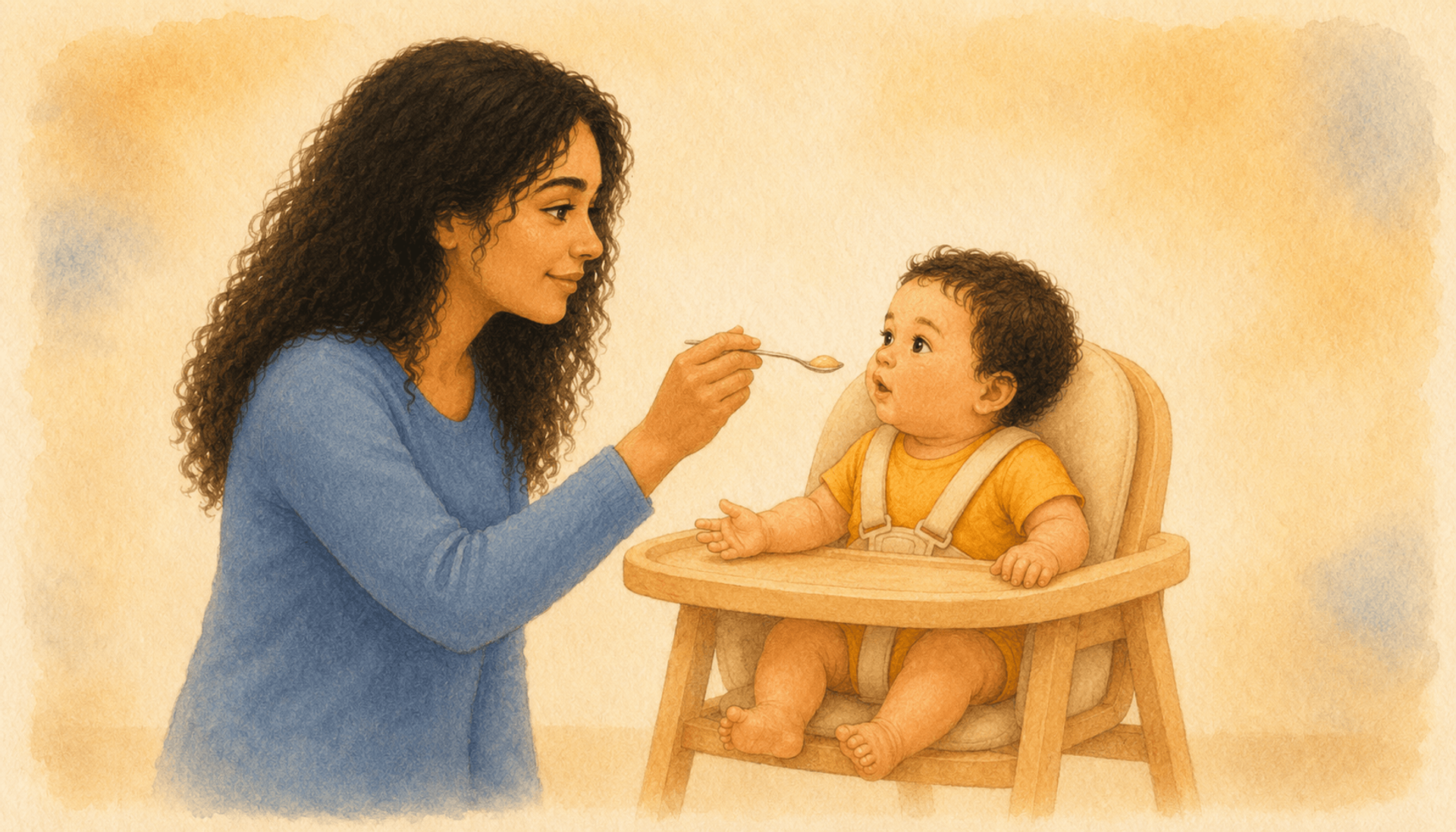
Two grams of peanut protein per week is roughly one and a half teaspoons of smooth peanut butter or about two teaspoons of peanut powder mixed into food. Two grams of egg white protein is approximately one small hard-boiled egg. These are the dose ranges the EAT trial identified as associated with protection, and the Canadian Society of Allergy and Clinical Immunology translated them into kitchen units in a 2023 statement specifically because the gram figures were not actionable for parents.
The practical implication is that "offering a taste" is not the same thing as reaching the threshold. A rice cake with a thin smear of peanut butter is a start. Half a teaspoon mixed into oatmeal twice a week is closer to what the research was measuring. The distinction matters because many families believe they are following the guidance once they have introduced the food without a reaction, when what the evidence points to is a sustained practice.
None of this means every family needs to measure to the milligram. It means that the goal of keeping allergens in regular rotation, appearing in a meal two or three times a week rather than once a month, is grounded in what the studies tested. For families who have already worked through best first foods for baby, allergens slot naturally into that same rotation — cooked egg alongside iron-rich purees, thin nut butter on soft toast, well-mashed legumes already in the mix. For families following a baby led weaning approach, the same logic applies with finger foods.
The AAP's 2023 update, authored by Abrams and colleagues in Pediatrics, notes that regularity of ingestion appears to play some role in maintaining tolerance, though the exact mechanisms are still being studied. This connects to a broader picture of how the first year shapes immune and neurological development in ways researchers are still mapping. It is not a simple switch that flips once — it is a practice that the immune system appears to benefit from over time.
The 3–5 day spacing rule: what it was meant for

The advice to wait three to five days between each new food is one of the most widely repeated instructions in first-foods guides, and most parents follow it as a fixed rule. The research basis for that specific window, when examined directly, is thinner than its universal status implies.
A 2020 analysis in JAMA Network Open by Samady and colleagues surveyed over 1,400 pediatric practitioners and found that while most still recommended the three-to-five-day interval, the researchers noted that it is unclear why this particular window was chosen and that diverse early diets are associated with reduced atopy risk regardless of introduction order or spacing.
The rule does real work for one specific purpose: identifying which allergenic food caused a reaction. Because IgE-mediated allergic reactions appear within approximately two hours of exposure, a single day is typically sufficient to attribute a reaction to a specific food. The three-to-five-day window was designed for the top allergenic foods (peanut, egg, cow's milk, tree nuts, wheat, soy, fish, shellfish, and sesame) so that if a reaction occurred, you could identify the cause.
For non-allergenic foods, vegetables, fruits, most grains, there is no published evidence that spacing between introductions changes any meaningful outcome. A family working through the list of best first foods can introduce a new vegetable without waiting five days after the last one.
Where the spacing rule matters, though, is in allergen introduction specifically. The practical guidance that follows from the research: introduce one new top-allergen food at a time, observe for a day or two, and if there is no reaction, that food can become part of the regular rotation while the next allergen is introduced. Spreading the top nine allergens across weeks or months is reasonable. Spreading them across a year while observing five days between each non-allergenic food is where the rule outlives its purpose.
Babies with eczema: a different starting point
The general guidance about introducing allergens early and at home applies to most infants. Babies with moderate to severe eczema, or those who already have a confirmed egg allergy, are in a category where the research is more specific and the guidance is more cautious.
The NIAID's 2017 addendum guidelines, authored by Togias and colleagues in the Journal of Allergy and Clinical Immunology, divided recommendations into three groups based on risk. For infants with severe eczema, egg allergy, or both, the guideline recommends considering peanut-specific blood or skin testing before introduction, and discussing timing with a physician, ideally introducing peanut as early as four to six months. For infants with mild to moderate eczema, introduction around six months is appropriate, and physician consultation is optional but reasonable. For infants with no eczema and no food allergy, introduction can happen at home per family preference.
The reasoning behind the distinction is that the LEAP trial was conducted with high-risk infants under medical supervision, including pre-enrollment skin testing. The trial protocol was not a home introduction without prior evaluation. For a baby with significant eczema, checking in with the pediatrician before the first peanut introduction is the step the research tested.
Eczema and food allergy are connected in a direction that surprised researchers: sensitization to food proteins appears to happen through inflamed skin before oral exposure occurs, which is part of why early oral introduction builds tolerance rather than allergy. But that same mechanism means that babies with more significant skin barrier problems deserve a conversation with their care team rather than a solo home debut of a top allergen. The signs of readiness for solid foods remain relevant here — eczema management and solid food readiness are separate tracks, and the pediatrician can help navigate both.
When the baby won't eat it: the most common way this goes wrong
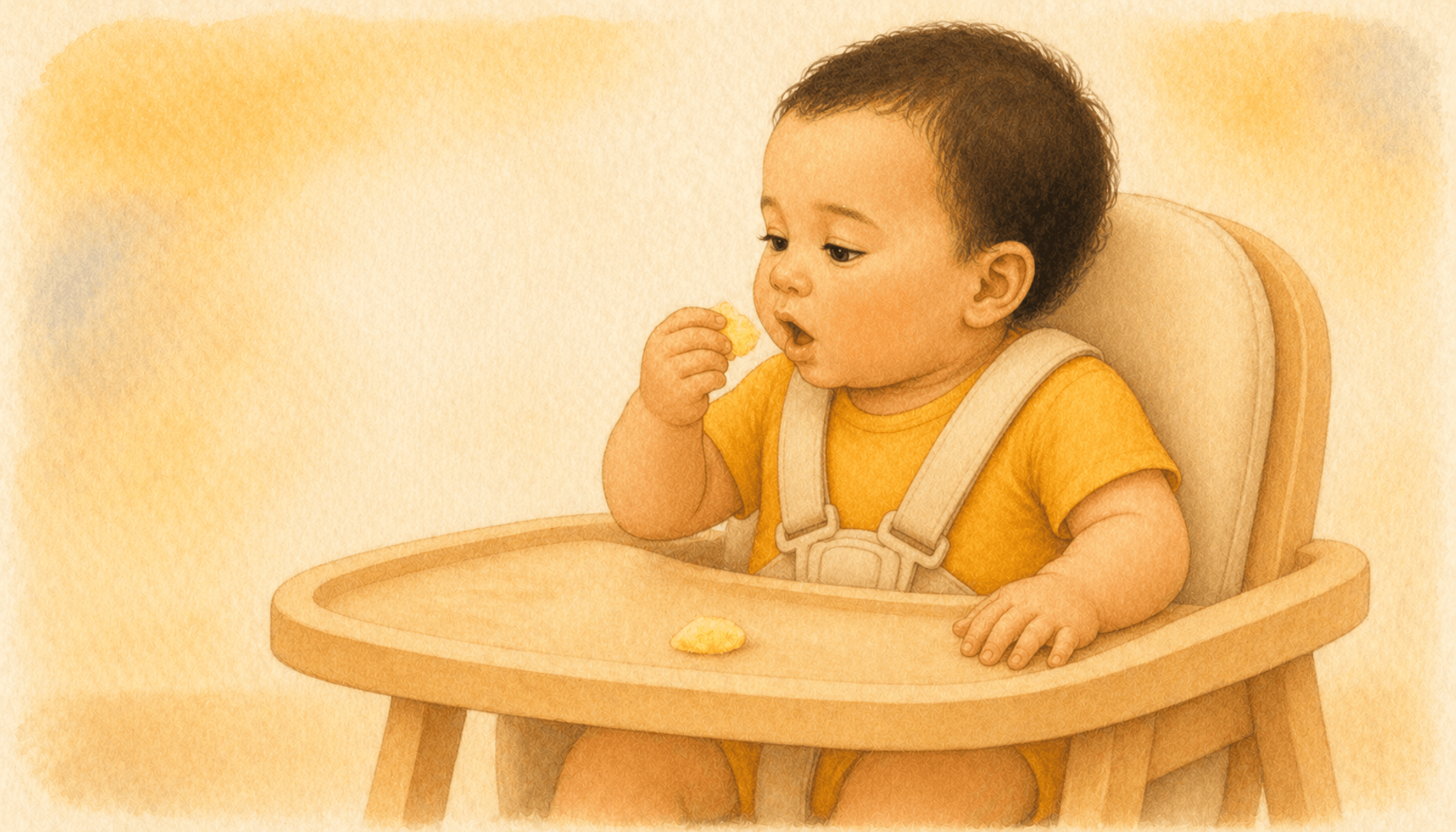
Food refusal was the primary reason families in the EAT trial could not sustain the target dose. A baby who spits out every spoonful of egg or turns away from peanut-containing foods is not failing — but the strategy is not working either, and the gap between "we introduced it" and "we are hitting the effective dose" can be wider than it appears.
A few things the research and feeding specialists consistently note: flavor and texture acceptance for new foods typically requires multiple exposures. (If refusal persists well into toddlerhood, the mechanisms are different from what is happening at six months — that is a separate pattern worth looking at.) What looks like rejection after two or three attempts is often still early in the learning curve. The AAP's 2023 guidance acknowledges that refusal is common and that persistence with varied preparations is a reasonable approach before concluding a food is not tolerated.
Mixing helps. Peanut butter stirred into oatmeal, banana puree, or yogurt does not reduce its allergen content. Hard-boiled egg mashed into avocado or sweet potato is still egg. Thin nut butter on a soft piece of toast counts. These are not tricks because that is how most families in successful allergen introduction studies administered the foods. Standalone spoonfuls of peanut powder are not particularly appealing to a six-month-old with strong opinions about textures.
Cooked egg is also worth noting: baking or hard-boiling significantly reduces egg's allergenicity compared to raw or lightly cooked preparations. Fully cooked egg (scrambled, hard-boiled, baked into something) is the standard form used in most allergen introduction studies and the form recommended in clinical guidance for the first year.
One thing to distinguish: if a baby consistently refuses a specific food across multiple attempts and multiple preparations over weeks, that pattern is worth mentioning to the pediatrician, particularly if the food in question is one of the top allergens. Consistent aversion to a food a baby has not tolerated before is occasionally the immune system's early signal. It is worth flagging, not pushing through.
What a reaction looks like and when to call
The fear of a severe allergic reaction on the first introduction is the most common reason parents delay, according to a 2023 survey of over 3,000 US caregivers by Samady and colleagues in Pediatrics. In that same survey, only about 1.4% of caregivers reported an actual reaction during peanut introduction at home. Most reactions that do occur are mild and localized: hives around the mouth, a few red patches on the cheeks, mild swelling of the lips.
Mild symptoms in the skin (hives, redness, a few raised welts) that appear and resolve without spreading or worsening are, per AAP guidance, something to note and discuss with your pediatrician before the next exposure, but they are not typically a reason to call 911. More significant symptoms — widespread hives spreading beyond the face, swelling of the tongue or throat, vomiting more than once, difficulty breathing, or a sudden change in behavior like unusual limpness or drowsiness — are the signs the guidelines describe as warranting immediate emergency care.
The practical approach described in the NIAID 2017 addendum guidelines and reinforced by the AAP's 2023 update: introduce a top allergen at home, earlier in the day, so there is time to observe. The guidelines suggest starting with a small amount, roughly a quarter teaspoon of peanut butter thinned with water or a small piece of well-cooked egg, and watching for about two hours. If there is no reaction, that food can move into regular rotation.
Whether families are using purees or a baby led weaning approach, for families with a history of severe food allergy in a first-degree relative, or any baby with significant eczema or confirmed egg allergy, the same general framework applies, but the starting point is a conversation with the pediatrician rather than a solo home introduction. That is not an abundance of caution as a formality — it reflects what the LEAP trial tested and what its results can reasonably be extended to claim.
Frequently Asked Questions
There is no single fixed schedule, but current guidance from the American Academy of Pediatrics and the National Institute of Allergy and Infectious Diseases supports introducing the top nine allergenic foods (peanut, egg, cow's milk, tree nuts, wheat, soy, fish, shellfish, and sesame) starting when a baby is ready for solids, typically around four to six months for high-risk infants and around six months for others. Each new top allergen can be introduced one at a time with a day or two of observation between them. Once tolerated, each food should stay in regular rotation, roughly two to three times per week, rather than being introduced once and set aside.
No single allergen has to come first. Clinical guidance from the NIAID 2017 addendum guidelines focuses most specifically on peanut because of the volume of research behind it — the LEAP trial, a large randomized controlled study published in the New England Journal of Medicine in 2015, showed that early and regular peanut consumption dramatically reduced peanut allergy in high-risk infants. For families with no specific risk factors, peanut and egg are reasonable early choices given the strength of the evidence. For babies with severe eczema or an existing egg allergy, a conversation with the pediatrician before the first peanut introduction is what the research protocol tested.
The EAT study, a 2016 randomized trial published in the New England Journal of Medicine by Perkin and colleagues, found that protective effects were associated with regular consumption of approximately two grams of protein per week for each allergen, which translates to roughly one and a half teaspoons of smooth peanut butter or one small hard-boiled egg per week. The families in that study who could not sustain that frequency showed no statistically significant benefit from early introduction. Most current guidance, including the 2023 Canadian Society of Allergy and Clinical Immunology statement, describes twice-weekly exposure as a practical target once a food is tolerated.
For babies with mild to moderate eczema, the National Institute of Allergy and Infectious Diseases 2017 addendum guidelines recommend introducing peanut around six months, and a conversation with the pediatrician is reasonable but not required. For babies with severe eczema or a confirmed egg allergy, the guidelines recommend discussing peanut introduction with a physician first, and consideration of allergy testing before the first home exposure. The reasoning is that the LEAP trial (the study behind early peanut introduction guidance) enrolled high-risk infants under medical supervision with pre-enrollment skin testing, so extending its findings to a home-only protocol for high-risk babies goes beyond what the trial tested.
This article is for educational and informational purposes only and is not a substitute for professional medical or nutritional advice. Allergen introduction decisions, particularly for infants with eczema, existing food allergies, or a family history of severe allergic reactions, should involve your pediatrician or a qualified allergist. Always consult your healthcare provider before making changes to your baby's diet.
- Abrams, E. M., Shaker, M., Stukus, D., Mack, D. P., & Greenhawt, M. (2023). Updates in food allergy prevention in children. Pediatrics, 152(5), e2023062836.
- Abrams, E. M., Chan, E. S., Shand, G., & Gerdts, J. (2023). Early introduction is not enough: A Canadian Society of Allergy and Clinical Immunology statement on sustained allergen exposure for food allergy prevention. Allergy, Asthma and Clinical Immunology, 19, 62.
- Du Toit, G., Roberts, G., Sayre, P. H., Bahnson, H. T., Radulovic, S., Santos, A. F., & Lack, G. (2015). Randomized trial of peanut consumption in infants at risk for peanut allergy. New England Journal of Medicine, 372(9), 803–813.
- Du Toit, G., Sayre, P. H., Roberts, G., Sever, M. L., Lawson, K., Bahnson, H. T., & Lack, G. (2016). Effect of avoidance on peanut allergy after early peanut consumption. New England Journal of Medicine, 374(15), 1435–1443.
- Du Toit, G., Foong, R. X. M., Bahnson, H. T., Plaut, M., Freiheit, E., Lack, G., & Roberts, G. (2024). Follow-up to adolescence after early peanut introduction for allergy prevention. NEJM Evidence, 3(6), EVIDoa2300311.
- Gabryszewski, S. J., Dudley, J., Faerber, J. A., & Grundmeier, R. W. (2025). Guidelines for early food introduction and patterns of food allergy. Pediatrics, 156(5), e2024070516.
- Perkin, M. R., Logan, K., Tseng, A., Raji, B., Ayis, S., Peacock, J., & Lack, G. (2016). Randomized trial of introduction of allergenic foods in breast-fed infants. New England Journal of Medicine, 374(18), 1733–1743.
- Perkin, M. R., Logan, K., Marrs, T., Radulovic, S., Craven, J., Flohr, C., & Lack, G. (2016). Enquiring About Tolerance (EAT) study: Feasibility of an early allergenic food introduction regimen. Journal of Allergy and Clinical Immunology, 137(5), 1477–1486.
- Samady, W., Warren, C., Bilaver, L. A., & Gupta, R. (2023). Early peanut introduction awareness, beliefs, and practices among parents and caregivers. Pediatrics, 152(2), e2022059376.
- Samady, W., Warren, C., Wang, J., Das, R., & Gupta, R. (2020). Food allergy in children with atopic dermatitis. JAMA Network Open, 3(10), e2020895.
- Scarpone, R., Kimkool, P., Ierodiakonou, D., Leonardi-Bee, J., Garcia-Larsen, V., Perkin, M. R., & Boyle, R. J. (2023). Timing of allergenic food introduction and risk of IgE-mediated food allergy: A systematic review and meta-analysis. JAMA Pediatrics, 177(5), 489–497.
- Togias, A., Cooper, S. F., Acebal, M. L., Assa'ad, A., Baker, J. R., Beck, L. A., & Boyce, J. A. (2017). Addendum guidelines for the prevention of peanut allergy in the United States. Journal of Allergy and Clinical Immunology, 139(1), 29–44.
More Articles

Parallel Play in Toddlers: Why Side-by-Side Is the Social Work
Your toddler spent the entire playdate building separate towers, and nobody shared a single block. That counted — more than it looked. A 2025 longitudinal study found that playing beside a specific child consistently predicted later social play with that same child, but not the other way around. Here's what parallel play in toddlers actually is, why the science calls it strategic rather than passive, and what it means for how you run a playdate.

When Do Babies Point: Why It Matters for Language
Most milestone articles treat pointing as a box to check around 12 months. The research tells a different story — one that starts months earlier, runs through the infant brain, and traces back to how much the parent is pointing. Here's what the last fifteen years of research actually found, and what it means for everyday interactions.

When Do Babies Wave Bye-Bye: Why Your Baby Needs You to Wave First
Most baby milestones unfold on a biological schedule — waving isn't one of them. A 2023 study found that babies develop imitation ability because their caregivers imitate them first, and waving is named directly as a cultural gesture learned through that loop. Here's what the research says about the 9–12 month window, why the first wave looks nothing like a wave, and what helps it arrive.