How to Baby Proof Your Home Room by Room: A Danger Map in the Right Order
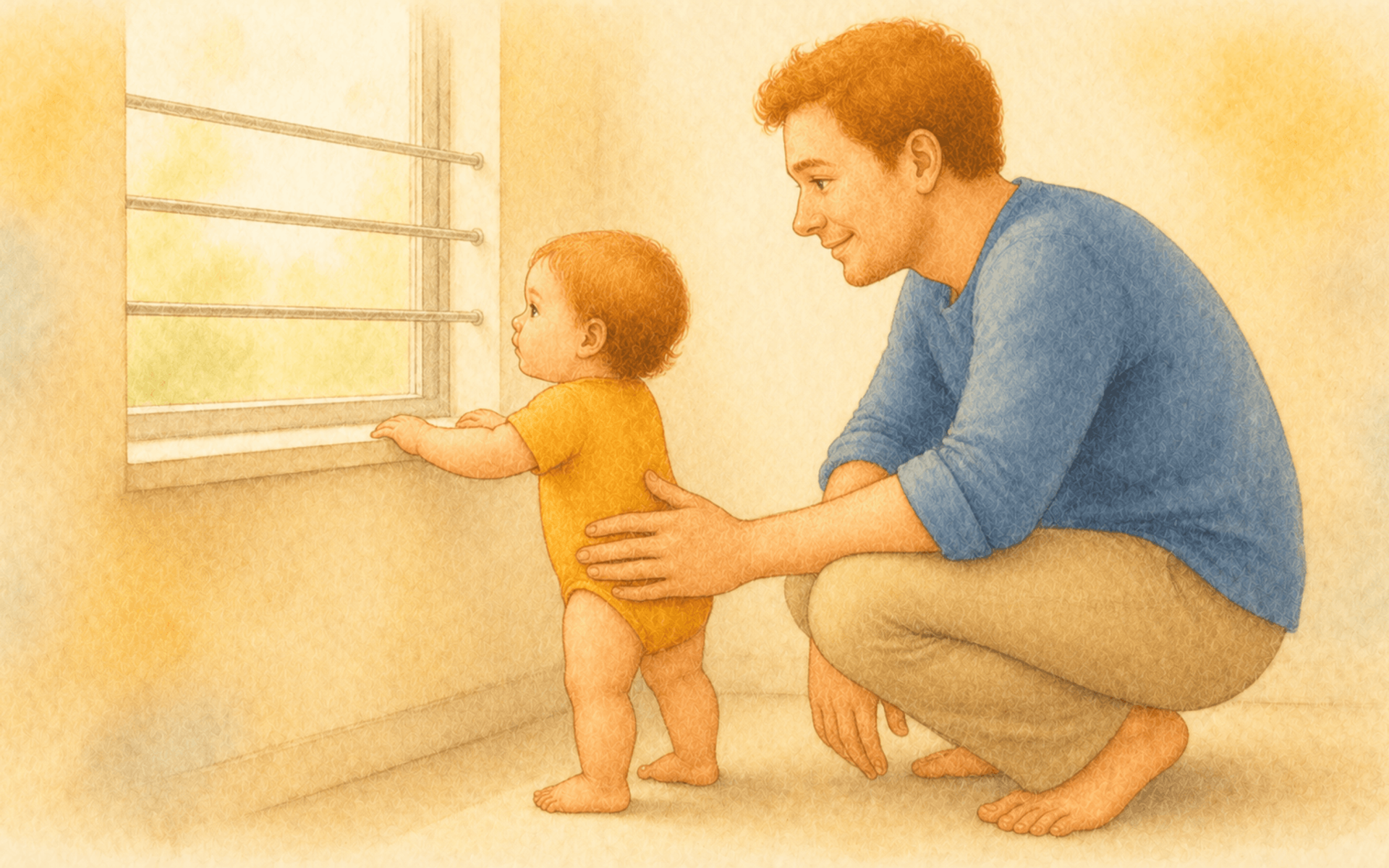
The standard baby proofing advice has you on your knees with a bag of plastic outlet plugs, working around the living room like you're defusing something. It feels productive, and it is almost backwards. The outlet is one of the rarest ways a baby actually gets hurt at home, and the plug you just pushed in becomes a choking hazard the moment your baby pries it back out. Meanwhile the dresser you didn't anchor, the half-full bucket you left in the bathroom, and the window with the perfectly good screen are the things that send babies to the emergency room. Effective baby proofing is less about buying gadgets and more about fixing the order you do things in.
- The single research finding that changes how you think about timing, and why "the baby can't do that yet" is the riskiest sentence in the house
- Why the room most parents start with is the one they should finish with
- The piece of furniture that's statistically more dangerous than the stairs
- Where babies really drown, and it isn't the pool
- The small, swallowable things that have their own emergency rooms now
- The window screen myth that sends children to the hospital every spring
If the one-sentence answer is enough, you’ve got the gist. If you want the mechanism behind each piece, keep reading.
Your baby's caution resets to zero every time the body changes
The most useful thing developmental science can tell you about baby proofing is that your baby's sense of danger does not carry over from one skill to the next. A baby who has learned to stop at the edge of the bed while crawling will go straight over that same edge a few weeks later as a brand-new walker, because the wariness was never general. It was tied to crawling, and walking is a different body entirely.
This comes from Karen Adolph's lab at New York University, which has spent decades putting babies on the edge of an adjustable drop-off to see what they do. In a 2013 study in Child Development, experienced twelve-month-old crawlers refused to crawl over a risky drop, but twelve-month-olds who had just started walking stepped right off the edge, over and over. The conclusion was blunt: infants do not develop a general fear of heights that protects them across situations. Each new posture starts the learning over from scratch.
It gets one layer stranger. In earlier work, Adolph found that babies learning to cruise (stepping sideways along the furniture) could accurately judge whether a gap in a handrail was safe to cross with their arms, while being, in the researchers' words, largely oblivious to the danger of a gap in the floor right under their feet. The same resetting happens at every transition, including the one from sitting to crawling, which is usually the milestone that turns a contained baby into a mobile one overnight. The body part doing the new learning is the body part that gets cautious. Nothing else updates automatically.
And the pace is relentless. Another Adolph study, this one tracking toddlers in their own homes, clocked new walkers at an average of 2,368 steps and 17 falls per hour. We covered that number in detail in our piece on when babies start walking, and the reassuring part is that almost none of those falls cause harm, because babies are low to the ground and slow. But the implication for baby proofing is the opposite of reassuring: the baby is a tireless, fearless explorer who re-learns danger one posture at a time. That is precisely why the room, not the baby's judgment, has to be the safety system. "The baby couldn't reach that last week" is true and irrelevant. The whole job is staying one milestone ahead.
Start with the furniture you can't picture falling
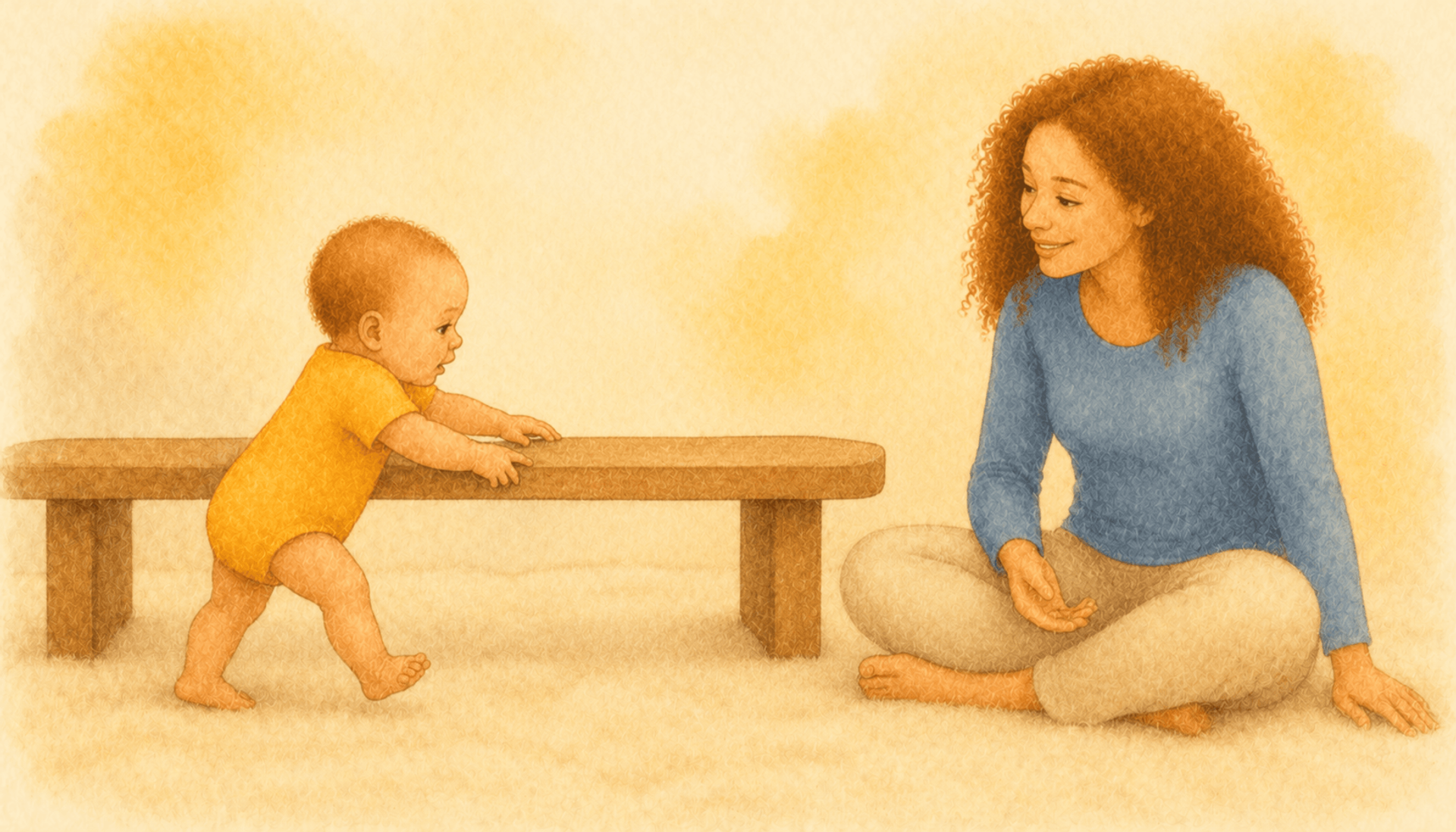
The first thing to secure in any room is the tall, heavy furniture, because tip-overs are one of the few household hazards that kill quickly and quietly, and they happen in rooms parents consider safe. A dresser, a bookcase, or a television on a stand can come down on a baby who is doing exactly what babies are built to do at this age: pulling up to stand on whatever is nearest.
The numbers are sobering without being mysterious. The U.S. Consumer Product Safety Commission has documented hundreds of tip-over deaths over the past two decades, the large majority of them young children, and the agency's reporting attributes 199 child deaths to clothing-storage-unit tip-overs alone between 2000 and 2022. That is the hazard behind the federal STURDY Act, signed in late 2022, which pushed a mandatory dresser-stability standard into effect in 2023. New furniture is being built to tip less. The dresser you already own was probably not.
The fix is anchoring straps or brackets that screw the furniture to a wall stud, used on anything a determined baby could climb or pull: dressers, bookcases, shelving, and especially the TV, which should be anchored or wall-mounted rather than perched on a console. This is the same advice we give for the pulling-up stage in our activities for a 6 month old guide, because the moment your baby starts using furniture as a ladder is the moment anchoring stops being optional. Anchoring is the highest-leverage ten minutes in the entire baby-proofing project, and it protects you across every posture your baby will invent over the next year.
The nursery is a safe-sleep problem before it is anything else
In the room where your baby sleeps, the dominant risk is not falls or furniture but suffocation, and it is worth saying plainly because it is the leading cause of injury death for babies under one year old in the United States. The American Academy of Pediatrics, in its updated 2022 safe-sleep guidance, ties the great majority of these deaths to the sleep environment: soft bedding, an adult bed, a couch, or anything that can wedge against or cover a baby's face.
The guidance is consistent and, by now, familiar to most parents: a firm, flat sleep surface, the baby on the back, and nothing else in the crib. No bumpers, no pillows, no loose blankets, no stuffed animals, however sweet they look in the nursery you spent months assembling. The bare crib feels stark precisely because the marketing around nurseries works against the evidence. Lives have been saved by stripping the crib down to almost nothing, and that trade is one nearly every pediatrician would make without hesitation.
For the mobile baby, the nursery has a second job. The crib mattress should drop a level the moment your baby learns to roll over, and again to its lowest setting once your little one can sit up and pull to stand, because the top rail of an un-lowered crib becomes a launch point the week your baby figures out standing. Anchor the dresser here too, keep the cord of any monitor or blind well out of reach, and move the crib away from windows, which brings us to a hazard parents routinely misjudge.
Where babies actually drown is the bathroom and the kitchen
Drowning is the kind of risk parents associate with summer and swimming pools, but for babies the water is indoors and the amount is shockingly small. A baby can drown in a few inches, in the time it takes to answer the door, and the mechanism is simple physics: an infant is top-heavy, tips head-first into a container, and cannot push back out.
The bucket is the classic, underappreciated example. The CPSC has tracked hundreds of bucket drownings since the 1980s, most involving five-gallon buckets and children most commonly between eight and twelve months. A five-gallon bucket holds enough weight at the base that a baby's struggle won't tip it, and it stands about half a toddler's height. The broader picture from the CDC's 2024 drowning data is that drowning is the number-one cause of death for children ages one to four, and for the youngest the bathtub is the highest-risk site. The practical rules are unglamorous and they work: never leave a baby in the bath for even a moment, empty buckets and basins the instant you're done, and keep the bathroom door closed with the toilet lid latched, because the toilet is a bucket too.
The kitchen adds a hazard the bathroom doesn't: heat at crawler height. The oven door is the one most parents never picture, and the data are specific. A review of pediatric oven-door burns published in JAMA Pediatrics found the median age of the burned child was twelve months, and twelve of fourteen cases involved one or both hands, with a median hospital stay of ten days. A baby cruising past the kitchen reaches up or falls against the hot outer glass, and the burn lands on the hands, which are the worst place for long-term function. A 2005 Pediatrics study of kitchen burns in children under five, drawn from national injury surveillance, found the same pattern across stovetops and cookware. The fix is to treat the kitchen as off-limits during cooking, use back burners with handles turned in, and consider an oven-door guard or lock if your oven runs hot on the outside. Supervision matters here, but it is not a safety device on its own, a theme that runs through every room in this house.
The small things that now have their own emergency departments
Once your baby's pincer grasp arrives, usually around nine months, the floor becomes a buffet of swallowable objects, and a few categories have become serious enough that hospitals track them on their own. We wrote about the pincer-grasp turning point in our activities for a 9 month old article; the baby-proofing consequence is that anything smaller than about an inch and a quarter (the width of a toilet-paper tube) is a choking risk and needs to be off the floor and out of reach.
Three swallowable hazards deserve specific attention because they do damage a plain choking checklist misses. Button batteries, the coin-sized ones in remotes, key fobs, and singing greeting cards, can burn through a child's esophagus within a couple of hours of being swallowed. A 2022 study in Pediatrics estimated more than 70,000 battery-related pediatric emergency visits over a decade, with the rate more than doubling compared with earlier years, which is the hazard behind Reese's Law and its child-resistant battery-compartment requirements. High-powered magnets are the second: the small, shiny neodymium kind sold as desk toys. When a baby swallows two, the magnets snap together through loops of intestine and cut off the blood supply. A 2022 multicenter study in Pediatrics led by Middelberg found that of nearly 600 children treated for high-powered magnet exposure, more than half needed hospitalization and roughly one in ten faced a life-threatening complication; the CPSC put a new safety standard in place in late 2022. Third are the household liquids that look like drinks: laundry detergent pods, which a 2014 Pediatrics study linked to more than 17,000 exposures in children under six across a single two-year window, and liquid nicotine, where a few drops can be dangerous to a toddler.
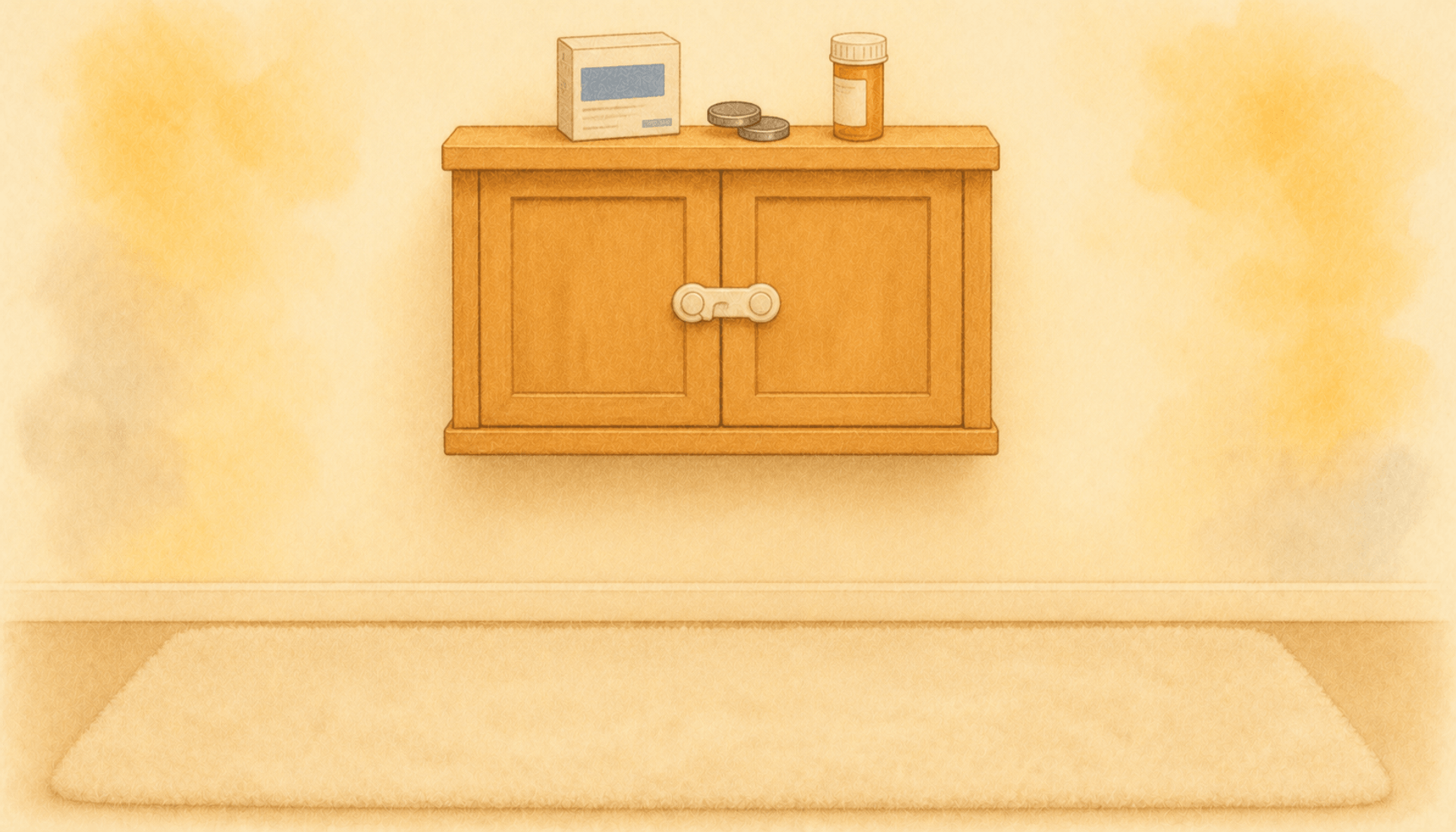
The rule that covers all three is the same one that covers medications and cleaning products: up high, latched, and in original child-resistant packaging, not "pushed to the back of the counter." This is where cabinet locks earn their place, on the cabinets that hold anything ingestible, rather than scattered across every door in the kitchen.
Hands, fingers, and the doors that close on them

The least dramatic injuries in the house are also among the most common, and they happen to fingers. A 2010–2019 analysis of national injury data found roughly 234,000 emergency-department visits for finger amputations, with the highest rates in children aged zero to four, and doors ranking as the second most-involved product after power tools. Most of these happen at home, and most happen on the hinge side of the door, the gap parents never think about, where a slowly closing door still has enough force to take a fingertip.
This is the part where door stoppers and soft-close mechanisms give a false sense of completion. A doorstop wedged at the base keeps a door from slamming, but it does nothing for the hinge-side gap, and a soft-close hinge slows the swing without removing the pinch. Documented cases include toddlers losing a fingertip on the hinge side even with a slowing mechanism in place. The genuinely protective fixes are foam or U-shaped guards that block the door from closing fully, and hinge-side covers for the gap. The same logic applies to drawers and cabinet doors, which is why soft-close drawers and simple finger-pinch guards belong on the same weekend list as the cabinet locks.
Stairs, windows, and the screen that was never a safety device
Stairs and windows close out the room-by-room sweep, and both are places where parents trust a barrier that wasn't built for the job. For stairs, the fix is well established: gates at the top and bottom, installed before you think your baby is ready, because climbing arrives suddenly. Worth naming here is the wheeled walker, which the AAP has recommended against since 2001. A 2018 Pediatrics study found walker injuries still sent thousands of children to emergency departments, the large majority head and neck injuries and most from falls down stairs. We unpack the developmental case against wheeled walkers in our walking article; for baby proofing, the short version is that a walker hands a not-yet-mobile baby the speed to reach the stairs before any caution exists. Stationary activity centers without wheels are a different product, and the safest setup of all is simply clear floor space with something worth reaching for in the middle of it, the kind of low-prep play our Sensory Play Cards were built around. Floor time keeps a baby low, slow, and out of the devices that create the falls in the first place.
Windows are where one specific myth does real damage every warm season. A window screen is built to keep insects out, not to hold a child in. It pops out under a child's weight, and public-health agencies from the CPSC to NYC's health department are unambiguous that screens are not a fall-prevention device. The solution that does work has a remarkable track record: New York City's window-guard requirement, born from the 1970s "Children Can't Fly" campaign, cut window falls by more than half within a few years, and the city now reports a small handful of falls a year where there used to be dozens. Window guards or window stops that limit the opening to about four inches are inexpensive and decisive. Keep furniture away from windows too, since a low dresser or bed under a window is simply a staircase to the sill.
Why outlets come last
The outlet is the most baby-proofed object in the American home and one of the least dangerous. Serious shocks and burns from outlets do happen, but they are rare compared with tip-overs, drowning, ingestion, and falls, and the standard fix makes things slightly worse: removable plastic plug caps are easy for a toddler to pull out, at which point the cap itself becomes a small, swallowable choking hazard. The better solution, where you can do it, is tamper-resistant receptacles with built-in spring shutters, which have been required in new construction since 2008 and need no add-on at all.
None of this means you should skip outlets. It is just the clearest illustration of why order matters. A 2012 Cochrane review of home-safety equipment, the most rigorous look at whether these devices actually reduce injuries, found that safety gear reliably changes parents' behavior while the evidence that it lowers injury rates stays mixed. The honest reading is that gadgets are not magic, so your effort belongs where the harm actually is: anchoring, water, safe sleep, locking up what can be swallowed, and guarding stairs and windows. Cover the outlets after all of that, with the receptacles rather than the caps, and you've spent your weekend on the hazards that matter most.
Frequently Asked Questions
Safety work starts before birth and never fully ends; what changes is the level. Before the baby arrives, it means a bare, firm crib with nothing loose in it. In the early months, it means never leaving a baby unattended on a high surface once rolling begins. Then crawling, the pincer grasp, and walking each open a new category of hazard, from swallowable objects to stairs. Because babies hit milestones on their own schedule and trouble tends to arrive the week you weren't expecting it, set up for each stage about a month before the typical age for it rather than after. Anchoring furniture is the one thing worth doing from the very start.
Anchor tall, heavy furniture and televisions to the wall. Furniture and TV tip-overs are among the few home hazards that injure or kill quickly, and the U.S. Consumer Product Safety Commission attributes 199 child deaths to clothing-storage-unit tip-overs between 2000 and 2022. A baby who pulls up to stand will use a dresser or bookcase as a ladder, so wall straps or brackets into a stud are the single highest-impact fix, ahead of outlets, gates, or cabinet locks.
No. A window screen is designed to keep insects out, not to hold a child in, and it gives way under a child's weight. Public-health agencies including the CPSC are clear that screens are not fall-prevention devices. Install window guards or window stops that limit the opening to about four inches, and keep beds and dressers away from windows so a child can't climb to the sill. New York City's window-guard program cut childhood window falls by more than half after it began.
They help less than parents assume, and they carry their own risk. Removable plastic caps can be pulled out by many toddlers within seconds, and once out, the cap is a choking hazard sized to fit a small mouth. A better option is tamper-resistant receptacles with built-in shutters, standard in new construction since 2008. Outlets are also a lower-priority hazard overall than tip-overs, water, ingestion, and falls, so they belong near the end of a baby-proofing sweep, not the start.
Treat the kitchen as off-limits during cooking and watch for heat at crawler height. The oven door is a common and overlooked burn source: a JAMA Pediatrics review found the median age of children burned by oven doors was twelve months, with most burns on the hands. Use back burners with handles turned inward, consider an oven-door guard if your oven's outer surface gets hot, lock cabinets that hold detergent pods or cleaners, and never leave water standing in a sink or bucket.
This article is for educational and entertainment purposes only. It is not a substitute for professional medical advice. Always consult your pediatrician with questions about your baby's safety and development.
- Adolph, K. E. (2000). Specificity of learning: Why infants fall over a veritable cliff. Psychological Science, 11(4), 290–295.
- Adolph, K. E., Berger, S. E., & Leo, A. J. (2011). Developmental continuity? Crawling, cruising, and walking. Developmental Science, 14(2), 306–318.
- Adolph, K. E., Cole, W. G., Komati, M., Garciaguirre, J. S., Badaly, D., Lingeman, J. M., Chan, G. L. Y., & Sotsky, R. B. (2012). How do you learn to walk? Thousands of steps and dozens of falls per day. Psychological Science, 23(11), 1387–1394.
- Adolph, K. E., Kretch, K. S., & LoBue, V. (2014). Fear of heights in infants? Current Directions in Psychological Science, 23(1), 60–66.
- Chandler, M. D., Ilyas, K., Jatana, K. R., Smith, G. A., McKenzie, L. B., & MacKay, J. M. (2022). Pediatric battery-related emergency department visits in the United States: 2010–2019. Pediatrics, 150(3), e2022056709.
- Drago, D. A. (2005). Kitchen scalds and thermal burns in children five years and younger. Pediatrics, 115(1), 10–16.
- Greenhalgh, D. G., et al. (2001). Household oven doors: A burn hazard in children. Archives of Pediatrics & Adolescent Medicine (JAMA Pediatrics), 155(1), 84–86.
- Kendrick, D., Young, B., Mason-Jones, A. J., Ilyas, N., Achana, F. A., Cooper, N. J., Hubbard, S. J., Sutton, A. J., Smith, S., Wynn, P., Mulvaney, C., Watson, M. C., & Coupland, C. (2012). Home safety education and provision of safety equipment for injury prevention. Cochrane Database of Systematic Reviews, (9), CD005014.
- Kretch, K. S., & Adolph, K. E. (2013). Cliff or step? Posture-specific learning at the edge of a drop-off. Child Development, 84(1), 226–240.
- Middelberg, L. K., Funk, A. R., Hays, H. L., McKenzie, L. B., Rivera, E. A., & Spiller, H. A. (2022). High-powered magnet exposures in children: A multi-center cohort study. Pediatrics, 149(3), e2021053616.
- Moon, R. Y., Carlin, R. F., & Hand, I.; AAP Task Force on Sudden Infant Death Syndrome. (2022). Sleep-related infant deaths: Updated 2022 recommendations for reducing infant deaths in the sleep environment. Pediatrics, 150(1), e2022057990.
- Reddy, S. S., et al. (2024). Traumatic finger amputations: Epidemiology and mechanism of injury, 2010–2019. Journal of Hand Surgery Global Online / Hand. (NEISS analysis of finger-amputation emergency visits.)
- Sims, A., Chounthirath, T., Yang, J., Hodges, N. L., & Smith, G. A. (2018). Infant walker–related injuries in the United States. Pediatrics, 142(4), e20174332.
- U.S. Consumer Product Safety Commission. (2023). Final consumer product safety standard for clothing storage units (STURDY Act / ASTM F2057-23).
- U.S. Consumer Product Safety Commission. (1994 and updates). Warnings on five-gallon bucket drowning hazards for young children.
- Centers for Disease Control and Prevention. (2024). Drowning prevention: Data and statistics.
- Valdez, A. L., Casavant, M. J., Spiller, H. A., Chounthirath, T., Xiang, H., & Smith, G. A. (2014). Pediatric exposure to laundry detergent pods. Pediatrics, 134(6), 1127–1135.
Related Products

More Articles
Parallel Play in Toddlers: Why Side-by-Side Is the Social Work
Your toddler spent the entire playdate building separate towers, and nobody shared a single block. That counted — more than it looked. A 2025 longitudinal study found that playing beside a specific child consistently predicted later social play with that same child, but not the other way around. Here's what parallel play in toddlers actually is, why the science calls it strategic rather than passive, and what it means for how you run a playdate.
When Do Babies Point: Why It Matters for Language
Most milestone articles treat pointing as a box to check around 12 months. The research tells a different story — one that starts months earlier, runs through the infant brain, and traces back to how much the parent is pointing. Here's what the last fifteen years of research actually found, and what it means for everyday interactions.
When Do Babies Wave Bye-Bye: Why Your Baby Needs You to Wave First
Most baby milestones unfold on a biological schedule — waving isn't one of them. A 2023 study found that babies develop imitation ability because their caregivers imitate them first, and waving is named directly as a cultural gesture learned through that loop. Here's what the research says about the 9–12 month window, why the first wave looks nothing like a wave, and what helps it arrive.