Summer Activities for Preschoolers: What Changes at 3, 4, and 5
A concrete playground and a nature-based one are both outside. In both places, preschoolers run and shout and argue about whose turn it is. When researchers attached voice recorders to the same children in each setting and compared what came out of their mouths, the results weren't what most adults would predict. The children didn't just talk more on the grass-and-sticks side — they negotiated more, reached for more specific words, and produced utterances that were semantically more layered than anything the smooth, predictable paved surface had asked of them. Summer activities for preschoolers fill a dozen different category lists. What the research keeps pointing to is a variable that most of those lists forget to mention: the environment itself.
- Why moving the same preschooler from pavement to grass changes the sentences coming out of their mouth — and what that tells parents about summer setup
- What specifically shifts in outdoor play between ages 3, 4, and 5, and why those shifts matter for which activities are worth setting up
- The summer activities that match each age's developmental window: scavenger hunts, cooperative relays, mud kitchens, big-body play, and what the research says about each
- What rough-and-tumble and risky physical play look like at this age and why summer specifically enables them in ways supervised indoor environments mostly don't
- How much outdoor time is linked to measurably better school readiness, and the practical framework for building it into a summer day
If the one-sentence answer is enough, you’ve got the gist. If you want the mechanism behind each piece, keep reading.
What shifts when a toddler becomes a preschooler outdoors
The clearest difference between a 2-year-old and a 4-year-old at the sandbox isn't motor skill — it's social architecture. At 24 months, the standard move is to play next to another child while guarding the blue bucket with territorial precision, which developmental researchers call parallel play and which most 2-year-olds do exceptionally well. By 3-and-a-half, something else is possible: a shared plan. The stick becomes a fishing rod by mutual agreement, the puddle becomes the ocean, and the other child gets assigned a role rather than tolerated as a nearby presence. This shift from parallel to cooperative play is the developmental story of the 3-to-5-year window, and outdoor summer environments (with their open space, loose materials, and social ambiguity) are particularly well-matched to it.
Research observing preschoolers across outdoor and indoor free play settings has found consistently that children tend to cooperate more and conflict less when they're outside. The mechanism isn't fully settled, but the leading explanation is ecological: outdoor spaces present problems that require joint effort: you need someone on the other side of the stick, someone to hold the container while you fill it, while indoor spaces more often offer solutions designed for individual use. A 2017 review of outdoor play research published in a biomedical journal noted this pattern across multiple studies and countries, framing it as one of the clearest developmental arguments for prioritizing outdoor time in the preschool years.
This matters for how parents set up summer. The parent who turns a backyard into a structured activity station for one child is getting a different developmental return than the one who creates conditions for two or three children to figure something out together. The sections below organize summer preschool activities by age because what a 3-year-old can do cooperatively is not what a 5-year-old can do cooperatively, and the gap is worth knowing. For the toddler years that precede this window, the summer activities for toddlers guide covers the sensory-first approach that works best at 1 to 3.
The surface changes the sentence: why nature-based outdoor time is different
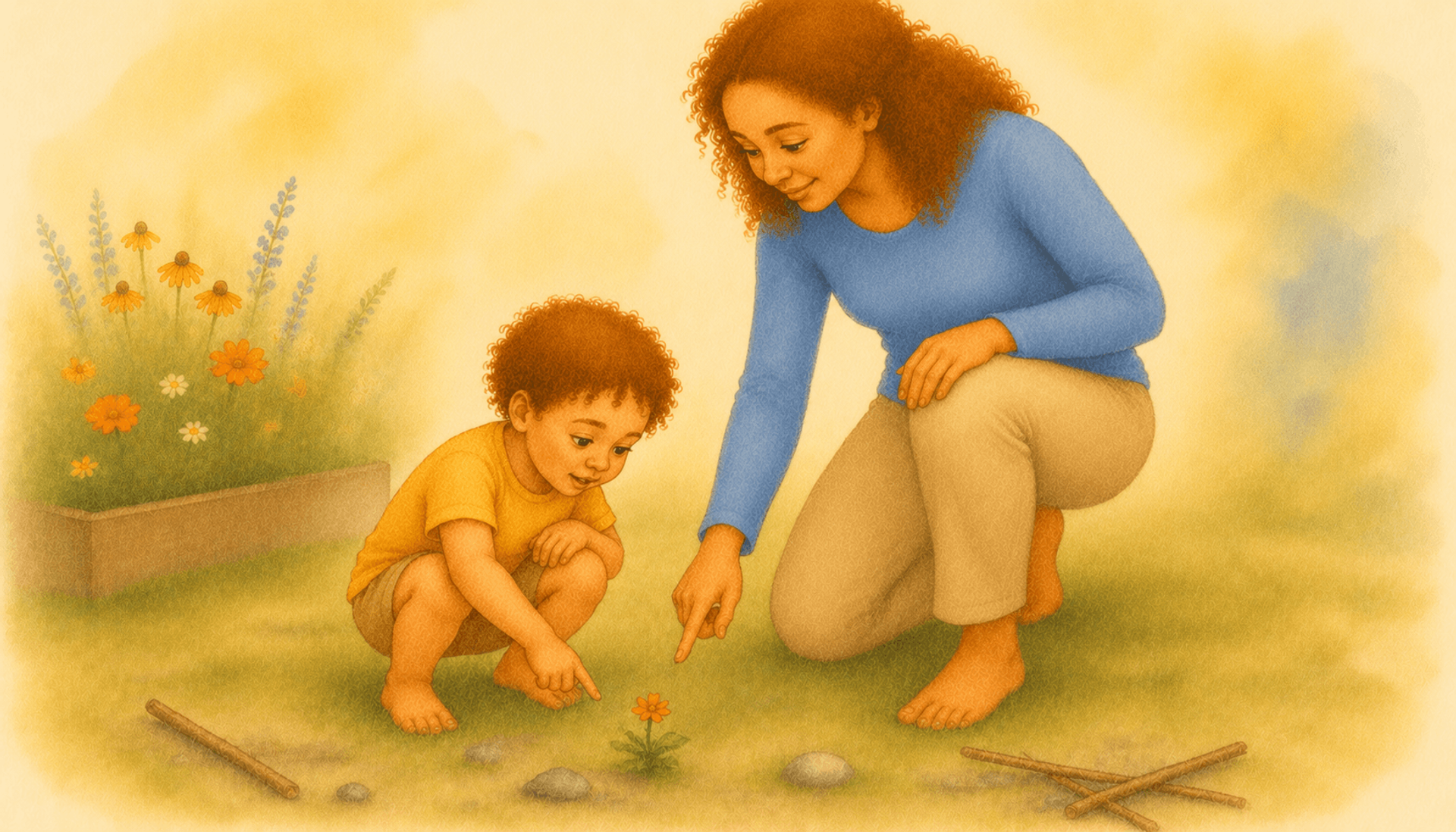
The most counterintuitive finding about summer activities for preschoolers has nothing to do with what children are doing — it has to do with where they're doing it. A 2023 study published in the International Journal of Early Years Education compared the same group of children in two conditions: a standard paved school playground, and a nature-based outdoor space with grass, sticks, loose materials, and vegetation. Researchers attached portable voice recorders and transcribed what the children said in each setting. Moving from the concrete surface to the natural one didn't just increase the quantity of speech. It changed the register. In the nature-based environment, the children negotiated more, their sentences became semantically more layered, and they produced language that required them to describe, compare, explain, and reason about things the flat, predictable concrete had never offered.
A 2018 study from Cardiff University reinforced this from a different angle, using head-mounted cameras on parent-child pairs with children aged 3 to 4. The same families were observed in an outdoor natural environment and in a nature-themed indoor centre. Outside, communication between parents and children was measurably more responsive and connected: children were more talkative, conversations lasted longer, and both adults and children produced a higher proportion of genuine responses to what the other person actually said. The parents weren't doing anything differently. The environment was.
Both studies are small, and both research teams describe their results as exploratory signals rather than settled conclusions. But a 2024 doctoral study from Vrije Universiteit Amsterdam, examining children aged 2 to 4, replicated and extended the finding: children in nature-based settings produced significantly more words, and crucially, significantly more different words (a measure of vocabulary range that is directly relevant for early literacy). For a child a year out from kindergarten, vocabulary range predicts reading outcomes more reliably than letter-name knowledge does.
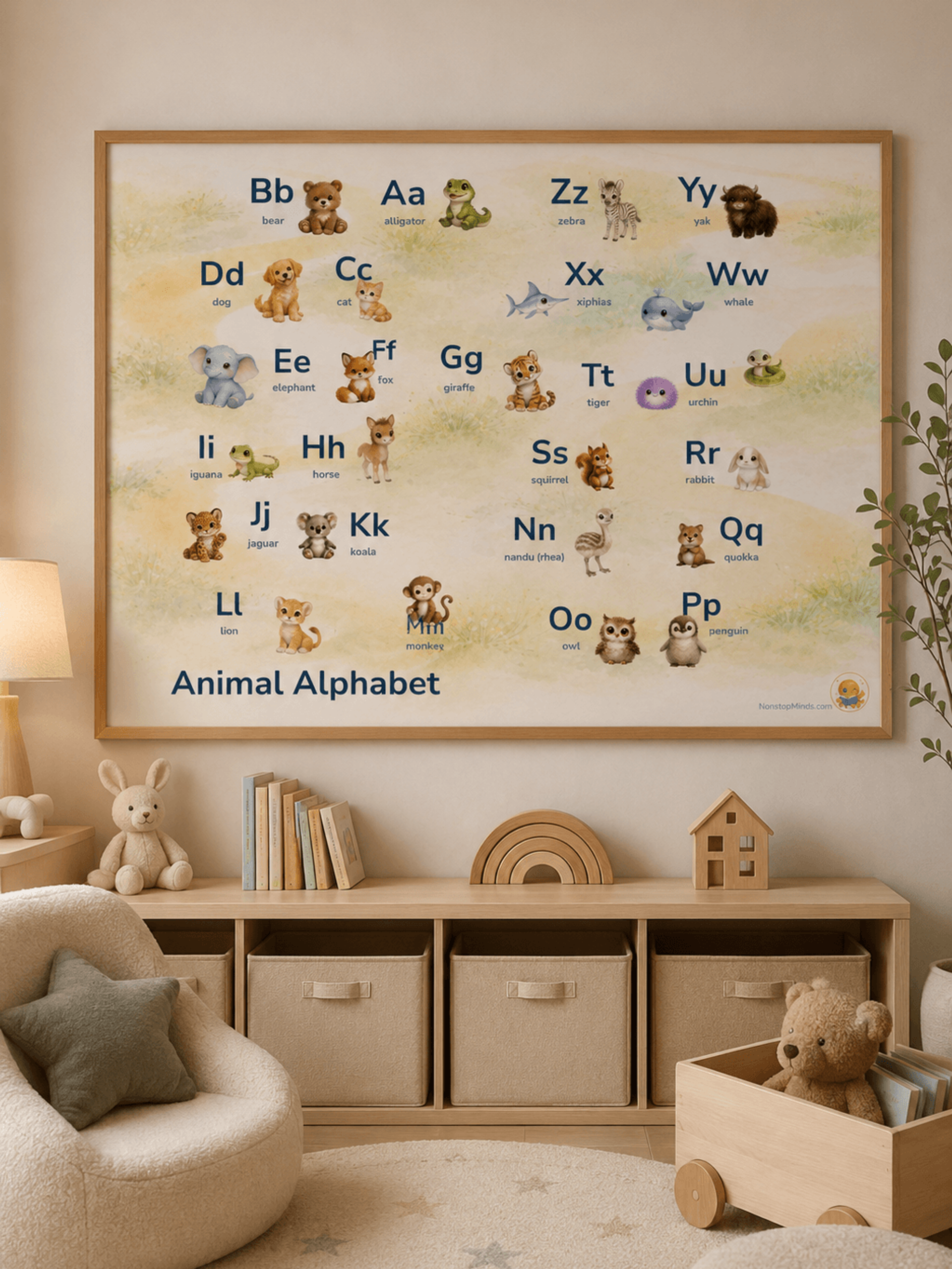
Practically, "nature-based" in these studies means biological variability: grass rather than rubber, a flower bed or vegetable patch, loose materials with unclear function (sticks, stones, seed pods, anything that isn't pre-shaped by an adult). A backyard with soil and at least one growing thing qualifies. A paved area with a plastic slide doesn't, even if it's technically outside. The My Zoo Alphabet Poster works well in the hours after these outdoor sessions. When a child who has been turning sticks into animals and narrating elaborate nature scenarios comes back inside, the vocabulary for the creatures they've been playing with is already partly activated.
Summer activities for 3-year-olds: the first cooperative outdoor window
The individual outdoor formats that work well at this age — scavenger hunts, obstacle courses, water pouring and measurement play, mud kitchens with a pretend play frame — are covered in the summer activities for toddlers guide, which follows the arc from 12 months through the early threes. What changes around 3 to 3.5 years is the social dimension: cooperative play begins to emerge, and summer outdoor settings are unusually good at drawing it out.
The shift is fragile at first. A 3-year-old can hold a shared plan for a few minutes before competing interests pull the narrative apart, and the adults who understand this tend to set up outdoor activities with a visible shared goal rather than an open-ended prompt. A two-child scavenger hunt where each child is looking for different things — one finds something smooth, the other finds something rough; they compare at a finish line — gives the cooperation a purpose without requiring sustained turn-taking, which is still genuinely hard at this age. A partner obstacle course where one child calls out instructions and the other follows them introduces the experience of listening to a peer rather than an adult, a socially distinct skill that most indoor activities don't create the conditions for.
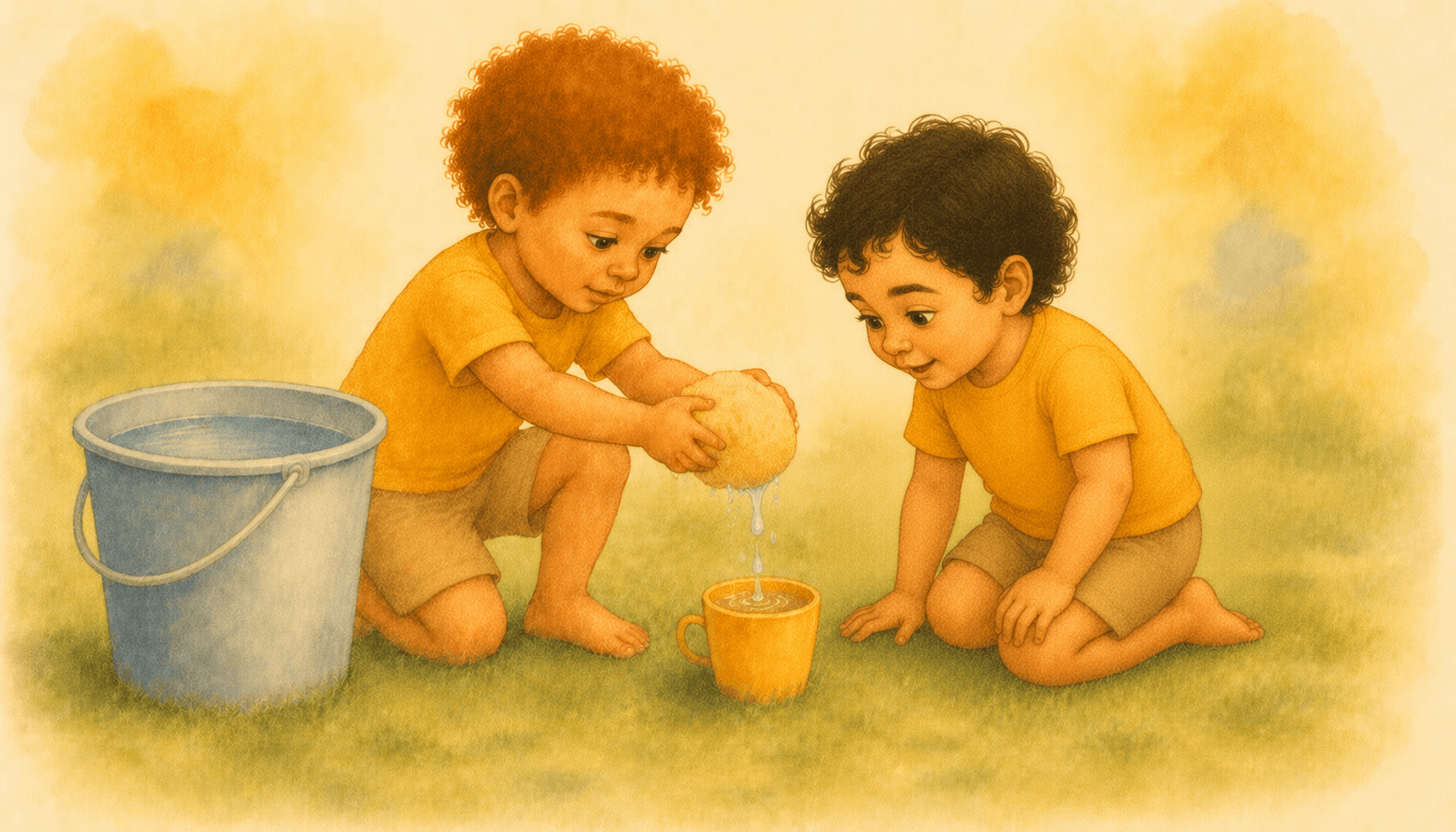
Water relay formats work similarly. Two buckets, a sponge, a short distance: the structure makes the joint goal obvious enough that 3-year-olds don't need to negotiate it from scratch. The research on cooperative play development consistently points to the same design principle at this age: shared physical goals with a visible outcome reduce the social processing load so that the cooperation itself can happen.
A 2021 observational study published in the Early Childhood Education Journal that coded nearly 1,900 video sequences of children's free play found that risky physical play (climbing, chasing, social-contact play) occurred in about 10% of total free-play time and was significantly more frequent outdoors than in. For 3-year-olds specifically, this category of play is how social calibration begins: reading another child's signals, adjusting force, understanding the difference between play and distress. The backyard creates conditions for this that the living room mostly can't. The activities for a 3-year-old guide covers the full developmental picture at this age across all contexts.
Summer activities for 4-year-olds: cooperative games and big-body play
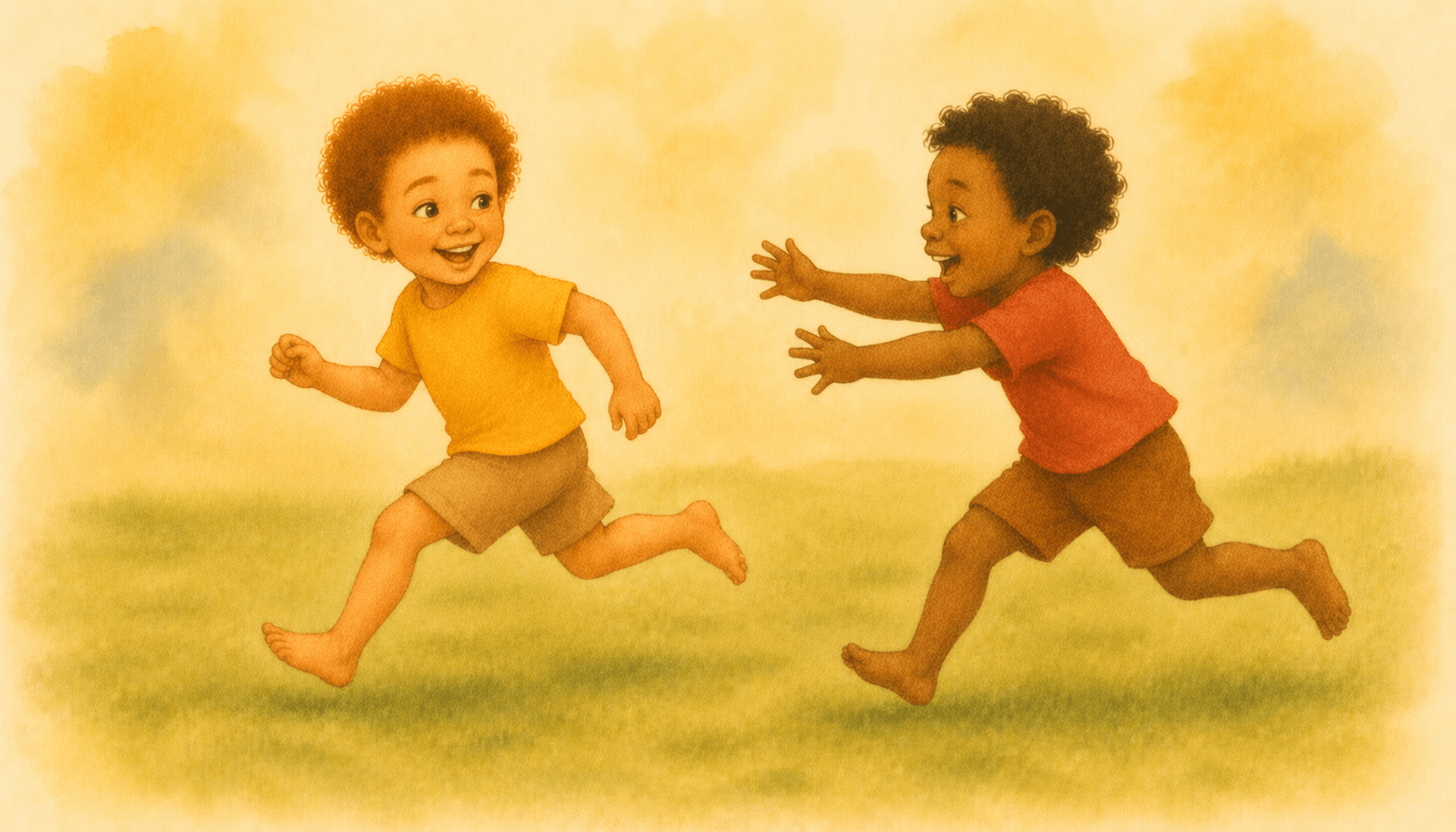
At 4, something that wasn't reliably available at 3 becomes accessible: a shared rule. Not just shared pretend, meaning a negotiated game with a structure that both children hold simultaneously. That's the cognitive leap that makes Red Light Green Light work, that turns a water relay from chaotic to organized, and that makes rough-and-tumble play at this age categorically different from the same activity at 2. A 4-year-old rolling in the grass with another child isn't simply playing: they're reading social cues, calibrating force, monitoring the other person's face for signals of genuine distress vs. playful distress, and practicing the distinction between the two in real time.
The developmental research on rough-and-tumble play in preschoolers (the rolling, chasing, play-wrestling, and physical contact that adults often instinctively stop) has been building for decades, beginning with foundational work by Pellegrini in the late 1980s. The consistent finding is that children who engage in more of this physical contact play show better social competence and emotion regulation with peers. A longitudinal study by Lindsey and Colwell that tracked 122 preschoolers over two years found that rough-and-tumble play specifically predicted both emotional expressiveness and emotion regulation one year later, while exercise play predicted emotion regulation on its own. Summer enables this in ways that supervised indoor environments mostly don't: there's grass to fall on, room to run, and no furniture in the way.
For the cooperative game formats, a 2022 intervention study enrolled 4-to-5-year-olds in eight weeks of outdoor group-play activities (relay formats, partner chase games, activities requiring coordination) and found significant improvements in both executive function and motor skills compared to children in standard activities. The combination of physical output with social demands (staying in a group, responding to a partner, following a shared rule) appears to be what produces the developmental gain, more than either component alone.
Good cooperative outdoor setups at 4 don't require elaborate materials. A water relay using two buckets and a sponge, a team obstacle course where one child calls directions and the other follows them, a collect-and-sort nature challenge where two children are looking for different items and then combine their finds: these are formats that create the joint-effort structure the research points to. The activities for a 4-year-old guide covers the full developmental picture at this age.
Summer activities for 5-year-olds: vocabulary, spatial reasoning, and the pre-kindergarten window
Five-year-olds preparing for kindergarten are typically assumed to need academic preparation: letter recognition, number drills, maybe some worksheets. The research on what kindergarten actually tests tells a different story. The capacities that most reliably predict success in the first year of school are executive function, self-regulation, and vocabulary, specifically the range and variety of words a child can use to describe and reason about what they observe. Outdoor summer play in a setting with biological variability addresses all three in the same afternoon, through a mechanism that worksheets mostly can't replicate.
A 2023 nationally representative randomized trial published in the Journal for Research in Mathematics Education found that preschoolers who practiced spatial reasoning showed stronger math outcomes than those who didn't. The activities that build spatial reasoning look almost identical to what a 5-year-old does in an outdoor summer setting: building structures, estimating and measuring, fitting water into differently shaped containers, navigating terrain, understanding how things compare in size and weight. These aren't warm-ups for mathematical thinking. They are mathematical thinking, in the form that the preschool brain is best equipped to process.
The vocabulary component compounds this. A 2024 doctoral study from Vrije Universiteit Amsterdam found that children aged 2 to 4 in nature-based settings produced significantly more distinct words than the same children did in paved-surface environments. For a rising kindergartner, vocabulary range is a stronger predictor of early reading than knowing letter names, and the outdoor environment builds that range through exposure to things that don't exist inside: the names of insects, the vocabulary of growth and weather and physical change, the descriptions of texture and scale that require a richer lexicon than "big" and "nice."
Two specific habits are worth building into a 5-year-old's summer routine. The first is asking the child to retell the outdoor experience afterward, not describe it in the moment but narrate it as a story: "What happened first? Then what? What did you figure out?" This retrieval-and-sequencing practice builds the story structure that early reading requires. The second is bridging the outdoor vocabulary to indoor materials: the Farm Animals Match, Spell & Play connects the visual and auditory vocabulary of animals the child has been observing outdoors to the letter patterns and word-building that precede reading. The outdoor observation comes first; the printed word connects to something real. For the full kindergarten readiness picture, the activities for a 5-year-old guide covers the research in detail.
How much outdoor time, and how to build it into a summer day
A 2024 study that tracked school readiness outcomes in more than 10,000 preschoolers found a consistent pattern: children who spent more than three hours outdoors per day showed better outcomes across every domain measured: early literacy, self-regulation, social-emotional development, and overall flourishing. On weekdays during the school year, fewer than one in three preschoolers reaches that amount. Summer is when the ratio can realistically change.
Three hours doesn't need to be continuous. In most US climates during summer, a split structure works better: an outdoor session in the morning before the heat peaks, indoor rest at midday, and a shorter outdoor session in the late afternoon or evening. The Big Kid Routine Cards for preschoolers support this structure visually without scripting every moment; the cards hold the shape of the day while leaving the content of outdoor time genuinely open. A preschooler who knows "outside" comes after breakfast and again before dinner can self-direct within that frame in ways that a child with a less predictable day often can't.
The specific heat-safety thresholds — the heat index at which outdoor play should stop, hydration timing, and sunscreen protocol are all covered in the summer activities for toddlers guide and apply equally to preschoolers. The guidelines don't change at 3; only the activity does.
Frequently Asked Questions
The activities with the strongest research support for pre-kindergarten readiness are nature-based outdoor play that builds vocabulary range, loosely cooperative outdoor games with shared rules (water relays, partner scavenger hunts, obstacle courses with two children), and open-ended time in settings with biological variability. A 2024 study of over 10,000 preschoolers found that more than three hours of outdoor play per day was associated with better outcomes across early literacy, self-regulation, and social-emotional development, the three domains kindergarten most directly tests. Asking the child to retell outdoor experiences afterward, rather than just narrate them in the moment, builds the story-sequencing skill that early reading requires.
Picture-card scavenger hunts, three-station obstacle courses, water pouring and measurement challenges, mud kitchens with a pretend play narrative frame, cooperative relay games using household containers, and unstructured time with loose natural materials (sticks, stones, soil, anything with biological variability). The space doesn't need to be large; it needs to have surfaces that aren't already solved: a patch of soil, a planter with growing things, an uneven edge of lawn.
Yes, and specifically the outdoor format adds something indoor physical activity mostly doesn't. The observational research on young children's free play found that risky physical activity (climbing, chasing, rough-and-tumble contact, play at height) occurs far more often outdoors than in, accounting for roughly 10% of total outdoor free-play time in one study of nearly 1,900 coded video sequences. This kind of play directly builds force calibration, balance, and the proprioceptive body awareness that indoor movement on flat surfaces rarely demands.
In the research on outdoor language and vocabulary development, the defining features are biological variability (at least one living surface: grass, soil, plants, a tree), loose natural materials (sticks, stones, seed pods, anything without a designed function), and some degree of unpredictability (wind, sun angle, a plant that has grown since last week). A small raised garden bed, a patch of unmowed grass along a fence, or three container pots with herbs qualifies. A smooth paved patio with molded plastic toys does not — even if it's outside — because the pre-solved quality of the environment doesn't generate the same negotiation demand.
For educational and informational purposes only. Not a substitute for professional medical or developmental advice. If you have concerns about your child's development, consult your pediatrician or a qualified developmental specialist.
- Bai, J., Huang, H., & Ouyang, H. (2022). Effects of group-play moderate to vigorous intensity physical activity intervention on executive function and motor skills in 4- to 5-year-old preschoolers: A pilot cluster randomized controlled trial. Frontiers in Psychology, 13, 847785.
- Bento, G., & Dias, G. (2017). The importance of outdoor play for young children's healthy development. Porto Biomedical Journal, 2(5), 157–160.
- Cameron-Faulkner, T., Melville, J., & Gattis, M. (2018). Responding to nature: Natural environments improve parent-child communication. Journal of Environmental Psychology, 59, 9–15.
- Lindsey, E. W., & Colwell, M. J. (2013). Pretend and physical play: Links to preschoolers' affective social competence. Merrill-Palmer Quarterly, 59(3), 330–360.
- Pellegrini, A. D. (1988). Elementary school children's rough-and-tumble play and social competence. Developmental Psychology, 24(6), 802–806.
- Pellegrini, A. D., & Smith, P. K. (1998). Physical activity play: The nature and function of a neglected aspect of play. Child Development, 69(3), 577–598.
- Prins, J., van der Veen, C., & Meeter, M. (2024). Nature play in early childhood leads to great and varied language production
- Prins, J., van der Wilt, F., van Santen, S., van der Veen, C., & Hovinga, D. (2023). The importance of play in natural environments for children's language development: An explorative study in early childhood education. International Journal of Early Years Education, 31(2), 450–466.
- Resnick, I., & Lowrie, T. (2023). Spatial reasoning supports preschool numeracy: Findings from a large-scale nationally representative randomized control trial. Journal for Research in Mathematics Education, 54(5), 295–316.
- Sandseter, E. B. H., Kleppe, R., & Sando, O. J. (2021). The prevalence of risky play in young children's indoor and outdoor free play. Early Childhood Education Journal, 49, 303–312.
- World Health Organization. (2019). Guidelines on physical activity, sedentary behaviour and sleep for children under 5 years of age. WHO Press.
- Zhu, W., Luo, X., Werneck, A. O., Pindus, D., Kramer, L., Kramer, A. F., Hillman, C. H., Herold, F., Zhang, Z., & Zou, L. (2024). Nature and success: Outdoor play is linked to school readiness. Complementary Therapies in Clinical Practice, 57, 101895.

More Articles
Parallel Play in Toddlers: Why Side-by-Side Is the Social Work
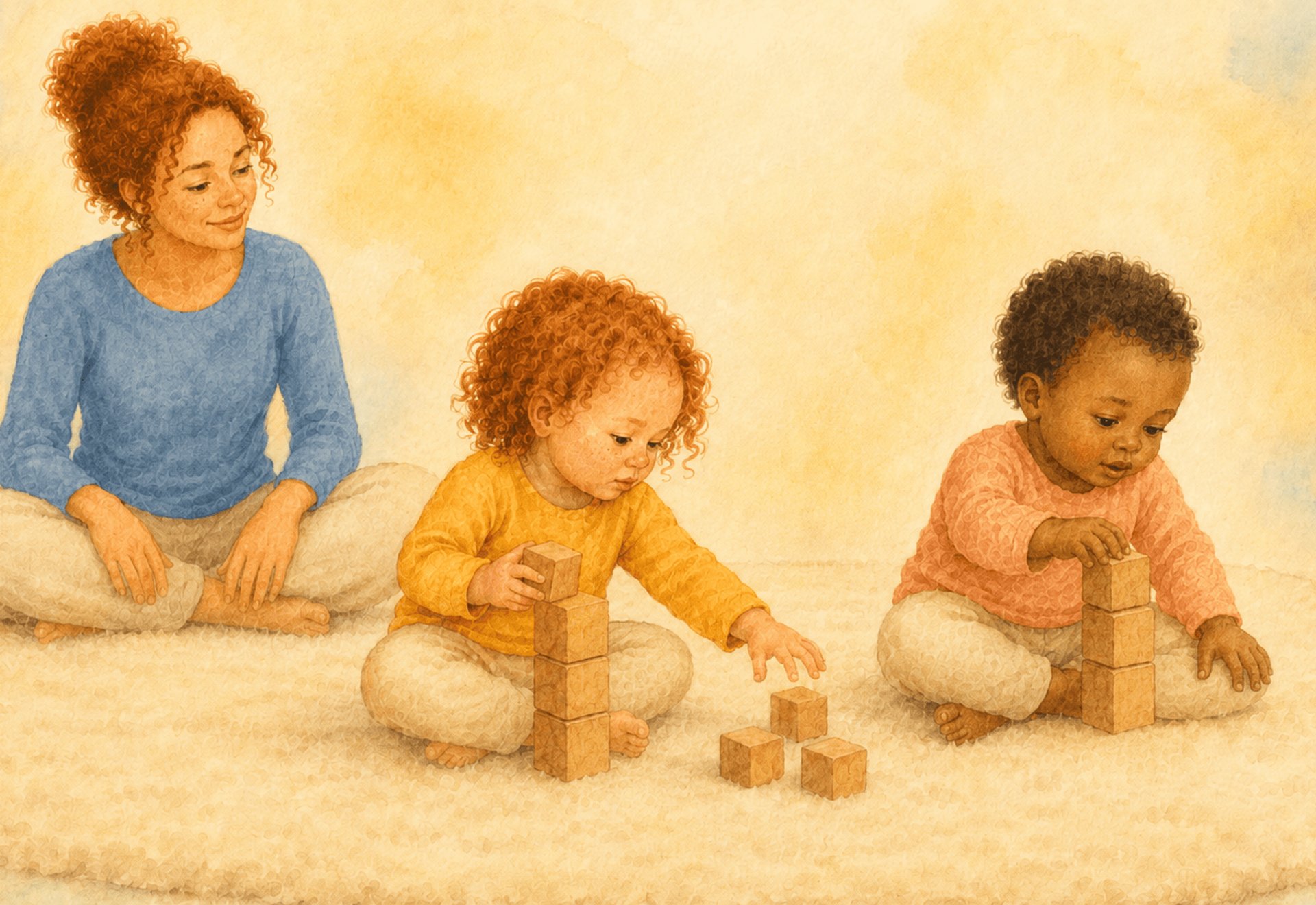
Your toddler spent the entire playdate building separate towers, and nobody shared a single block. That counted — more than it looked. A 2025 longitudinal study found that playing beside a specific child consistently predicted later social play with that same child, but not the other way around. Here's what parallel play in toddlers actually is, why the science calls it strategic rather than passive, and what it means for how you run a playdate.

When Do Babies Point: Why It Matters for Language
Most milestone articles treat pointing as a box to check around 12 months. The research tells a different story — one that starts months earlier, runs through the infant brain, and traces back to how much the parent is pointing. Here's what the last fifteen years of research actually found, and what it means for everyday interactions.

When Do Babies Wave Bye-Bye: Why Your Baby Needs You to Wave First
Most baby milestones unfold on a biological schedule — waving isn't one of them. A 2023 study found that babies develop imitation ability because their caregivers imitate them first, and waving is named directly as a cultural gesture learned through that loop. Here's what the research says about the 9–12 month window, why the first wave looks nothing like a wave, and what helps it arrive.