Summer Activities for Toddlers: What the Research Says About Outdoor Play
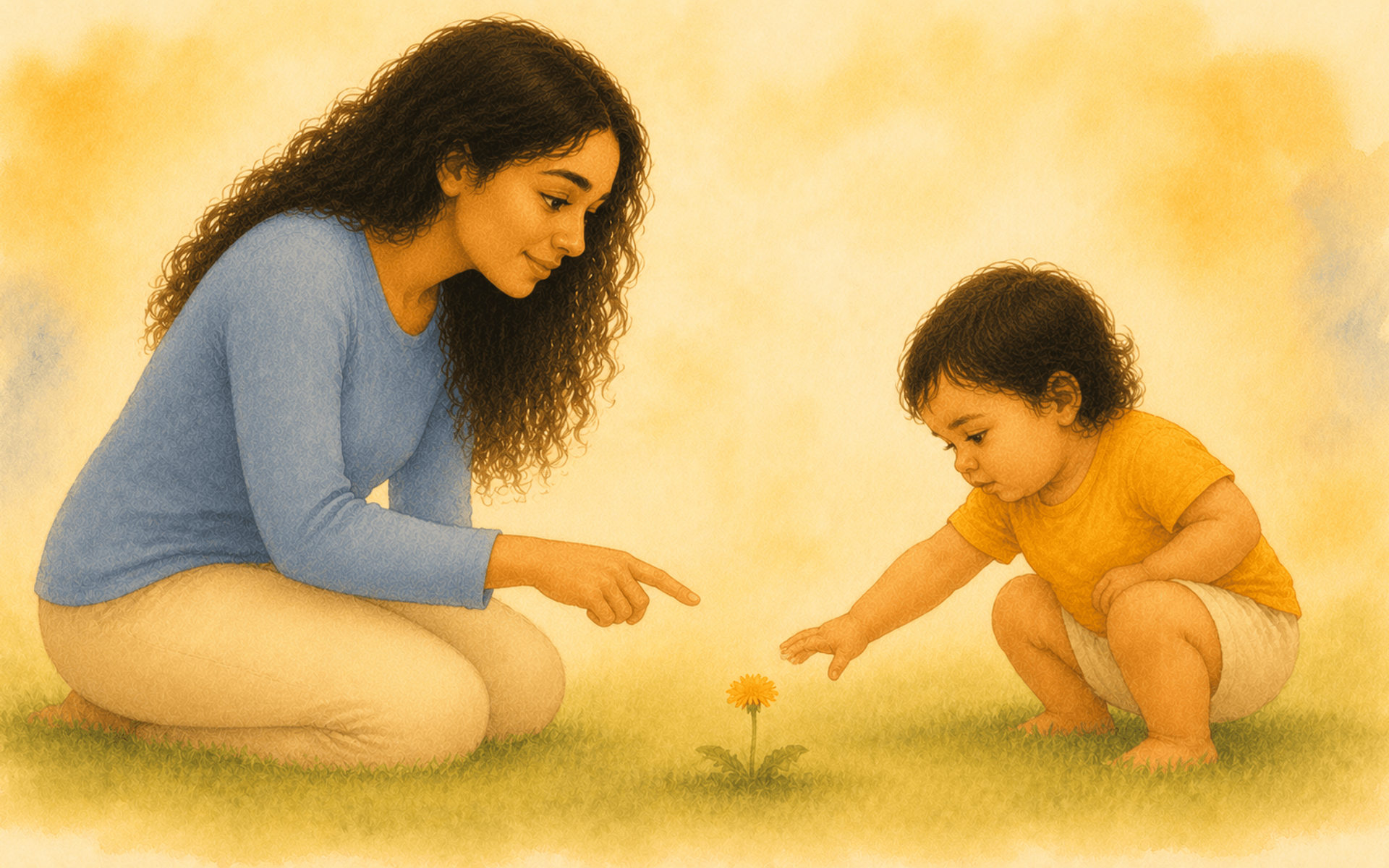
Your toddler has logged more screen hours this week than you planned. It happens to everyone. But a 2023 study that followed 885 children for two years found that toddlers who played outside regularly at age two showed measurably stronger daily-living skills at age four — and that outdoor play erased about one-fifth of the developmental gap between high- and low-screen-time groups. The summer activities for toddlers you're about to read aren't a guilt trip about devices. They're the antidote.
- Why the research on outdoor play and toddler development got more specific in the last few years — and what that changes
- The heat-safety threshold that licensed child care programs actually use, which is different from what most parenting forums quote
- What water play does to a toddler's developing motor system that "sensory play" doesn't fully capture
- A breakdown of summer activities by sub-age (12 to 18 months, 18 to 24 months, and 2 to 3 years), because the developmental distance between those windows is bigger than it looks
- Why parallel play at the sandbox is not a social problem and is in fact exactly what a 2-year-old's brain is built to do in summer 2025
- How to actually build outdoor time into the day before the heat, the nap schedule, and the general logistics of existing make it impossible
If the one-sentence answer is enough, you’ve got the gist. If you want the mechanism behind each piece, keep reading.
The research on outdoor play and toddler development got more concrete recently
Most summer activity lists operate on the assumption that outdoor play is obviously good and that any reasonable person already agrees. What those lists skip is that researchers are now measuring the developmental impact of outdoor time in ways that produce specific, usable numbers rather than general encouragement.
In 2023, Sugiyama and colleagues published a study in JAMA Pediatrics tracking 885 children from birth through age four in Japan. The researchers were testing whether outdoor play modified the relationship between screen time and developmental outcomes — and it did. Children who played outside more frequently at around age two and a half showed measurably better daily-living skills at age four, and that outdoor time accounted for about 18% of the association between higher screen exposure at age two and lower scores on developmental assessments. The study used validated measurement tools, controlled for family and socioeconomic variables, and applied causal mediation analysis to model the pathway. It's observational research, not a controlled trial, so it can't prove causation in the way a drug study would. But the relationship between outdoor time, screen time, and toddler developmental outcomes is robust enough that the authors called outdoor play a "mitigating factor" — a term with specific methodological meaning.
What makes this finding more useful than general "screens bad, outside good" messaging is that it points to a mechanism. The outdoor environment provides a density of sensory complexity (variable terrain, wind, temperature shifts, sound, smell, unpredictable social encounters) that an indoor setting almost never matches. Toddler brains build neural connections most rapidly when processing varied, unpredictable input. You can read about how sensory input drives neural development across the first year in our sensory play month-by-month guide. The same principle applies, and expands, when the environment is the backyard rather than a play mat.
Our guide to screen time research covers what the current pediatric guidance actually says about device use in the early years. The short version: screens at this age aren't a catastrophe, and they're not morally neutral. Outdoor time is the variable that, according to the evidence, most reliably shifts the picture in the right direction.
The heat-safety threshold most parents haven't heard of — and why it matters more than the thermometer
The parenting forum version of summer heat safety tends to land somewhere around "above 80°F, stay inside." The version that licensed child care programs use is different, and for a parent trying to get a toddler outside on a June morning, the difference matters.
The standard in Caring for Our Children (the national health and safety performance standards used by licensed early childhood programs across the United States) is a heat index of 90°F as the upper limit for outdoor play, not an air temperature of 80°F. Below that heat-index threshold, supervised outdoor activity with shade and hydration is appropriate. At or above 90°F, children stay in. The heat index combines temperature and humidity, which is what determines the actual physiological load on the body. On a humid day in the mid-Atlantic or Southeast, the heat index can exceed 90°F when the thermometer reads 82°F. On a dry day in the Southwest, a thermometer reading of 92°F may produce a lower heat index. The thermometer is the wrong instrument.
Understanding why toddlers carry higher heat risk than adults also requires correcting a widespread assumption. A 2025 narrative review by van de Kamp and Daanen summarized two decades of physiology research, including the foundational analysis by Falk and Dotan from 2008: children actually cool themselves through a somewhat different mechanism than adults, relying more on dry heat dissipation via their relatively larger skin surface area. Under moderate heat conditions, this makes toddlers neither more nor less capable than adults at managing body temperature. Their genuine vulnerability during extreme heat is largely behavioral, not physiological. Your toddler cannot reliably signal overheating, cannot independently seek shade, cannot remove extra layers, and will not ask for water before physiological strain has already set in. The caregiver is the behavioral thermostat — and that responsibility is real.
In practice: check the heat index before going out, not just the temperature. Morning outdoor time, typically before 10am, captures the best window most days in the continental US from June through August. Offer water before toddler shows thirst, because a meaningful level of fluid loss can accumulate before thirst kicks in. Keep sessions shorter for children on the younger end of the toddler range. The My First Routine Cards can make the "water, sunscreen, outside" morning sequence predictable for toddlers who do better with visual cues than verbal reminders.
For sun protection more broadly, the AAP recommends a short checklist before heading out: lightweight, tightly woven clothing; a wide-brimmed hat that shades the face, neck, and ears; and sunglasses with at least 99% UV protection. That last item is more important than it looks — a toddler's eye lens transmits more UV radiation to the retina than an adult's, making young eyes genuinely more vulnerable to long-term damage. For skin, broad-spectrum SPF 15 to 50 applied 15 minutes before outdoor time, reapplied every two hours and after water. Mineral formulas (zinc oxide or titanium dioxide) are the AAP's preferred option for young children.
What water play is doing to a toddler's motor system — more than the word "sensory" covers
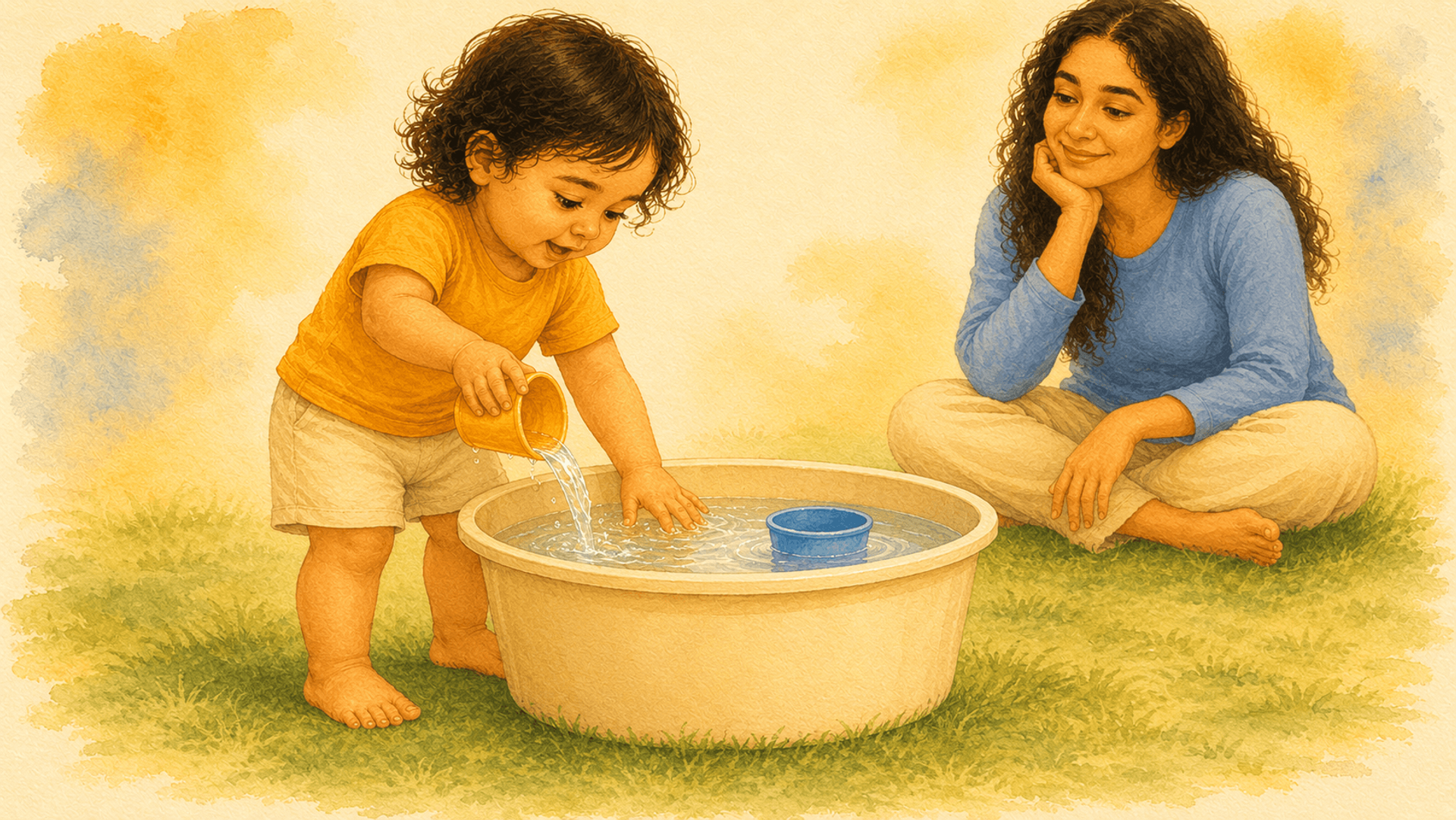
Every summer activity list includes a water table. The stated reason is almost always "sensory play," which is accurate but undersells what's happening in the body.
The physics of what happens to a moving body in water explains the motor value. Water provides multidirectional resistance that flat ground doesn't, buoyancy reduces the gravitational load on developing joints and muscles, and the proprioceptive input from moving through water activates balance and coordination pathways that dry-land surfaces leave quiet. For a toddler who is still consolidating upright balance and learning to navigate uneven terrain, the instability of a wet surface with moving water jets is a genuine motor challenge — not a harder version of the same thing, but a different category of demand entirely. SHAPE America's physical activity guidelines for early childhood specifically recommend exposing children ages 1 to 3 to varied movement environments, because motor skill development at this age is driven more by encountering novel physical problems than by repeating familiar ones.
This has a practical implication for planning summer activities for toddlers: water setups are not the easy, lower-effort option on a hot afternoon. They are, from a motor-development standpoint, one of the more varied environments available at this age. A standard water bin with cups, funnels, and small containers gives younger toddlers the pouring and transfer practice that supports fine motor development alongside early quantity concepts: full, empty, more, less.
A few practical notes on water safety: any outdoor water activity requires direct supervision and a closed water source. Wading pools should be emptied when not in use, because standing water poses a risk even at very shallow depths. Water temperature matters; test before setting toddlers in. Close supervision means actively watching, not just being nearby.
Summer activities for a 1-year-old: when the world is a very loud textbook

A 12 to 18 month old is operating in a specific developmental window: newly mobile, intensely sensory, and in the middle of a vocabulary that contains somewhere between 10 and 50 words on a good day. What toddlers at this age need from summer is not enrichment in the formal sense. They need novel sensory input at low complexity, delivered alongside a narrating adult.
The most developmentally productive thing a parent can do outside with a 1-year-old is narrate what the child is touching. "Hot sidewalk. Cool grass. The leaf is rough. This stone is smooth." Language acquisition at 12 to 18 months runs on concrete nouns tied to physical experience, and outdoor environments provide a density of nameable objects that an indoor space rarely matches: wind, shadow, ants moving across the path, gravel, puddles, flower petals, the sound a screen door makes when it closes. Research on early word learning consistently shows that words first encountered in direct physical context (the actual worm, the actual dandelion) are acquired faster and retained more reliably than words introduced through pictures or video alone.
The Fruits and Vegetables First Words cards work well in combination with the outdoor environment at this age: summer garden time builds the physical reference point ("you touched a real strawberry leaf this morning"), and the cards reinforce the vocabulary in calm indoor wake windows. Developmental linguists call this referential grounding, and summer is an unusually efficient season for it.
In terms of specific summer activities for 1-year-olds at home: keep setup minimal and complexity low. A shallow water table with a few cups — the Sensory Play Cards offer structured sensory setups for the indoor wake windows that bookend outdoor time — and no drain that can surprise them. A patch of dirt with a spoon. Bubbles to chase, which turns out to be one of the most effective tools for encouraging walking and early running because of how it provides a moving target in multiple directions. Chalk marks to walk over. Avoid small objects, avoid unsupported standing in water deeper than a few inches, and stay physically close. A 14-month-old cannot tell you they've walked too far into the spray or that the gravel they just found looked interesting.
The 1-year-old activities guide covers the full developmental context for this age range across all settings, not just summer.
Summer activities for a 2-year-old: mud kitchens, vocabulary explosions, and the shovel that will not be shared
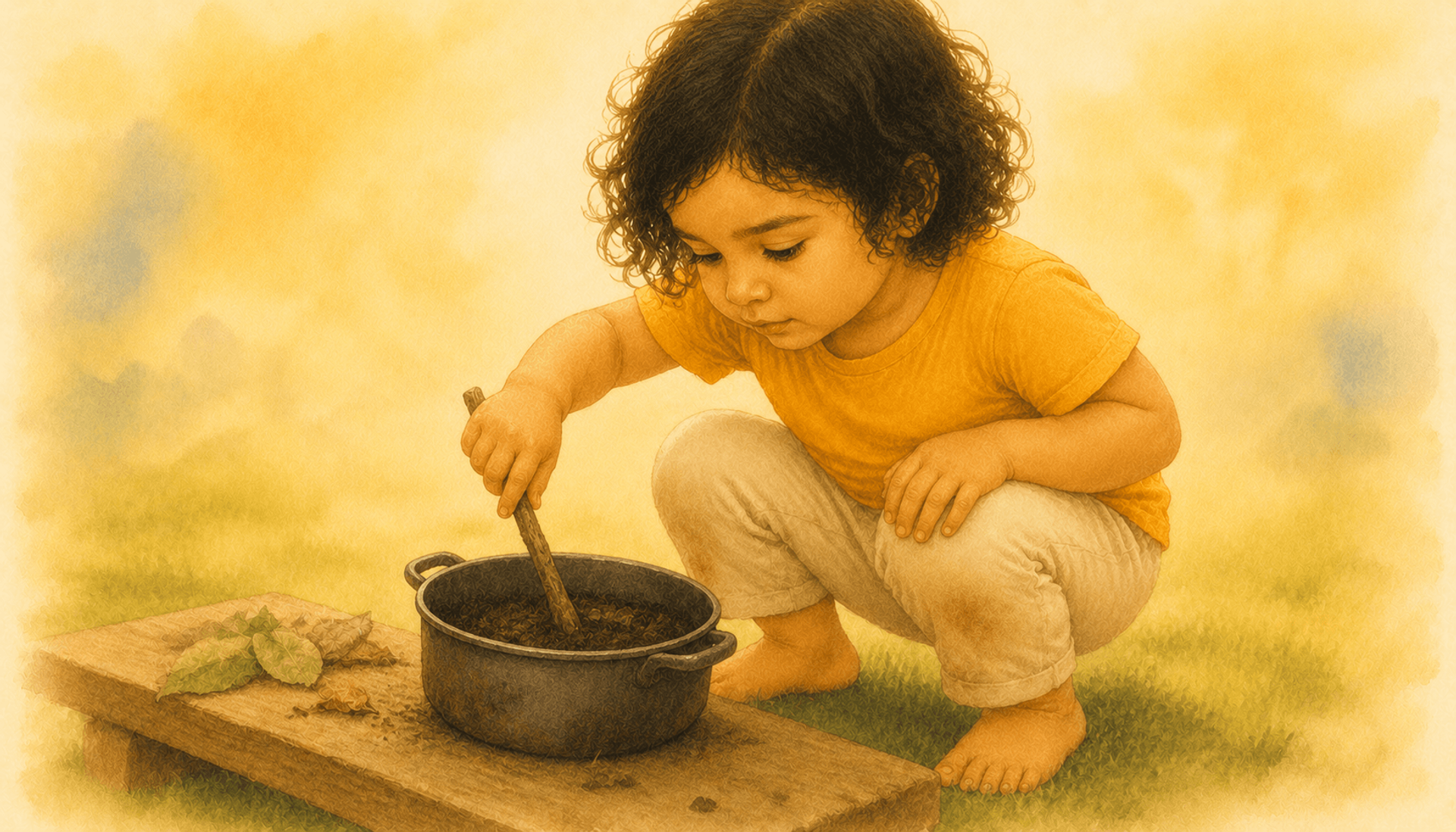
Between 18 and 24 months, several things happen at once in a way that tends to surprise parents who were not expecting this particular combination of developments. Vocabulary erupts, going from roughly 50 words at 18 months to somewhere between 200 and 300 words by 24 months, with new words appearing daily at peak acquisition. Pretend play appears for the first time: the empty cup becomes tea, the stick becomes a spoon, the puddle becomes soup. And socially, the 2-year-old enters the developmental phase that researchers call parallel play — playing next to another child, watching carefully, occasionally imitating, but not actually playing with them in any coordinated sense.
That last point is worth stating directly because parents frequently read it as shyness, social avoidance, or a developmental flag. It is none of those things. Parallel play is the developmentally correct social mode for this age, and research on social development going back to Mildred Parten's 1932 taxonomy of early childhood play stages consistently places cooperative play as a skill that consolidates closer to age 3. A 2-year-old at the sandbox who is working next to another toddler but guarding the blue bucket with fierce territorial conviction is doing exactly what their developmental stage calls for: observing, processing, filing information about other humans, and practicing play skills independently before the social hardware for genuine cooperation is installed.
This is precisely why a mud kitchen is so well matched to 2-year-olds in summer, and why messy water setups rank among the most effective summer sensory activities for toddlers at this stage. It activates the pretend play that has just emerged (the stick becomes a spatula, the water becomes broth), it accommodates parallel play naturally because two toddlers can each be cooking without needing to coordinate, and it provides messy sensory input in a form that toddlers at this age process deeply. The developmental return per unit of mess is unusually high. Other summer activities for 2-year-olds that fit the same profile: ice cube excavation, sidewalk chalk paint in large arm-sweep strokes (which is mark-making, a genuine precursor to writing), bubble chasing in pairs without taking turns, and simple water pouring stations with multiple containers so sharing is never required.
For a fuller picture of what a 2-year-old is doing developmentally across all contexts, the activities for a 2-year-old guide covers the cognitive, language, and social windows in detail.
Summer activities for a 3-year-old: when outdoor play gets complicated enough to actually need a plan
At 24 to 36 months, the picture shifts in ways that change which outdoor summer activities are worth setting up. Running is now controlled rather than effortful. Jumping with both feet appears or has just appeared. Language has moved from two-word combinations to three- and four-word sentences, and the toddler who was narrating the mud kitchen in approximate sounds is now explaining why the soup needs more leaves. Cooperative play — actual "you be the puppy and I'll be the vet" play — is beginning to emerge, though it remains fragile and doesn't survive many competing interests.
Three-year-olds benefit from outdoor activities that have a light structure, not because they need formal programming, but because their developing working memory can now hold a sequence of two steps and carry it out. A scavenger hunt built on picture cards gives the right level of challenge (look for something green, something wet, something you can pick up) without requiring reading or complex rule-following. An obstacle course with three stations gives something to anticipate, attempt, complete, and then repeat, because repetition at this age is how motor patterns consolidate into skill.
Water play scales beautifully into the 3-year-old range. Water balloons introduce fragility physics. A pouring challenge (move all the water from this bucket to that one using only a cup) supports early measurement reasoning in a context that feels like a game. And the pretend play that started at 2 has become elaborate enough to sustain a full car wash or restaurant setup for an extended outdoor session. Garden participation: watering a plant with a real small watering can, picking cherry tomatoes, looking for worms after watering — combines language, fine motor, cause-and-effect, and the kind of sustained attention that an iPad session produces in a completely different direction.
To see how the same outdoor scaffolding continues to evolve as cooperative play and rule-following mature, the activities for a 3-year-old guide, activities for a 4-year-old guide, and activities for a 5-year-old guide carry the thread forward.
Frequently Asked Questions
The standard used by licensed child care programs in the United States, per Caring for Our Children: National Health and Safety Performance Standards (Standard 3.1.3.2), is a heat index of 90°F as the threshold for stopping outdoor play, not an air temperature of 80°F. Heat index combines temperature and humidity to reflect actual physiological load; on a humid day, the heat index can exceed 90°F when the thermometer reads only 83°F. Below the 90°F heat index, supervised outdoor play with shade and regular hydration is appropriate. Offer water before your toddler asks, since meaningful fluid loss can accumulate before thirst signals appear.
The best summer activities for toddlers at age 1 tend to be low-setup and sensory-focused: a shallow water table with cups and funnels, sidewalk chalk for large-scale mark-making, bubbles for chasing and walking practice, mud or soil with a spoon, and short narrated nature walks where the adult names what the toddler is touching. At ages 2 to 3, mud kitchens and water pouring stations add pretend play. At 3 and beyond, scavenger hunts with picture cards and simple obstacle courses fit the working memory window well. The guiding principle across all ages: novel sensory input at the right complexity level, with an adult narrating the experience.
Yes. The American Academy of Pediatrics recommends a layered approach for toddlers: a wide-brimmed hat that shades the face, neck, and ears; sunglasses with at least 99% UV protection (toddlers' eye lenses transmit more UV to the retina than adult lenses, making early protection genuinely important); and broad-spectrum SPF 15 to 50 applied 15 minutes before outdoor time, reapplied every two hours and after water. Mineral sunscreens (zinc oxide or titanium dioxide) are the AAP's preferred option for young children's skin.
SHAPE America's physical activity guidelines for children ages 1 to 3 recommend at least 30 minutes of structured physical activity and at least 60 minutes of unstructured physical activity daily, with no single sedentary stretch exceeding 60 minutes except during sleep. In summer, the timing matters as much as the total duration. Morning outdoor sessions before 10am and evening sessions after 4pm avoid peak UV and heat-index hours. For toddlers on the younger end of the range (12 to 18 months), shorter and more frequent outdoor sessions (15 to 20 minutes out, inside to cool down, outside again) tend to work better than one long stretch.
For educational and entertainment purposes only. Not a substitute for professional medical or developmental advice. If you have concerns about your child's health or development, consult your pediatrician.
- American Academy of Dermatology Association. (2023). Infant sun protection: How parents can keep their baby safe. American Academy of Dermatology.
- American Academy of Ophthalmology. (2023). Should infants wear sunglasses? Ask an Ophthalmologist.
- American Academy of Pediatrics. (2024). Summer sun, heat & air quality: Tips to keep kids safe. HealthyChildren.org.
- Bloemsma, L. D., Wijga, A. H., Klompmaker, J. O., Lebret, E., Gehring, U., Oldenwening, M., Brunekreef, B., & Hoek, G. (2021). Green space, air pollution, traffic noise and saliva cortisol in children: The PIAMA study. Environmental Epidemiology, 5(2), e141.
- Centers for Disease Control and Prevention. (2023). Heat and infants and children. National Center for Environmental Health.
- Falk, B., & Dotan, R. (2008). Children's thermoregulation during exercise in the heat: A revisit. Applied Physiology, Nutrition, and Metabolism, 33(2), 420–427.
- Godar, D. E., Urbach, F., Gasparro, F. P., & van der Leun, J. C. (2003). UV doses of young adults. Photochemistry and Photobiology, 77(4), 453–457.
- National Resource Center for Health and Safety in Child Care and Early Education. (2019). Caring for our children: National health and safety performance standards (4th ed.), Standard 3.1.3.2: Outdoor play in hot weather.
- Parten, M. B. (1932). Social participation among pre-school children. Journal of Abnormal and Social Psychology, 27(3), 243–269.
- SHAPE America — Society of Health and Physical Educators. (2009). Active start: A statement of physical activity guidelines for children birth to age 5 (2nd ed.). SHAPE America.
- Smith, C. J., & Havenith, G. (2019). Pediatric thermoregulation: Considerations in the face of global climate change. Nutrients, 11(9), 2010.
- Sugiyama, M., Tsuchiya, K. J., Okubo, Y., Rahman, M. S., Uchiyama, S., Harada, T., Iwabuchi, T., Okumura, A., Nakayasu, C., Amma, Y., Suzuki, H., Takahashi, N., Kinsella-Kammerer, B., Nomura, Y., Itoh, H., & Nishimura, T. (2023). Outdoor play as a mitigating factor in the association between screen time for young children and neurodevelopmental outcomes. JAMA Pediatrics, 177(3), 303–310.
- van de Kamp, E., & Daanen, H. (2025). Narrative review on infants' thermoregulatory response to heat. International Journal of Environmental Research and Public Health, 22(8), 1265.

More Articles

Parallel Play in Toddlers: Why Side-by-Side Is the Social Work
Your toddler spent the entire playdate building separate towers, and nobody shared a single block. That counted — more than it looked. A 2025 longitudinal study found that playing beside a specific child consistently predicted later social play with that same child, but not the other way around. Here's what parallel play in toddlers actually is, why the science calls it strategic rather than passive, and what it means for how you run a playdate.

When Do Babies Point: Why It Matters for Language
Most milestone articles treat pointing as a box to check around 12 months. The research tells a different story — one that starts months earlier, runs through the infant brain, and traces back to how much the parent is pointing. Here's what the last fifteen years of research actually found, and what it means for everyday interactions.

When Do Babies Wave Bye-Bye: Why Your Baby Needs You to Wave First
Most baby milestones unfold on a biological schedule — waving isn't one of them. A 2023 study found that babies develop imitation ability because their caregivers imitate them first, and waving is named directly as a cultural gesture learned through that loop. Here's what the research says about the 9–12 month window, why the first wave looks nothing like a wave, and what helps it arrive.