Tummy Time Exercises for Baby: The Month-by-Month Progression (0–6 Months)

Every article about tummy time tells you the same thing: thirty minutes a day. Some say forty-five. The AAP says start from day one. The apps send reminders. The mom groups track it like a fitness goal.
Here's what none of them mention: thirty minutes of a newborn lying flat with chin on the mat is not thirty minutes of strength training. It's thirty minutes of a baby in an uncomfortable position with no ability to do what tummy time is actually asking of the body.
The goal was never the minutes. The goal is what the baby does inside them — and that changes completely between week two and month five. There are five different physical challenges stacked inside what we call "tummy time," and most parents are stuck trying to survive the first one long after their baby is ready for the third.
- What tummy time is building — and why "core" is only part of the story
- The five-rung ladder inside prone, with research on why each rung predicts what comes next
- What inclined props do to muscle activation — and when they help vs. when flat is better
- The 3–4 month tolerance shift — what changes, and how to use it
- What counts, what doesn't, and how to build a realistic daily habit
If the one-sentence answer is enough, you’ve got the gist. If you want the mechanism behind each piece, keep reading.
The muscles tummy time builds — and why "core" is a misleading label
The phrase you'll see everywhere is "strengthens neck, shoulder, and core muscles." Technically accurate, but it skips over something important: those three muscle groups are not doing equal work during prone, and which one is leading shifts as the months go by.
Researchers at the University of Arkansas Medical Sciences attached surface electrodes to 22 healthy infants between two and six months old and measured exactly which muscles fired in different positions. The finding, published in the Journal of Biomechanics by Siddicky and colleagues in 2020, was unambiguous: prone lying produced the highest erector spinae (back extensor) activity of any position measured. Compared to supine lying on the back, lumbar erector spinae activity increased by 185% in prone, and cervical paraspinal activity increased by 283%. The primary engine of tummy time is the antigravity extensor chain (the muscles that run along the spine and into the neck), not the abdominals.
This matters because it changes how you think about the whole activity. Tummy time is not abdominal "core" training in the gym-class sense. It is extensor training: building the back and neck musculature that will eventually let your baby hold up the head for long stretches, prop on forearms, push up on extended arms, and sit, crawl, and walk upright later. The core stabilizes, but the extensors are doing the headline work.
It also means that sessions where the baby's head is mostly resting on the mat are not accomplishing what they look like they are. The extensor chain only fires when it's working against gravity. A baby slumped flat with chin on the ground is getting warmth and sensory input but not the extensor activation that makes prone time genuinely developmental. Which is why what happens inside a session matters as much as how long it lasts.
An EMG study from the same Siddicky lab found that infants received, on average, only 12.4% of their awake time in prone. More than half the infants in the sample spent 10% or less of their day on their tummies. This is the gap between what the guidelines recommend and what's happening in most households, and this is part of why the progression matters so much when prone time does occur.
The five-rung ladder — what's being built, month by month
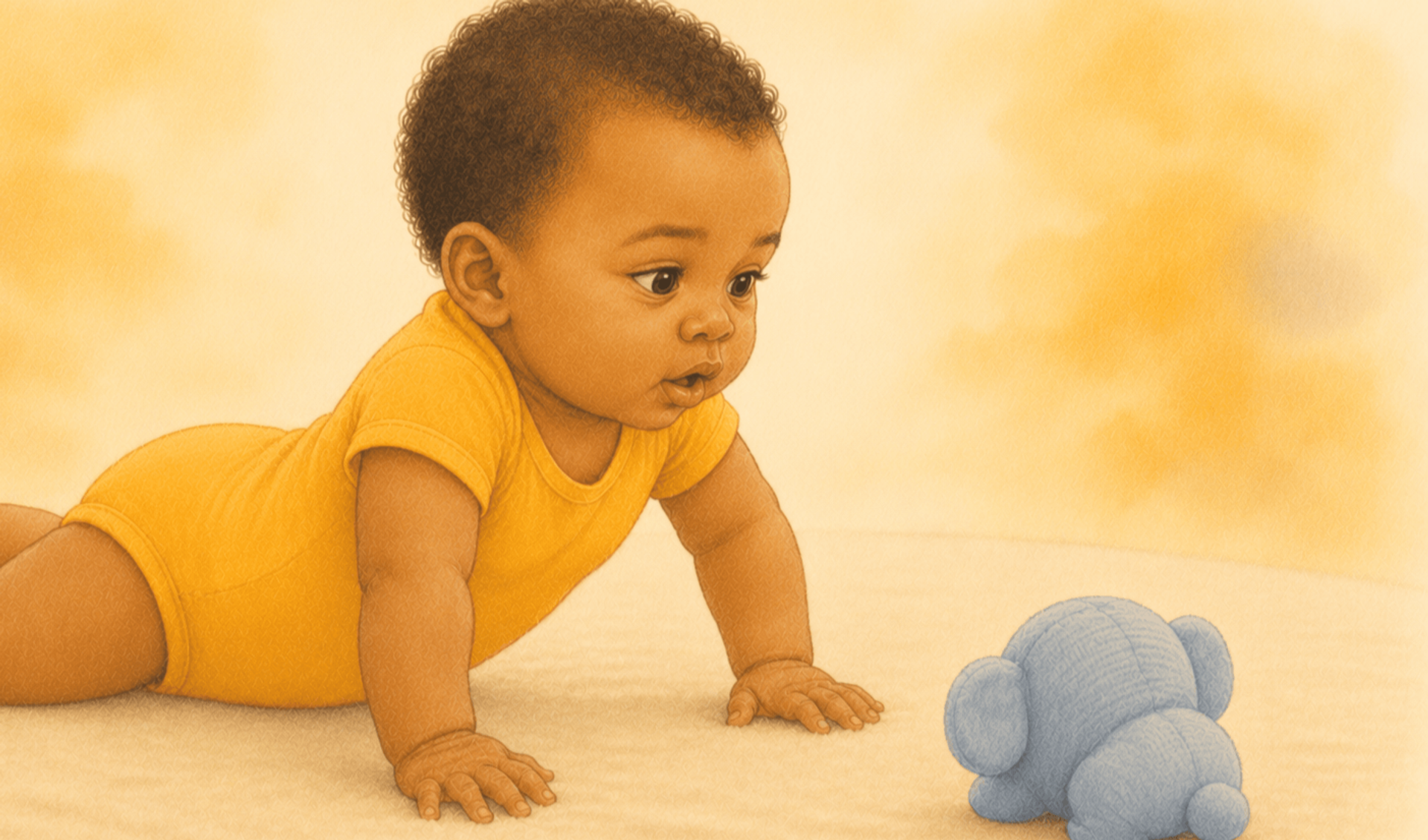
Tummy time is not one thing. It is five different physical challenges stacked on top of each other, and what the baby is building at week two looks nothing like what's happening at month five. Once you see the sequence, the thirty-minute goal stops being the point.
Rung 1 — Chin and head lift (newborn through about 6 weeks)
In the first weeks, even a brief head lift is a significant event. The neural pathways that tell the neck muscles to work against gravity are still being established, which is why a newborn's head wobbles and drops even when the baby is clearly trying. What looks like almost nothing from the outside is the nervous system learning a completely new instruction.
A 2015 study in Early Human Development by Bentzley and colleagues tracked how well preterm infants controlled their heads at 12 weeks, then checked back at 12 months. Head control quality at three months predicted broader neurodevelopmental outcomes at one year, not perfectly but meaningfully enough to matter. Those early wobbly lifts are not just cute. They are information.
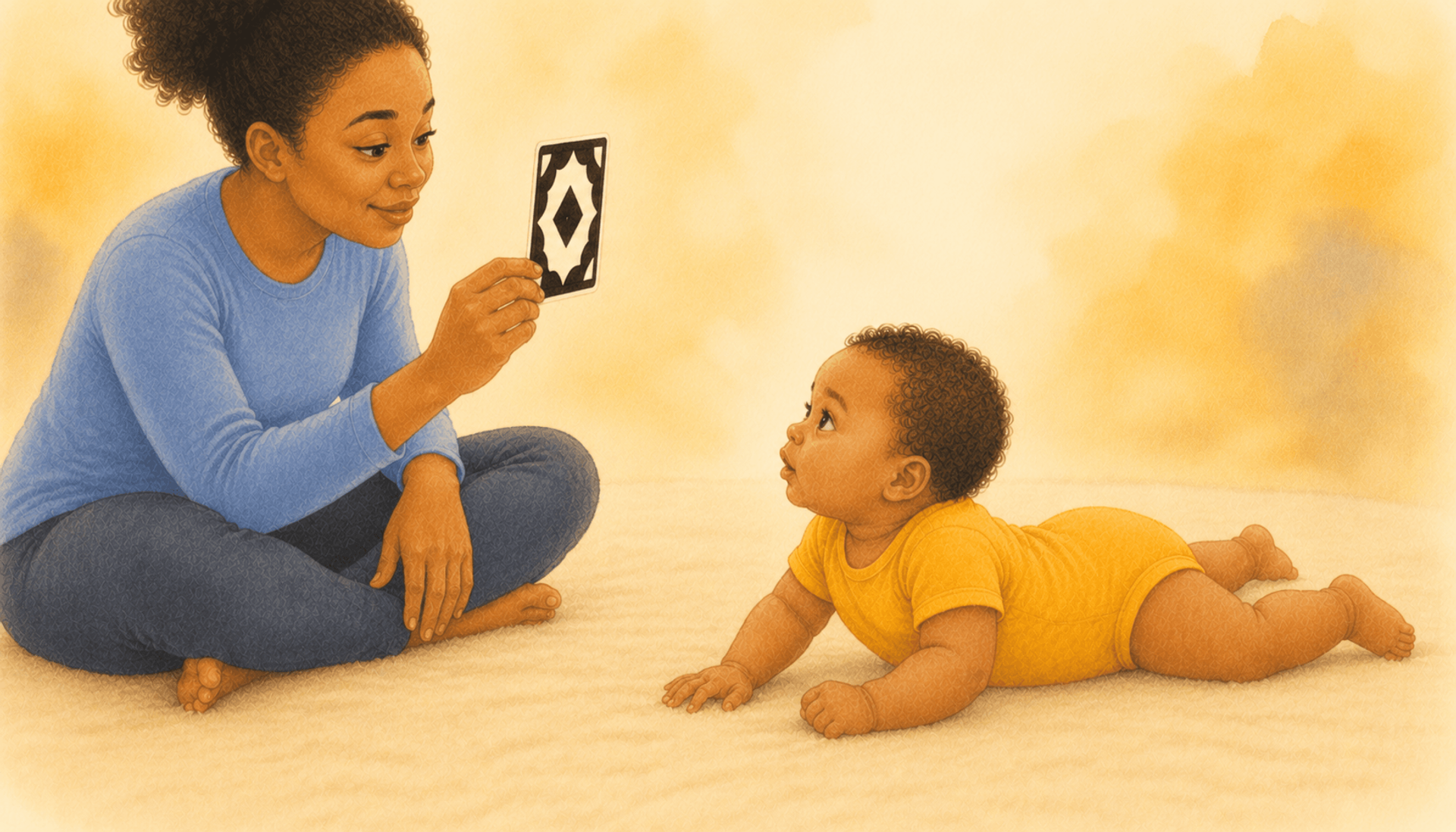
Exercise for this rung: get down on the floor face-to-face with your baby at eye level. Your face is the most compelling visual target available to a newborn. Hold position and let your baby work to lift toward you. Even 90 seconds of active effort counts. Our High Contrast Flashcards work well at this stage too — prop one upright at eye distance, and the high-contrast pattern gives the baby a reason to lift that isn't just effort for effort's sake.
Rung 2 — Forearm prop (roughly 2–3 months)
At this stage, the baby graduates from barely-lifted chin to resting on forearms — elbows behind the shoulders at first, then gradually creeping forward until they sit directly underneath. Head angle climbs from around 45 degrees to closer to 90. The muscles keeping the baby up here are different from the ones doing the work in week one, and they need more time under load to build.
Exercise: elevate the target (your face, a mirror, a card) so that reaching the optimal viewing angle requires a little more push-up effort than the week before. The visual pull does the coaching; you don't need to physically assist the posture.
Rung 3 — Extended-arm push-up, chest off the floor (3–4 months and onward)
This is the rung where the research gets specific. In a 2018 prospective cohort study published in Pediatrics International, Senju and colleagues followed 2,020 full-term Japanese infants. At the six-month health screening, 1,625 could maintain prone on extended arms and 179 could not. The group that couldn't reach this rung scored significantly lower on ASQ-3 assessments across not just gross motor but communication, fine motor, problem-solving, and personal-social domains, differences that persisted until 1.5 to 3 years of age depending on the domain.
The extended-arm push-up is doing more than building shoulder strength. To hold that position, the baby's balance system, body-position sense, and vision all have to work together in a way the earlier rungs don't require. Reaching it by six months appears to be a signal that the whole motor system is organizing well — which is why the research found the effects spread beyond gross motor into communication, fine motor, and problem-solving.
Exercise: hold a target higher and farther away than in the forearm-prop stage, ideally a toy at or slightly above the baby's eye level when arms are extended. The baby will work to get the head up far enough to see it. Fathers who get down on the floor here are particularly effective, partly because a new face at a slightly different angle generates more visual attention.
Rung 4 — Weight-shifting onto one arm (around 4–5 months)
Once the baby can hold extended arms steadily, something interesting starts happening: one hand comes free. The baby shifts weight onto the opposite forearm and reaches toward whatever caught the eye. It looks casual. It's the first rehearsal of the weight-shifting sequence that crawling and walking will later demand.
Exercise: place the target off to one side at just slightly more than arm's reach, so that getting to it requires a weight shift. Color Contrast Cards work particularly well at this stage, since the baby's color vision has developed enough that the chromatic contrast creates a pull that motivates reaching in a way black-and-white alone no longer does.
Rung 5 — Pivot and reach, the pre-crawl extension (5–6 months)
By the time the baby can hold extended arms, shift weight, and reach, the final move is pivoting in place, arcing around a 180-degree semicircle on the tummy to reach something that moved. A 2021 paper in the Journal of Clinical Medicine by Gajewska and colleagues, which analyzed the motor development sequence of 200 infants, identified "high support on extended upper limbs with open palms and raising the chest high from the surface" as the posture that immediately precedes the crawl position. The shoulder girdle strength develops proximal-to-distal (from trunk outward to the hand), which is exactly what these later-rung prone sessions are building.
Exercise: arc a toy slowly in a semicircle so the baby has to rotate to follow it. The twist and reach that results is the closest thing to a crawling preview you'll see in a five-month-old: same weight shifts, same trunk rotation, just without the forward propulsion yet.
Flat vs. propped: what the muscle research shows
A rolled towel under the chest or a Boppy pillow prop is a legitimate tool for a baby who cannot yet tolerate flat prone. It reduces the gravitational demand on the neck and lets the baby experience the position without immediate distress. That is useful, especially in the first weeks.
What the research adds is a useful nuance about what changes on an incline. In a study published in Journal of Biomechanics, the Mannen lab measured muscle activity in infants during prone on flat vs. inclined surfaces and found that inclined positioning reduced erector spinae (back extensor) activity by up to 48% compared to flat prone, while abdominal activity increased. A separate analysis by Wang and colleagues found the same gradient: the steeper the incline, the less back-extensor load.
This does not mean props are wrong. They serve a specific purpose. An inclined prop helps a resistant baby get onto the mat at all. Flat prone is where the extensor work that tummy time is designed to build happens. The practical approach: use the prop to build tolerance, and treat flat-surface prone as the goal you are working toward, not the alternative to avoid.
If the prop has been the default for several weeks and flat prone still feels impossible, the tummy time for resistant babies guide covers positions that build tolerance while keeping the baby in flat or near-flat prone.
One safety note that applies regardless of position: inclined surfaces for infant sleep are not safe under any circumstances. Everything above applies only to supervised, awake tummy time.
The 3–4 month shift — what changes and why the sessions should too
One pattern across dozens of Reddit threads is unmistakably consistent: babies who hated tummy time for the first three months often suddenly become more tolerant, and then genuinely interested, somewhere between three and four months. Parents describe it as a switch flipping.
The research confirms this is real. A 2022 study in the European Journal of Pediatrics by Zhang and colleagues tracked tummy time patterns across 411 infants and found that how often babies were placed prone, how long sessions lasted, and how willingly they tolerated it all increased steadily through the first six months. More importantly, the link between prone time and developmental outcomes became measurably consistent starting at four months — before that the relationship exists but varies a lot between babies. At four months, it stabilizes.
What is happening around 3–4 months is a convergence of several developments: the vestibulospinal pathways are more mature, neck extensor strength has reached a threshold where lifting the head is no longer maximally effortful, and color vision and depth perception have developed enough to make the floor visually interesting rather than just flat. A baby at 5 months who is spending 90% of an awake window face-down is not grinding through an exercise. That baby is in an environment that makes sense to the nervous system.
This is the data behind the sessions changing after 3–4 months. A 2022 study by Carson and colleagues, published in the International Journal of Behavioral Nutrition and Physical Activity, followed 411 infants and found that higher tummy time was significantly associated with earlier attainment of six major gross motor milestones, including earlier independent sitting and earlier crawling. The dose-response was real. And it was the post-3-month tummy time that carried the most consistent predictive weight.
The sessions before 3 months are important. The AAP recommends starting supervised tummy time from the first day home, working toward 15–30 minutes daily by 7 weeks, but the growth in what prone time can do for your baby accelerates significantly once that neurological shift arrives. Plan for this. When the 3-month flip comes, extend session length, raise the challenge level, and move up the ladder. The fine motor development that comes later depends directly on the shoulder-girdle strength that prone time is quietly building right now.
What actually counts as tummy time (and what doesn't quite)
This is genuinely confusing, and the confusion is not the parent's fault. The definition of tummy time varies across sources in ways that are hard to reconcile.
Official AAP and WHO guidance refers to supervised, awake prone positioning on a firm, flat surface. The research that shows developmental outcomes is based on this same setup: Dudek-Shriber and Zelazny's 2007 study in Pediatric Physical Therapy found significant differences in the attainment of seven prone milestones, three supine milestones, and three sitting milestones between infants who had regular prone time and those who did not, and it was conducted on the floor.
Chest-to-chest prone on a reclined parent is different. The Siddicky EMG study included in-arms carrying and found that active carry engages the cervical paraspinals but at lower levels than floor prone. Upright babywearing in a structured carrier has similar findings, contributing to neck muscle development, but not in the same way as flat prone. These count, especially in the early weeks when flat prone is genuinely too hard for many newborns. But they are not a substitute for flat floor prone as the primary mode once the baby can handle it.
The honest framing for families: in the first 6–8 weeks, chest-to-chest is where you start, and a few minutes of it multiple times a day is doing real work. By 3 months, the goal is flat-surface sessions as the primary form, with chest-to-chest used as warm-up or for especially resistant days. By 5 months, a baby who has progressed normally should be spending long stretches of awake time in flat prone without coaxing.
A 2025 compositional analysis by Carson and colleagues in Child: Care, Health and Development estimated that the optimal daily duration for developmental outcomes falls in the range of 38–43 minutes per day, spread across sessions. The WHO recommends at least 30 minutes daily for non-mobile infants. The AAP's practical recommendation of 15–30 minutes by 7 weeks represents a realistic early milestone, not the ceiling. Most families will fall short of optimal during the early weeks, and that is normal and consistent with studies showing that fewer than one-third of infants globally meet tummy time guidelines. Making up the difference after the 3-month shift is both possible and valuable.
What the red flags look like — specific, not alarming
Most babies who resist tummy time are doing so for the simple reason that it is hard work at a stage when the muscles involved are not yet strong. That is not a red flag. The Reddit thread with the baby who hated prone until 4 months and then walked at 10 months is not an outlier; it is consistent with the research showing developmental resilience across a range of prone-time histories.
The pattern that is worth raising with your pediatrician at the next visit is persistent inability to lift the head at all during prone by 3 months. Not every session — a tired baby won't perform on demand. But if three months have passed and the baby shows no active head-lifting attempt during supervised prone, and the pediatrician hasn't already flagged it, that is a good time to mention it.
Consistent head tilting to one side during prone, especially if the baby rarely turns in the other direction, is worth flagging, as it can be an early sign of torticollis, which responds very well to early physical therapy.
If floor tummy time produces immediate, significant distress every time, and the baby is also frequently spitting up, reflux may be a factor. That is worth raising directly rather than just pushing through.
Frequently Asked Questions
The AAP recommends starting with 2–3 short sessions of 3–5 minutes each from the first day home from the hospital, gradually working up to 15–30 minutes total daily by around 7 weeks. A 2025 compositional data analysis published in Child: Care, Health and Development estimated that approximately 38–43 minutes of prone time per day is associated with optimal motor and developmental outcomes in the first year. That target is realistic once the 3–4 month tolerance shift arrives; before then, accumulate whatever your baby will tolerate across multiple short sessions spread throughout the day.
Start on a firm, flat surface (a play mat on the floor works well), right after a diaper change when the baby is alert and not hungry. Begin with 1–2 minutes. Get down at floor level face-to-face so your face is the target. Alternatively, place your baby tummy-down on your reclined chest, which counts as prone time in the early weeks and significantly reduces the gravitational demand on the neck. A high-contrast card propped upright at eye level also gives the baby a reason to look up. End the session before the baby reaches peak distress; brief active effort is more valuable than a prolonged crying session.
For most babies, a noticeable shift in tolerance happens between 3 and 4 months. A 2022 study in the European Journal of Pediatrics tracking tummy time patterns in 411 infants found that bout frequency, bout length, and infant preference for prone all increased significantly over the first six months, with the clearest linear dose-response between tummy time and developmental outcomes emerging at 4 months. Neck extensor strength, vestibular maturity, and visual development all converge around this age, which is why a baby who needed constant coaxing in month two may genuinely enjoy prone time by month five.
The most evidence-supported engagement during tummy time is your face at eye level, positioned slightly above the baby's current comfortable gaze angle so they have to work to see it. Beyond that, mirrors produce strong visual engagement because movement attracts attention. High-contrast cards (black-and-white patterns with strong edges) are well-matched to newborn visual acuity. By 3–4 months, when color vision is more mature, color contrast cards work well to motivate weight-shifting and reaching. A 2024 study by Kanazawa and colleagues in the Journal of Applied Behavior Analysis found that both preferred items and parental attention during tummy time increased head elevation and reduced negative vocalizations, confirming that what you place in front of a baby matters, not just how long the session runs.
Start with position adjustments before interpreting resistance as a developmental problem. Flat floor prone from day one is the hardest version of tummy time, and most newborns will resist it. Chest-to-chest prone on a reclined parent significantly reduces gravitational demand and is a legitimate starting point. Rolling the baby into prone rather than placing them flat often reduces the startle response. Breaking sessions into very short intervals (60–90 seconds, many times a day) builds tolerance faster than one long session. If resistance continues consistently past 3 months, seven specific evidence-based positions for resistant babies are covered in the tummy time tips article on this site.
For educational and entertainment purposes only. Not a substitute for professional medical or developmental advice. If you have concerns about your baby's development, consult your pediatrician.
- American Academy of Pediatrics. (2022). Safe sleep recommendations. Pediatrics, 150(1), e2022057990.
- Bentzley, J. P., Coker-Bolt, P., Moreau, N. G., Hope, K., Ramakrishnan, V., Brown, T., & Jenkins, D. (2015). Kinematic measurement of 12-week head control correlates with 12-month neurodevelopment in preterm infants. Early Human Development, 91(2), 159–164.
- Carson, V., Lee, E. Y., Hesketh, K. D., & Predy, M. (2025). Longitudinal associations between movement behaviours and development among infants using compositional data analysis. Child: Care, Health and Development, 51(1), e70025.
- Carson, V., Zhang, Z., Predy, M., Pritchard, L., & Hesketh, K. D. (2022). Associations between tummy time and infant development: a longitudinal study. International Journal of Behavioral Nutrition and Physical Activity, 19, 10.
- Dudek-Shriber, L., & Zelazny, S. (2007). The effects of prone positioning on the quality and acquisition of developmental milestones in four-month-old infants. Pediatric Physical Therapy, 19(1), 48–55.
- Gajewska, E., Sobieska, M., Samborski, W., Lisewska, B., & Steinborn, B. (2021). Crawl position depends on specific earlier motor skills. Journal of Clinical Medicine, 10(23), 5605.
- Hewitt, L., Stanley, R. M., & Okely, A. D. (2020). Tummy time and infant health outcomes: a systematic review. Pediatrics, 145(6), e20192168.
- Hewitt, L., Kerr, E., Stanley, R. M., & Okely, A. D. (2020). Group tummy time classes: a pilot cluster randomized controlled trial. Pilot and Feasibility Studies, 6, 120.
- Kanazawa, T., Hagiwara, Y., & Kawakita, T. (2024). A comparison of parental attention and preferred items during tummy time: a consecutive controlled case series evaluation. Journal of Applied Behavior Analysis, 57(3), 812–823.
- Kuo, Y. L., Liao, H. F., Chen, P. C., Hsieh, W. S., & Hwang, A. W. (2008). The influence of wakeful prone positioning on motor development during the early life. Journal of Developmental & Behavioral Pediatrics, 29(5), 367–376.
- Mannen, E. M., Carroll, J., Bumpass, D. B., Hudson, H., Tichy, A., Abshire, R., Fortunato, J., & Davisson, M. A. (2020). Do inclined sleeping surfaces impact infants' muscle activity and movement? A safe sleep product design perspective. Journal of Biomechanics, 112, 110058.
- Moon, R. Y., Carlin, R. F., & Hand, I. (2022). Sleep-related infant deaths: Updated 2022 recommendations for reducing infant deaths in the sleep environment. Pediatrics, 150(1), e2022057990.
- Senju, A., Shimono, M., Tsuji, M., Suga, R., Shibata, E., Fujino, Y., Kawamoto, T., & Kusuhara, K. (2018). Inability of infants to push up in the prone position and subsequent development. Pediatrics International, 60(9), 811–819.
- Siddicky, S. F., Bumpass, D. B., Krishnan, L., Tackett, S. A., McCarthy, R. E., & Mannen, E. M. (2020). Positioning and baby devices impact infant spinal muscle activity. Journal of Biomechanics, 104, 109741.
- World Health Organization. (2019). Guidelines on physical activity, sedentary behaviour and sleep for children under 5 years of age. WHO.
- Zhang, Z., Predy, M., Hesketh, K. D., & Carson, V. (2022). Characteristics of tummy time and dose-response relationships with development in infants. European Journal of Pediatrics, 181(10), 3593–3602.


More Articles

Parallel Play in Toddlers: Why Side-by-Side Is the Social Work
Your toddler spent the entire playdate building separate towers, and nobody shared a single block. That counted — more than it looked. A 2025 longitudinal study found that playing beside a specific child consistently predicted later social play with that same child, but not the other way around. Here's what parallel play in toddlers actually is, why the science calls it strategic rather than passive, and what it means for how you run a playdate.

When Do Babies Point: Why It Matters for Language
Most milestone articles treat pointing as a box to check around 12 months. The research tells a different story — one that starts months earlier, runs through the infant brain, and traces back to how much the parent is pointing. Here's what the last fifteen years of research actually found, and what it means for everyday interactions.

When Do Babies Wave Bye-Bye: Why Your Baby Needs You to Wave First
Most baby milestones unfold on a biological schedule — waving isn't one of them. A 2023 study found that babies develop imitation ability because their caregivers imitate them first, and waving is named directly as a cultural gesture learned through that loop. Here's what the research says about the 9–12 month window, why the first wave looks nothing like a wave, and what helps it arrive.