When Do Babies Start Smiling: What the 6-Week Number Isn't Telling You
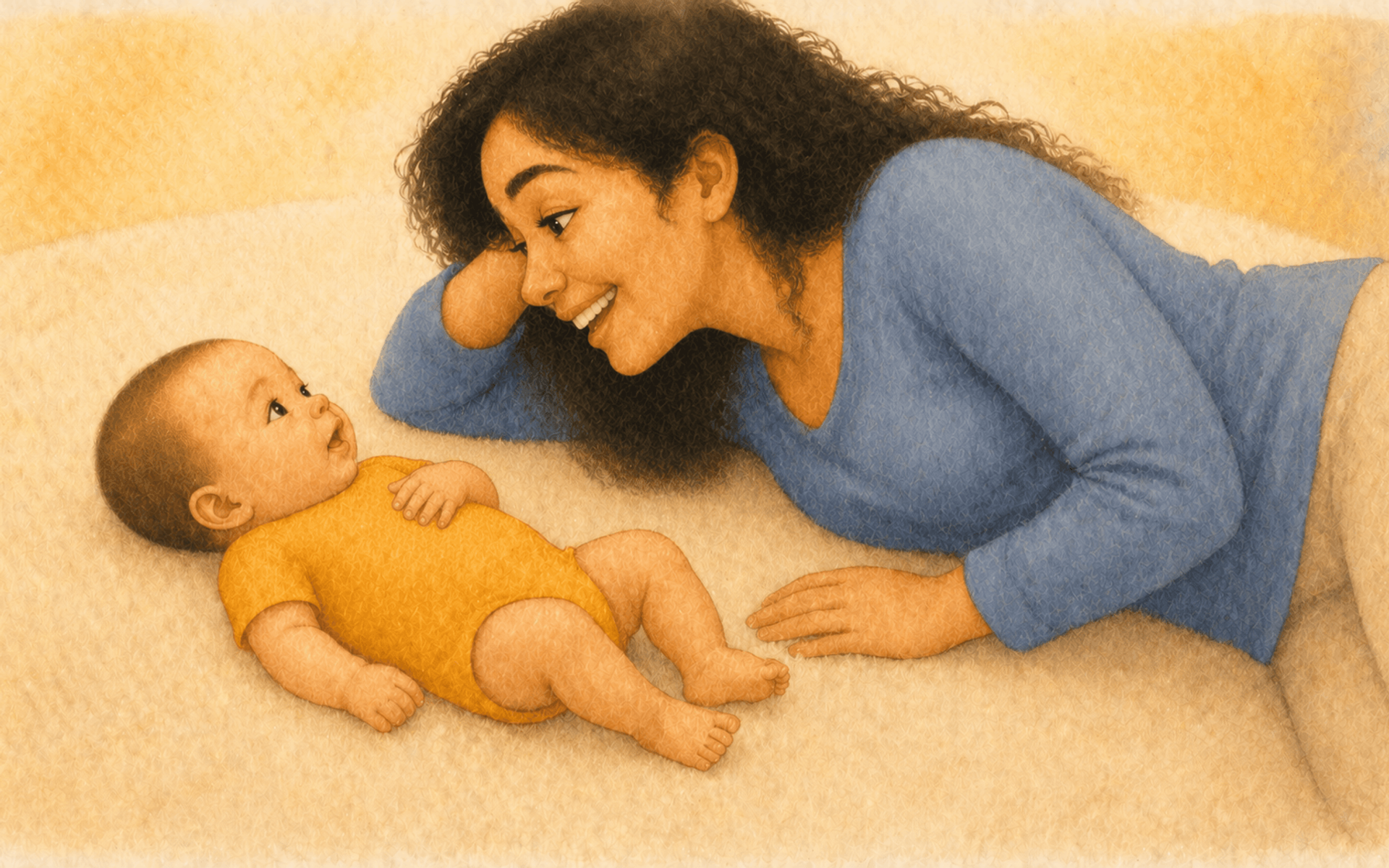
Your baby has been staring at your face for weeks with the serious focus of someone reviewing something they're not entirely sure about yet, and then one morning the review ends. When do babies smile for the first time? The window every article gives you (six to eight weeks) is roughly accurate, but almost none of those articles mention what those weeks are actually being counted from. That part changes how the milestone works, and it turns out to be genuinely useful information whether your baby is early, right on schedule, or a week-nine mystery.
- The surprising thing developmental scientists know about the six-to-eight-week number that almost no parenting article mentions
- Why your newborn's early grins and the first real smile are biologically different events, and how to tell them apart
- What's happening in the brain in the weeks leading up to the social smile, and why you genuinely cannot hurry it
- The specific kind of response that research shows helps the smile develop, which turns out to be more precise than "smile back"
- What to do if the smile hasn't arrived yet, and when it's worth bringing up at a pediatrician visit
If the one-sentence answer is enough, you’ve got the gist. If you want the mechanism behind each piece, keep reading.
What the six-to-eight-week window is measuring
The social smile appears at around six to eight weeks of age. That much is accurate and consistent across virtually every reputable source, from the CDC's milestone checklist to the American Academy of Pediatrics. What those sources rarely spell out is that "six to eight weeks" refers to weeks since birth only for full-term babies born around their due date. For everyone else, the number shifts, and the reason why turns out to reveal something interesting about how the whole milestone works.
In 1982, a researcher named Esther Anisfeld tracked the onset of social smiling in both full-term and preterm infants across two ethnic groups. What she found was striking: preterm babies didn't smile on the same calendar timeline as full-term babies at all. A baby born eight weeks early smiled about eight weeks later than a full-term baby by chronological age. When she recalculated using weeks from conception rather than weeks from birth, the two groups landed at almost exactly the same point — roughly 44 weeks post-conception, which works out to about four to six weeks past the original due date. A 2013 study published in the Journal of Human Growth and Development confirmed this in a larger sample of 105 preterm infants: only 71% showed a social smile at three months of chronological age, but 94% had one by three months corrected age. In 2024, a team at IRCCS Mondino Foundation in Italy found that full-term and very preterm babies (born before 32 weeks) showed no meaningful difference in social smiling at all, as long as age was measured from the due date, not the birth date.
What this means for every parent, not just those with preterm babies, is that when do babies smile is fundamentally a question about brain readiness rather than calendar age. The smile doesn't appear because a certain number of weeks have passed since the delivery room; it appears because the brain has reached a specific maturational threshold that the clock started tracking at conception. Birth changes the address. It doesn't change the schedule.
The two kinds of smiles in your baby's first weeks
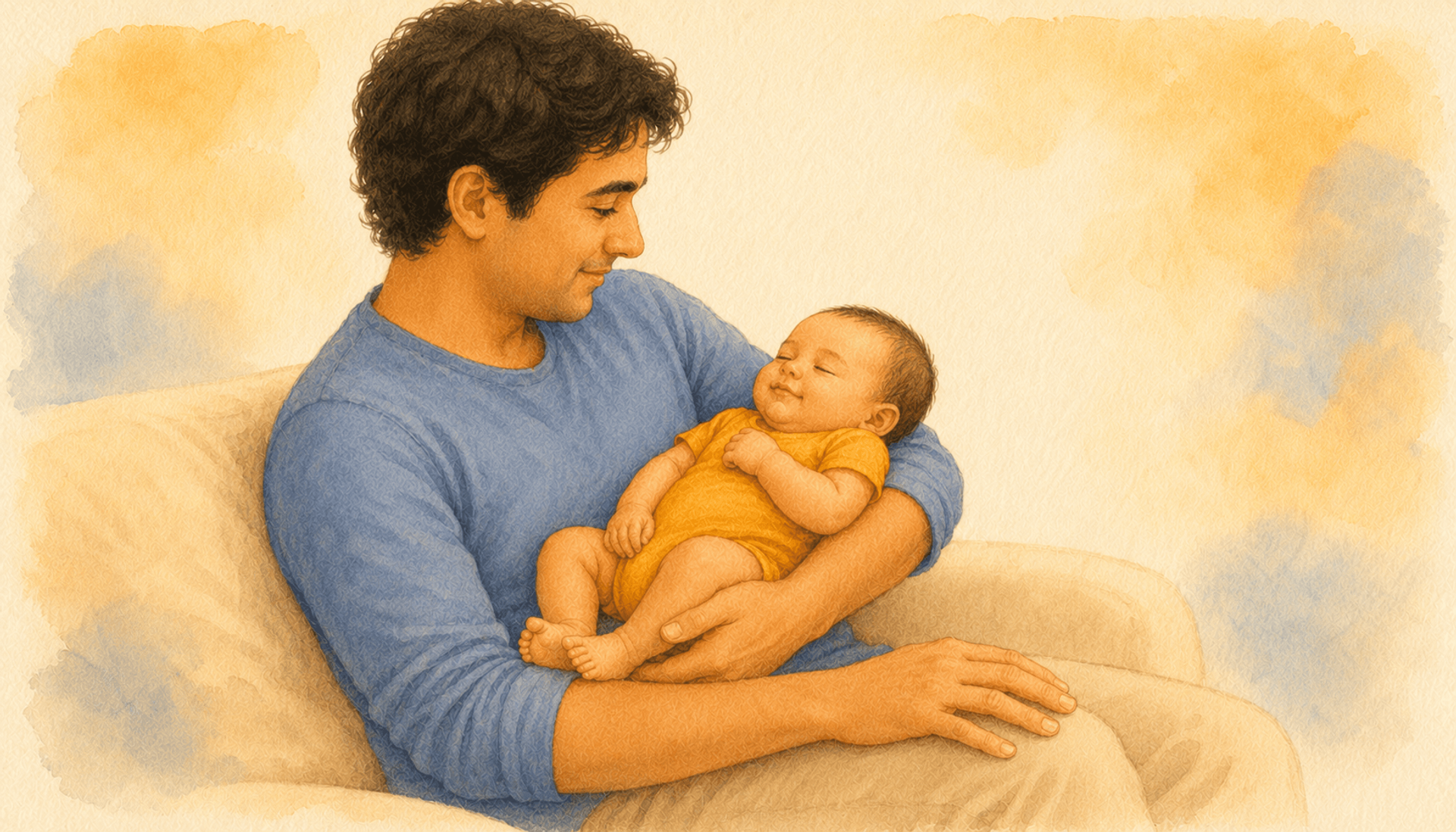
There are two biologically distinct types of smiles in early infancy, and they are not the same event wearing the same name. Understanding which one you're watching matters, partly because only one of them is the milestone, and partly because the reflex version can fool even attentive parents into thinking the real thing has arrived three weeks early.
The first type is the neonatal reflex smile. It appears from birth and is driven by internal neurological activity rather than external social input. Reflex smiles tend to happen when babies are drowsy, during REM sleep, or in response to gentle internal sensations. They're symmetric, brief, and (here's the giveaway) occur with the eyes closed or unfocused. There's nothing wrong with them and they're not meaningless: they represent the nervous system practicing the motor pattern it will later deploy deliberately. Think of them as the dress rehearsal.
The second type is the social smile, and it's a different neurological event entirely. When the first genuine social smile appears, it involves the whole face. The eyes crinkle slightly, the cheeks lift, and crucially, the baby is looking directly at you while it happens. The trigger isn't internal sensation but external social input: your face, your voice, the particular rhythm of being with a familiar person. By around six weeks of age, as described in research by Messinger and Fogel published across several decades of developmental studies, babies are no longer just practicing the smile pattern. They're using it to communicate. This shift from reflexive expression to deliberate social gesture is the milestone everyone's waiting for.
If you've been doing tummy time with high-contrast cards during your baby's alert periods, you may notice that the same visual focus your newborn brings to bold black-and-white patterns is the same attentiveness that eventually locks onto your face right before the first social smile appears. The two things are connected, as we cover in detail in what can newborns actually see, because the visual acuity developing in those first weeks is precisely what allows a baby to resolve a human face clearly enough to respond to it emotionally.
What's happening in the brain before the smile appears
Parents sometimes describe the weeks before the first social smile as a waiting game, which is accurate but slightly misleading. The brain is not idle during this period. Between birth and six weeks, the neural circuits involved in social processing are undergoing rapid myelination and reorganization, building the architecture that will eventually allow a baby to recognize a familiar face, register its emotional expression, and produce a coordinated response. The smile doesn't simply pop out when some threshold is crossed; it emerges as the endpoint of weeks of invisible preparation.
This is also why the social smile cannot meaningfully be accelerated. The timing is set not by how much stimulation a baby receives, but by where the brain is in its own developmental sequence. A baby whose parents smile at them constantly does not necessarily smile earlier than a baby from a quieter household. What the interaction does is provide the raw material the brain is simultaneously getting ready to process. The smile will arrive when the machinery is assembled, not before.
What changes dramatically in the weeks around six to eight weeks is visual acuity. A newborn's vision is limited to roughly eight to twelve inches of focal range, which conveniently corresponds to the distance between a cradled baby's face and the caregiver holding them. As we explore in the activities for a 1 month old guide, the earliest alert periods are short and the baby's interest is primarily in high-contrast edges and bold shapes. That's exactly why our high-contrast cards for newborns 0–3 months are designed to meet the visual system where it actually is, not where we wish it were. By around six weeks, focal range expands and contrast sensitivity improves enough that a human face at a normal holding distance becomes genuinely interesting rather than a friendly blur. The social smile, when it arrives, is in part the brain saying: I can see you clearly now. And I have something to say about that.
What helps the smile develop, and what is less important than you'd think
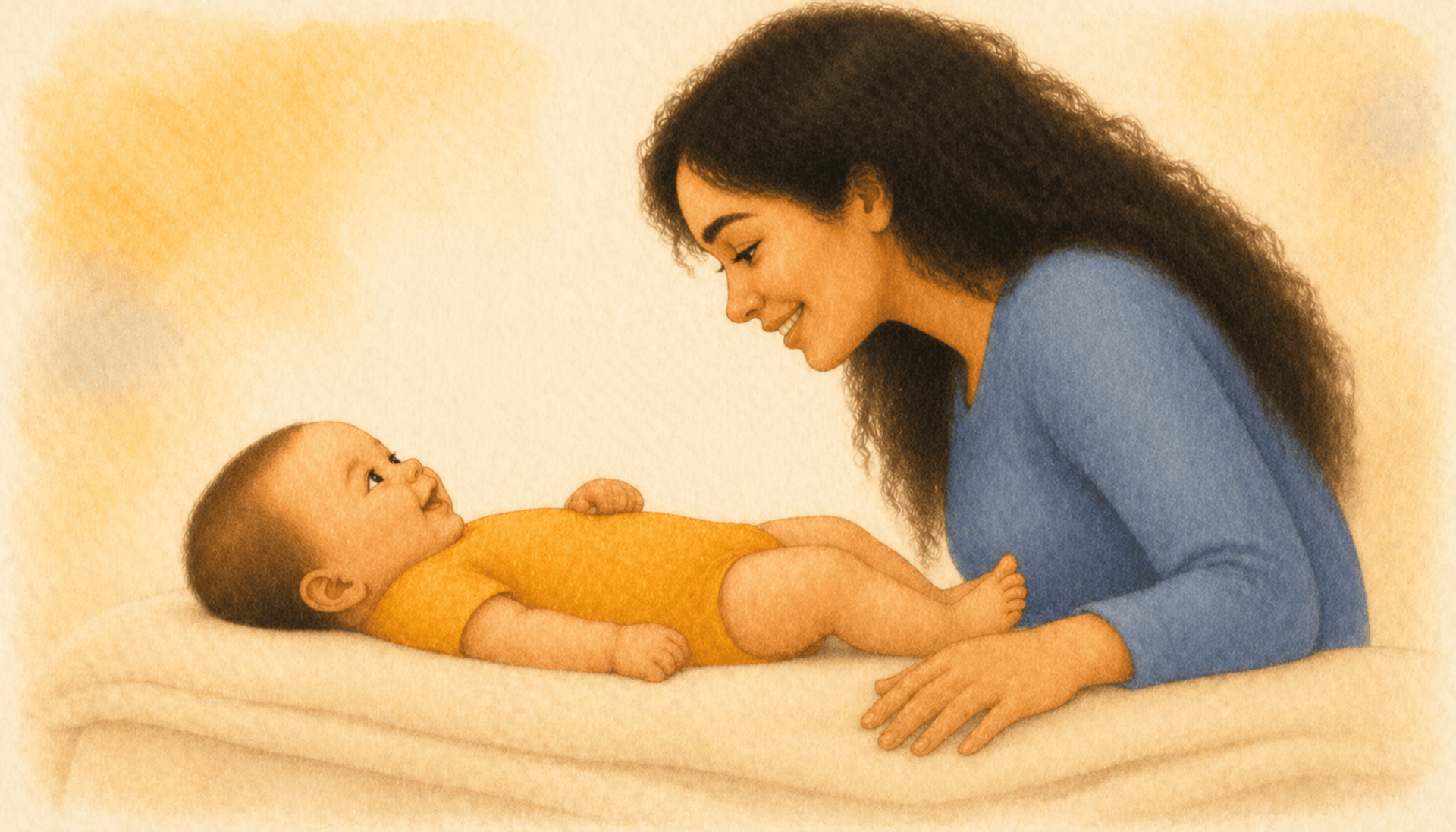
The standard advice for encouraging a baby's first smile is some version of: smile at your baby, make eye contact, talk and sing to them. None of this is wrong, but research published in Scientific Reports in 2016 suggests the picture is more specific than that.
A team led by Lynne Murray at the University of Reading tracked 19 mother-infant pairs weekly from one to nine weeks of age, coding every expression and response frame by frame. They found that the total amount of maternal responsiveness (how often a mother responded to anything her baby did) did not predict the development of infant social smiling. What did predict it was a much narrower category of response: mirroring and what the researchers called "marking with a smile." Marking meant responding to the baby's expressions with an exaggerated, warm, clearly-directed smile accompanied by raised eyebrows — a response that effectively told the baby: I noticed that, and here's what that looks like on a face you can study. Mothers who marked their babies' cues this way, rather than simply reacting to them neutrally, had babies whose social expressiveness developed more quickly.
The practical implication is less complicated than it sounds. When your baby produces any alert, interested, or positive expression — a wide-eyed look, a lip movement, a small sound — responding with a warm, exaggerated smile directed back at them is more developmentally useful than a neutral acknowledgment. It's not about quantity of interaction. It's about a specific quality: making your smile unmistakably about your baby, in response to what your baby just did. This is the serve-and-return dynamic described in what to do with a newborn all day, applied specifically to the earliest weeks of face-to-face exchange.
And then the development accelerates faster than most parents expect. Research by Ruvolo, Messinger, and Movellan published in PLOS ONE in 2015 found that by four months of age, babies have already learned to time their smiles strategically to maximize the probability that their caregiver will smile back. The social smile that appears in week six or seven isn't a fixed milestone. It's the opening note of a dialogue that gets increasingly sophisticated. If you're already exploring the activities in the 2-month-old guide, you're already participating in that dialogue whether you realize it or not.
What to do if your baby hasn't smiled yet
If your baby is approaching eight weeks without a social smile, the first and most important question is whether you're using the right age. For a baby born at 34 weeks gestation, eight weeks after birth is actually zero to two weeks past the due date — well before the typical window for the social smile. Using corrected age (weeks from the original due date rather than from birth) is not just a technicality for preemies; it's how the developmental biology works, as the research on the conception clock makes clear. For any baby born before 37 weeks, corrected age is the right yardstick, full stop.
For full-term babies who haven't smiled by ten or eleven weeks, it's worth taking a closer look at the context. The social smile is more likely to appear during calm, alert states when a baby is well-rested, not hungry, and being held in face-to-face position with a familiar caregiver. A baby who is rarely in that specific combination of circumstances may simply not have had enough opportunities. The American Academy of Pediatrics notes that most babies produce a clear social smile by the end of the second month, but there is a normal range, and a week or two of extra time in an otherwise healthy, responsive baby is not unusual.
If your baby has reached twelve weeks of age (or twelve weeks corrected, for preterm infants) without any clear social smile in response to a familiar face, that's a good thing to mention at the next pediatrician visit — not as an alarm, but as something to look at together. The CDC's 2022 milestone revisions continue to list a social smile as a two-month expected milestone, and a pediatrician who knows your baby's history is the right person to put the timing in context. The language to use: "My baby hasn't really started smiling yet. Is that something you'd want to check on?"
Frequently Asked Questions
Intentional social smiling typically begins at around six to eight weeks of age, when a baby's developing brain reaches the maturational point where a familiar face can trigger a deliberate, coordinated expression. Before this, newborn smiles are reflexive rather than intentional — they happen during sleep or drowsy states and are driven by internal neurological activity, not by the baby responding to you. By six weeks, most full-term babies begin producing smiles that are clearly aimed at a caregiver's face during alert, awake time.
A reflex smile tends to happen when a baby is drowsy or asleep, with eyes closed or unfocused, and it often comes and goes quickly without any apparent social trigger. A real social smile happens when the baby is awake and alert, with eyes open and looking at you, and the whole face participates, not just the mouth. The cheeks lift slightly, the eyes crinkle at the corners, and if you mirror it back, many babies will smile again. Once you've seen a real one, the distinction is usually obvious.
Responsive social smiling — where a baby smiles in reply to your smile rather than spontaneously — typically begins at the same developmental window as the first social smile, around six to eight weeks. By this point, the visual and social processing systems have matured enough that a baby can register a smiling face, interpret it as a positive social cue, and produce a matching response. A 2016 study in Scientific Reports found that babies whose caregivers used warm, exaggerated mirroring responses developed this reciprocal smiling more reliably and quickly.
Consistent, frequent social smiling usually becomes established between eight and twelve weeks of age, after the first social smiles appear. In the early weeks, smiles may be occasional and easily missed, especially if the baby isn't in the right state (awake, calm, face-to-face). By three months, most babies are smiling readily in social interactions, and by four months, research shows they've begun timing their smiles strategically to maximize engagement with familiar caregivers.
Preterm babies start smiling on a different calendar timeline than full-term babies, but at roughly the same biological point in development. A baby born eight weeks early will typically produce a first social smile around eight weeks later than a full-term baby by chronological age. A 2013 study in the Journal of Human Growth and Development found that 94% of preterm infants showed a social smile by three months corrected age (measured from the original due date), compared to only 71% at three months chronological age. Using the due date as the starting point (not the birth date) is the right way to track this milestone.
This article is for educational and informational purposes only and is not a substitute for professional medical advice, diagnosis, or treatment. If you have concerns about your baby's development, please consult your pediatrician.
- Albuquerque, R. C., Gagliardo, H. G. R. G., & Barbosa, A. S. L. (2013). Expression of social smile of pre-term infants with age adjusted. Journal of Human Growth and Development, 23(3), 318–321.
- American Academy of Pediatrics. (2021). When do babies first smile? HealthyChildren.org.
- Anisfeld, E. (1982). The onset of social smiling in preterm and full-term infants from two ethnic backgrounds. Infant Behavior and Development, 5(2–4), 387–395.
- Centers for Disease Control and Prevention. (2022). Learn the Signs. Act Early: Developmental Milestones.
- Hornman, J., de Winter, A. F., Kerstjens, J. M., Bos, A. F., & Reijneveld, S. A. (2021). Attainment of smiling and walking in infancy associates with developmental delays at school entry in moderately-late preterm children: a community-based cohort study. BMC Pediatrics, 21, 89.
- Messinger, D., & Fogel, A. (2007). The interactive development of social smiling. Advances in Child Development and Behavior, 35, 328–366.
- Murray, L., De Pascalis, L., Bozicevic, L., Hawkins, L., Sclafani, V., & Ferrari, P. F. (2016). The functional architecture of mother-infant communication, and the development of infant social expressiveness in the first two months. Scientific Reports, 6, 39019.
- Pezzotti, E., Provenzi, L., Naboni, C., Capelli, E., Ghirardello, S., Borgatti, R., & Orcesi, S. (2024). Masked or not, I smile to you: Exploring full-term and preterm infants' social smiles to adults wearing a protective facemask. Infant Behavior and Development, 75, 101947.
- Rogers, S. J., & Puchalski, C. B. (1986). Social smiles of visually impaired infants. Journal of Visual Impairment & Blindness, 80(7), 781–786.
- Ruvolo, P., Messinger, D., & Movellan, J. (2015). Infants time their smiles to make their moms smile. PLOS ONE, 10(9), e0136492.
- Simion, F., & Di Giorgio, E. (2015). Face perception and processing in early infancy: inborn predispositions and developmental changes. Frontiers in Psychology, 6, 969.
- Tronick, E., Als, H., Adamson, L., Wise, S., & Brazelton, T. B. (1978). The infant's response to entrapment between contradictory messages in face-to-face interaction. Journal of the American Academy of Child Psychiatry, 17(1), 1–13.
- Wörmann, V., Holodynski, M., Kärtner, J., & Keller, H. (2012). A cross-cultural comparison of the development of the social smile: A longitudinal study of maternal and infant imitation in 6- and 12-week-old infants. Infant Behavior & Development, 35(3), 335–347.
Related Products
More Articles
Parallel Play in Toddlers: Why Side-by-Side Is the Social Work
Your toddler spent the entire playdate building separate towers, and nobody shared a single block. That counted — more than it looked. A 2025 longitudinal study found that playing beside a specific child consistently predicted later social play with that same child, but not the other way around. Here's what parallel play in toddlers actually is, why the science calls it strategic rather than passive, and what it means for how you run a playdate.
When Do Babies Point: Why It Matters for Language
Most milestone articles treat pointing as a box to check around 12 months. The research tells a different story — one that starts months earlier, runs through the infant brain, and traces back to how much the parent is pointing. Here's what the last fifteen years of research actually found, and what it means for everyday interactions.
When Do Babies Wave Bye-Bye: Why Your Baby Needs You to Wave First
Most baby milestones unfold on a biological schedule — waving isn't one of them. A 2023 study found that babies develop imitation ability because their caregivers imitate them first, and waving is named directly as a cultural gesture learned through that loop. Here's what the research says about the 9–12 month window, why the first wave looks nothing like a wave, and what helps it arrive.