Summer Activities for Babies: Safe Outdoor Play by Age
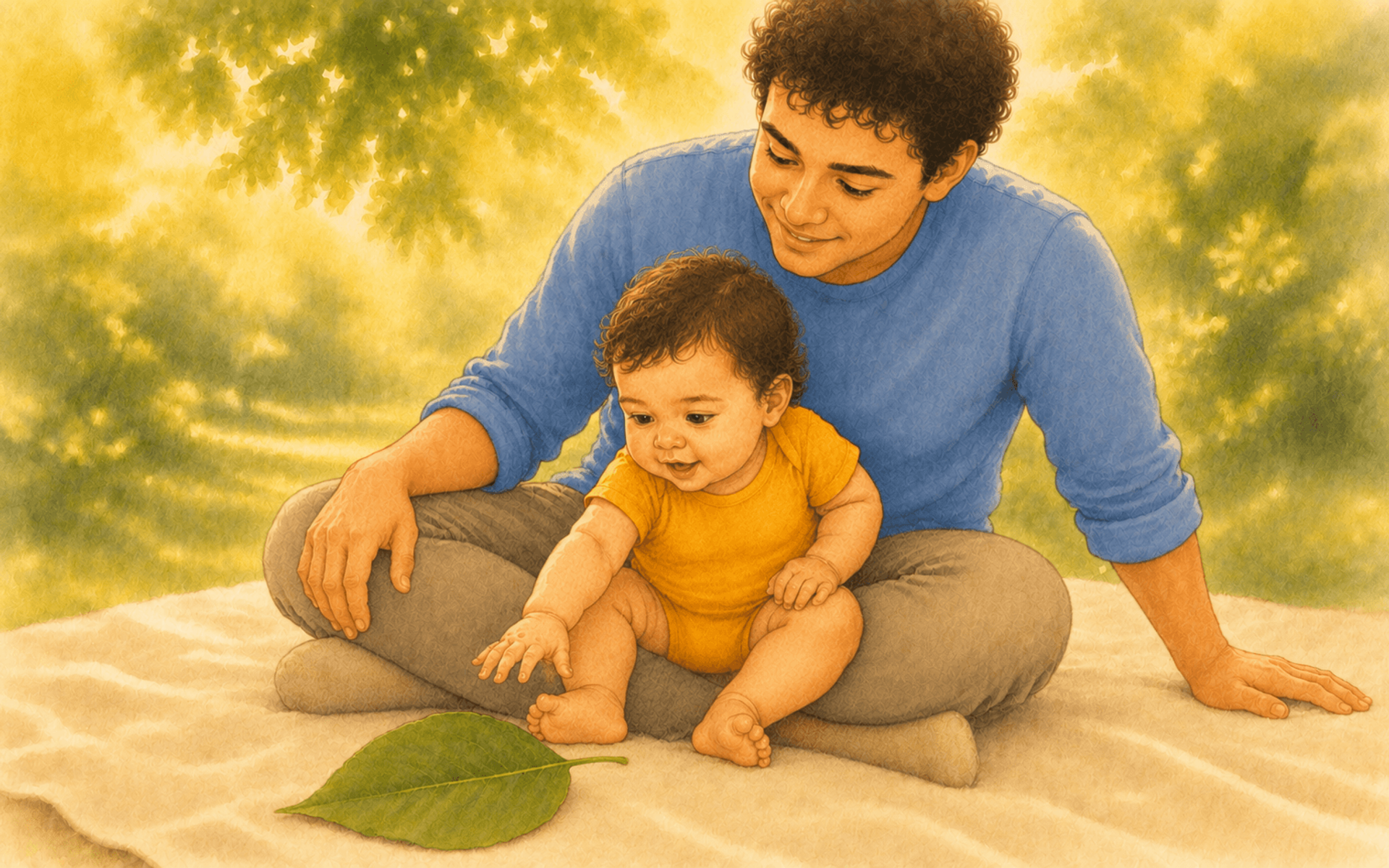
Somewhere around week six of summer, the indoor loop starts to feel very small: tummy time, high chair, activity mat, repeat. So you do what seems reasonable — pack the baby into the stroller at 8 a.m., find the shadiest stretch of sidewalk you own, and roll. An hour later the baby is asleep, your tea is still warm, and the morning has, somehow, been a success. Summer activities for babies don't require a kiddie pool or a Pinterest plan. The simplest version — outside, in shade, in motion — turns out to have more science behind it than most parents realize.
- Why the outdoor environment does something a playmat structurally cannot, and what that means for a developing nervous system
- The exact numbers — heat index threshold, UV window, sunscreen age cutoff — that turn a vague "be careful outside" into an actual plan
- What summer outdoor time looks like for 0-3 months, when shade and motion are the entire strategy
- How 3-6 month olds can start using outdoor surfaces as sensory tools, including why outdoor tummy time works differently than the living room floor version
- What 6-12 month olds can do with water, grass, and sand — including the drowning risk and surface-burn facts most articles leave out
If the one-sentence answer is enough, you’ve got the gist. If you want the mechanism behind each piece, keep reading.
What the outdoor environment does that a playmat structurally cannot
The outdoor environment is not just a change of scenery. A baby lying on a blanket in a shaded backyard is receiving something a living room mat cannot replicate: simultaneous input across multiple senses at the same time. A breeze moves through leaves overhead, which means the baby sees movement, hears rustling, and feels air on the skin all at once, in the same moment, from the same source. Research by Bahrick and Lickliter, published in Developmental Psychology in 2000, established that infants are specifically primed to process this kind of redundant multimodal input: when the same event is visible, audible, and tactile simultaneously, it captures attention and drives perceptual learning more effectively than any single-sense experience. A flashcard is visual. A sound toy is auditory. A tree in a breeze is both, plus temperature variation, plus movement, plus smell. That combination is something a playmat can approximate but cannot match.
There is also a newer finding that reframes the whole question of whether outdoor time is worth the logistics. In a 2025 randomized study from Radboud University's Donders Institute, published in the Journal of Environmental Psychology, researchers followed 101 mothers and their babies aged zero to five months through four different conditions: outdoor walk or indoor stay, combined with a chest carrier or a pram. Babies who were walked in an outdoor green environment slept longer afterward than babies who stayed indoors, and this held regardless of whether they were being carried or in a stroller. The same study found that babies in a chest carrier, both indoors and outdoors, showed a greater post-procedure drop in cortisol than babies in a pram. Going outside with your baby is not a luxury. It is, per a randomized trial, associated with longer naps.
The sleep connection has a second mechanism as well. A 2024 scoping review in the European Journal of Pediatrics (covering 25 studies on infant light exposure) found that natural daylight plays a meaningful role in establishing the infant circadian rhythm from as early as six to eight weeks of age. Daytime light exposure, particularly at intensities above 500 lux (which is typical outdoor shade), was a significant predictor of circadian rhythm development. The practical translation: regular morning outdoor time, even brief, helps a baby's brain learn the difference between day and night, which is the physiological prerequisite for nighttime sleep consolidation. A 2017 study in Scientific Reports by Iwata and colleagues, following over 1,000 mother-infant pairs in Japan, found that infants born in spring, who had longer natural daylight hours, slept significantly longer at night than infants born in autumn.
For more on how the senses develop in the first year and what kinds of input support that development, Baby's Five Senses Development covers the research on each sensory system month by month.
The safety numbers that turn "be careful outside" into an actual plan
The American Academy of Pediatrics states that a heat index at or above 90°F poses a significant health risk for children, and that parents should avoid prolonged outdoor time above this threshold (HealthyChildren.org, "Extreme Heat: Tips to Keep Kids Safe When Temperatures Soar," 2025). Heat index (which combines air temperature and humidity) is the number to watch, not temperature alone. At 86°F with 70% humidity, the heat index exceeds 90°F. A weather app that shows "86" without showing the "feels like" is leaving out the relevant number.
Babies are more vulnerable to overheating than adults for two reasons that matter practically. First, their sweat glands are not yet fully developed, which means sweating does not cool them as effectively. Second, they cannot tell you they are uncomfortable. The AAP recommends checking on a baby every 15 to 20 minutes during outdoor time on warm days. Signs that a baby needs to go indoors immediately include flushed red cheeks, rapid breathing, unusual fussiness, a hot or damp neck, or sudden lethargy after being active. These are the early-warning signs; do not wait for them to progress.
Sun protection rules are different before and after six months. For babies under six months, the AAP recommends keeping the baby out of direct sunlight entirely, using shade from a tree, umbrella, or stroller canopy, and avoiding sunscreen as a primary strategy, since a young baby's skin absorbs chemical ingredients more readily and their sweat glands cannot compensate for the heat that some formulas trap. When shade cannot be guaranteed, the AAP allows a minimal amount of mineral sunscreen on small exposed areas for very young infants. For babies six months and older, broad-spectrum mineral sunscreen (zinc oxide or titanium dioxide, SPF 15 or higher) applied 15 to 30 minutes before going out and reapplied every two hours is appropriate. Both age groups should wear a wide-brimmed hat and lightweight, light-colored clothing that covers the arms.
Peak UV intensity runs from 10 a.m. to 4 p.m., according to AAP sun-safety guidance. Early morning outings (before 10 a.m.) or late afternoon (after 4 p.m.) avoid the highest-UV window while still capturing the natural light that supports circadian rhythm development. This timing applies to all the summer activities for babies described in the sections below.
For families who have already covered the basics of keeping babies cool indoors, What to Do with a Newborn All Day has a broader activity guide for the early months.
Summer activities for babies 0-3 months: shade, motion, and fresh air are enough
At this age, babies experience the world through what they can see, hear, and feel, and the outdoor environment provides all three simultaneously. The activities that matter most for a newborn outside are also the simplest: a shaded stroller walk in the morning, or 15 to 20 minutes on a blanket in full shade while you sit nearby. That is not a placeholder for "real" activities. Based on the Radboud University study, it is one of the most evidence-supported things you can offer at this age.
A useful visual anchor for a young baby outdoors is anything overhead that moves. Dappled light through tree leaves, a branch swaying in wind, or the shifting shadows of an umbrella edge engage the visual tracking system in a way that a stationary mobile indoors cannot, because the movement is unpredictable. A ceiling fan moves in a single, repetitive arc; a tree in a breeze does not. Unpredictable visual movement is, per foundational infant perception research, more cognitively engaging than repeating patterns, which is one reason babies stare at leaves so intensely. You can read more about the early development of baby vision and what captures attention in What Can Newborns Actually See.
Keep outdoor sessions to 15 or 30 minutes and plan them for the early morning window before 10 a.m. Do not put sunscreen on babies under six months; shade and clothing are the protection strategy. On any day with a heat index above 90°F, skip outdoor time entirely and use the morning light through an open window or a shaded doorway instead. For hydration in heat, the answer at this age is more frequent nursing or formula feeds, not water; the AAP recommends waiting until six months to introduce water, and offering it before that age in response to heat carries a risk of hyponatremia.
A baby carrier is useful here. The Radboud study found that babies carried in a chest carrier showed a greater post-procedure drop in cortisol than babies in a pram, and this effect held both indoors and outdoors. If a baby is fussy and you are heading out for a walk, a breathable mesh carrier in the shade combines the carrying benefit with the sleep benefit of the outdoor environment.
Summer activities for babies 3-6 months: outdoor tummy time and first textures
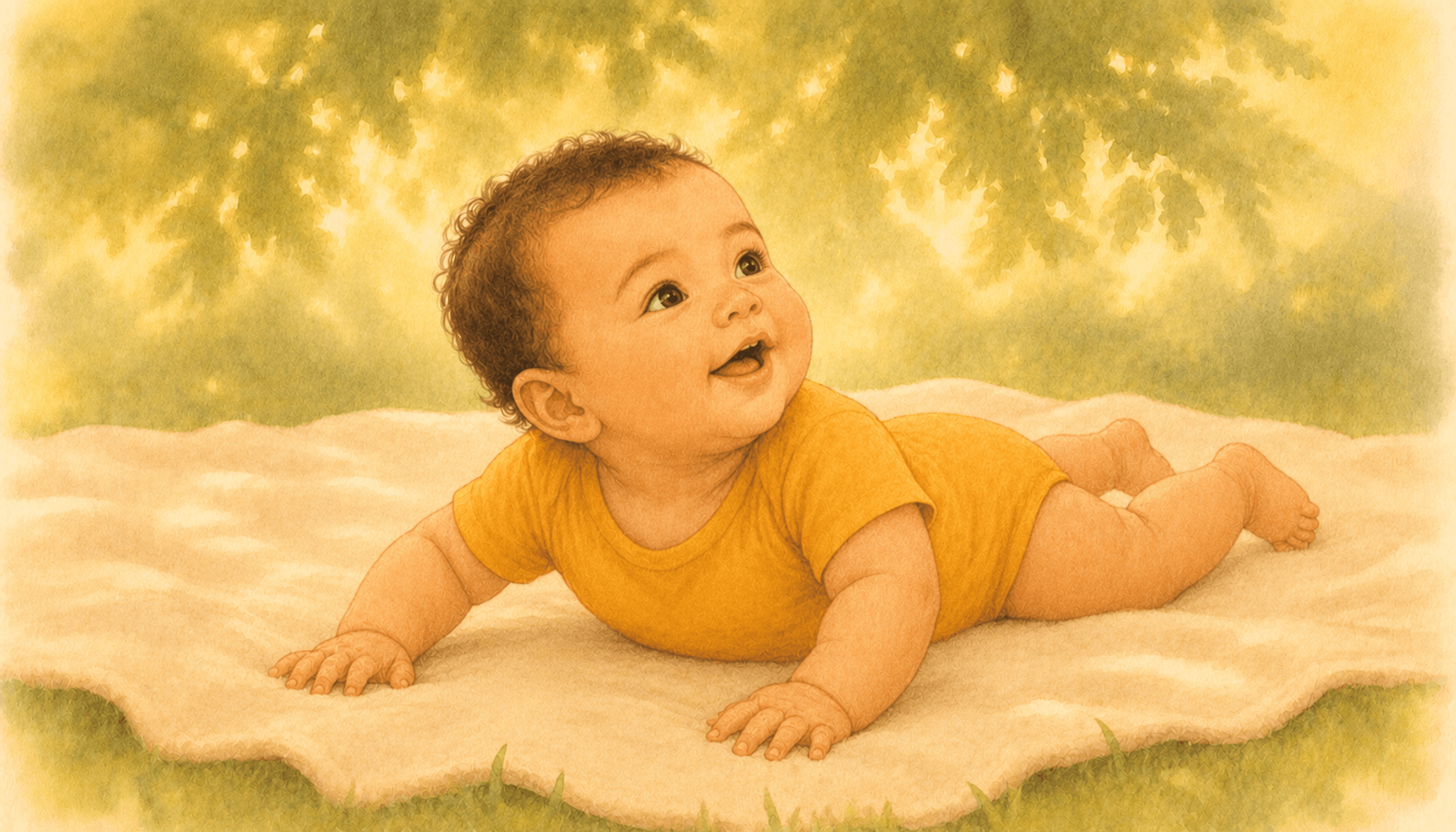
By three to four months, most babies have enough head control to begin lifting and holding the head during tummy time, and the outdoor environment gives them a reason to. A baby who is moderately interested in lifting the head inside to look at a familiar play mat will often work considerably harder outdoors, because the visual input (moving grass, shifting light, a sibling or a parent at an interesting angle) gives the baby something new to track. This is not a parenting hack; it is the intersensory redundancy principle at work. More interesting visual target equals more motivated lift equals more neck and shoulder work.
Outdoor tummy time should always be on a blanket or firm surface, never directly on grass without protection, and with an adult within arm's reach. Sessions of five to ten minutes, three to four times a day, are appropriate at this age; longer than ten minutes is often too tiring. For a baby who resists tummy time indoors, the outdoor version is sometimes more tolerable simply because there is more to look at. More evidence-based strategies for a baby who objects to tummy time are in Baby Hates Tummy Time.
This is also the age when supervised texture exploration can start in a simple form. Letting a baby touch (with your hand guiding hers) a smooth leaf, a dry grass blade, or a cool smooth stone gives the tactile system input that is qualitatively different from any manufactured toy. The outdoor environment delivers real-world textures: irregular, temperature-variable, and with mild natural scent. Supervision means your hand is present, the object is too large to enter the mouth, and the session ends when the baby's interest ends. No object from the ground should go in a baby's mouth at this age.
Stroller walks remain the anchor activity for this age group. The Radboud University research covered infants zero to five months, which means the sleep benefit of outdoor walking is directly evidenced for babies across this entire window. A morning walk of 30 minutes in shade, timed before 10 a.m., covers the circadian rhythm support, the multimodal sensory input, and the sleep benefit from the Rheinheimer research in one outing.
For fathers taking outdoor lead during a weekend morning, a chest carrier walk in a shaded park is an easy, high-quality activity that requires nothing except a carrier and a route. The cortisol and sleep effects from carrying in the Radboud study were not limited to mothers; the study notes co-regulation as the likely mechanism, which works regardless of which parent is wearing the carrier.
Babies 6-12 months: water, barefoot grass, and the rules that matter
At six months, the range of summer activities for babies expands considerably, and so does the category of risks that need clear rules. Water play, surface exploration, and outdoor sensory time with natural materials all become possible, and each requires a different level of vigilance.
Water safety comes first. The AAP's guidance on infant water safety is direct: babies can drown in as little as one to two inches of water, and drowning happens silently and within seconds (HealthyChildren.org, "Infant Water Safety: Protect Your New Baby from Drowning," 2019). This applies to kiddie pools, splash bins, water tables, and any shallow water container. The rule for water play at this age is constant touch-supervision — meaning an adult's hand is within arm's reach of the baby at all times, no exceptions, including when the phone rings. Leaving a six-month-old in two inches of water to answer the door takes less than a minute and is long enough for a fatality.
Pool water temperature matters more than most parents realize. An American Red Cross Scientific Advisory Council review established a recommended pool temperature range of 87 to 94°F for infant and toddler aquatic programming. Below 85°F, babies lose body heat much faster than adults; Stanford Medicine Children's Health notes that infants can lose heat roughly four times as fast as an adult. Avoid commercial pools set for adult competitive swimming, which typically run 78 to 82°F. A small backyard kiddie pool filled from the tap and allowed to warm in the shade for 20 to 30 minutes before use is usually within a safe range on a warm day; check with your hand before placing the baby in.
Surface temperature is the hazard most parents do not expect. Research by Chestovich and colleagues, published in the Journal of Burn Care & Research in 2023, documented outdoor surface temperatures in direct sunlight at ambient air temperatures around 120°F: asphalt reached 166°F, concrete and galvanized metal reached 144°F, and sand reached 143°F. On a typical summer afternoon, these surfaces can cause contact burns in less than a minute. For babies six to twelve months who are crawling or pulling to stand, assume that any paved or sandy surface in direct sun is too hot to sit on, and check with the back of your own hand before placing a baby on it. Shade, a blanket, or water shoes remove this risk.
Barefoot grass exploration in shade is a genuinely worthwhile sensory activity for babies who are sitting independently or pulling to stand. The proprioceptive input of irregular grass underfoot (especially for a baby who is starting to weight-bear) is qualitatively different from any indoor flooring. Keep sessions under shade and within arm's reach, and skip it on days when the lawn has been recently treated with fertilizer or pesticide.
Splash pads are appropriate for this age group with full supervision. One note from Cincinnati Children's and CDC recreational water illness guidance: splash-pad water recirculates and can carry pathogens including cryptosporidium if the chlorination system is not maintained. Skip the splash pad if the baby has had diarrhea in the last two weeks, and change swim diapers at least once per hour.
The Sensory Play Cards for 0-12 months are laminated, wipe-clean, and sized for outdoor tummy time and sensory sessions. For the month-by-month breakdown of which sensory activities match each developmental stage through the first year, Sensory Play for Babies Month by Month and Sensory Play Ideas No Prep are both worth bookmarking before summer starts.
The AAP is also explicit about swim lessons that there is no evidence that structured swim programs reduce drowning risk in babies under one year of age (Denny and colleagues, Pediatrics, 2019; reaffirmed December 2024). Parent-baby water classes from around six months are appropriate as a bonding activity and for gradual water acclimation, but they do not replace constant supervision and they do not confer water safety. The only evidence-based drowning prevention at this age is touch-supervision and removing access to water when the adult cannot supervise.
Frequently Asked Questions
Yes, with adjustments. The American Academy of Pediatrics recommends keeping babies under six months out of direct sunlight and avoiding prolonged outings when the heat index (temperature combined with humidity) is at or above 90°F. A shaded stroller walk of 15 to 30 minutes in the early morning, before 10 a.m., is appropriate and evidence-supported. A 2025 randomized trial from Radboud University found that babies aged zero to five months who were walked in an outdoor green environment slept longer than babies who stayed indoors.
Shaded stroller walks, outdoor tummy time on a blanket in full shade, and babywearing in a breathable carrier in cool morning hours are the core activities for this age. No sunscreen, no direct sun, no water play. The developmental goal at this age is sensory input — natural light for circadian rhythm development, multimodal stimulation from moving leaves and outdoor sounds, and the proprioceptive input of motion. No swimming pools, no water bins, and no outdoor outings above a heat index of 90°F.
The clearest early signs are flushed red cheeks, a hot or damp neck and back, rapid breathing, and unusual fussiness or unusual quietness. A baby's temperature should sit around 97.5°F; anything at or above 100.4°F is a fever and warrants medical attention. If any of these signs appear, bring the baby indoors into a cool space immediately. The AAP recommends checking on your baby every 15 to 20 minutes during outdoor time on warm days, since babies cannot regulate temperature as effectively as adults and cannot communicate discomfort.
There is no specific minimum age, but practically, pool water play before six months is difficult because babies have no independent sitting balance and cannot regulate body temperature in cool water. From six months, shallow water play with constant touch-supervision is appropriate, provided the water is warm enough; the recommended temperature range for infant water programs is 87 to 94°F. The American Academy of Pediatrics is clear that babies can drown in as little as one to two inches of water, so a parent's hand must remain within arm's reach at all times, without exception.
Before 10 a.m. or after 4 p.m., when UV intensity is lowest, according to AAP sun safety guidance. Early morning is preferable because natural light exposure in the morning most effectively supports circadian rhythm development, since the infant's internal clock responds most strongly to morning light, which helps establish the day-night distinction that underpins nighttime sleep. On very hot days, the morning window also tends to be cooler before the pavement and sand have had time to absorb heat.
This article is for informational and educational purposes only and is not a substitute for professional medical advice. Always consult your pediatrician about your individual baby's health and development.
- American Academy of Pediatrics / HealthyChildren.org. (2019). Infant water safety: Protect your new baby from drowning.
- American Academy of Pediatrics / HealthyChildren.org. (2024, August 9). Summer sun, heat & air quality: Tips to keep kids safe.
- American Academy of Pediatrics / HealthyChildren.org. (2025, June 23). Extreme heat: Tips to keep kids safe when temperatures soar.
- Bahrick, L. E., & Lickliter, R. (2000). Intersensory redundancy guides attentional selectivity and perceptual learning in infancy. Developmental Psychology, 36(2), 190–201.
- Bahrick, L. E., Lickliter, R., & Flom, R. (2004). Intersensory redundancy guides the development of selective attention, perception, and cognition in infancy. Current Directions in Psychological Science, 13(3), 99–102.
- Bradley, S., & Tan, A. (2013). Appropriate water temperatures in which to conduct infant and preschool aquatic programs. International Journal of Aquatic Research and Education, 7(2).
- Chestovich, P. J., et al. (2023). Outdoor surface temperatures and risk of contact burns in residential settings. Journal of Burn Care & Research.
- Clemens, T., et al. (2024). Vital signs: Drowning death rates. MMWR, 73(20).
- Denny, S. A., et al. (2019). Prevention of drowning. Pediatrics, 143(5), e20190850.
- Iwata, S., et al. (2017). Dependence of nighttime sleep duration in one-month-old infants on alterations in natural and artificial photoperiod. Scientific Reports, 7, 44749.
- Kok, E. Y., et al. (2024). The role of light exposure in infant circadian rhythm establishment. European Journal of Pediatrics, 184(1), 112.
- Rheinheimer, N., et al. (2025). Effects of outdoor walking and infant carrying on behavioral and adrenocortical outcomes. Journal of Environmental Psychology, 102, 102527.
- Rheinheimer, N., et al. (2024). Infant care: Predictors of outdoor walking, infant carrying and infant outdoor sleeping. IJERPH, 21(6), 694.
Related Products
More Articles
Parallel Play in Toddlers: Why Side-by-Side Is the Social Work
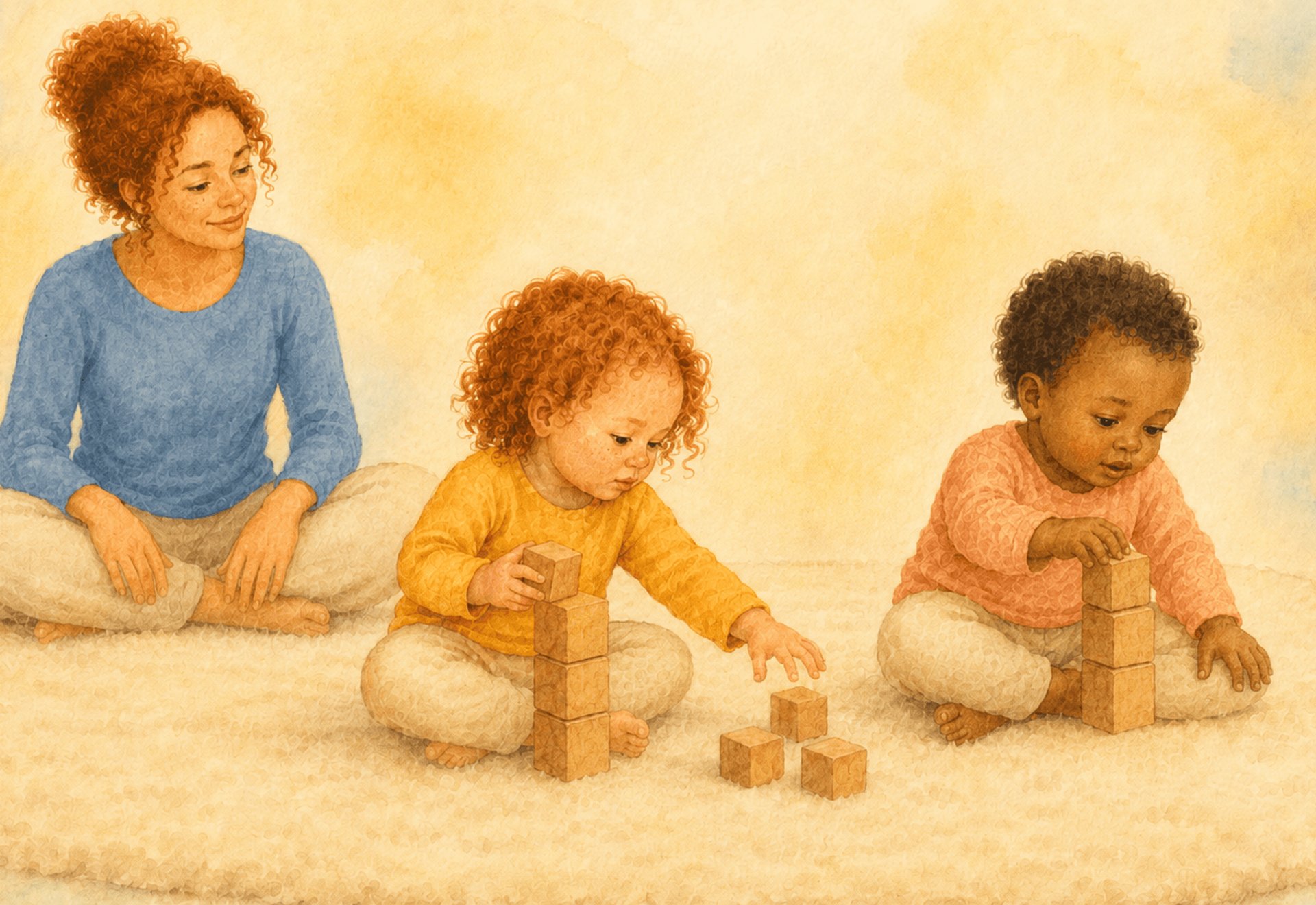
Your toddler spent the entire playdate building separate towers, and nobody shared a single block. That counted — more than it looked. A 2025 longitudinal study found that playing beside a specific child consistently predicted later social play with that same child, but not the other way around. Here's what parallel play in toddlers actually is, why the science calls it strategic rather than passive, and what it means for how you run a playdate.
When Do Babies Point: Why It Matters for Language
Most milestone articles treat pointing as a box to check around 12 months. The research tells a different story — one that starts months earlier, runs through the infant brain, and traces back to how much the parent is pointing. Here's what the last fifteen years of research actually found, and what it means for everyday interactions.
When Do Babies Wave Bye-Bye: Why Your Baby Needs You to Wave First
Most baby milestones unfold on a biological schedule — waving isn't one of them. A 2023 study found that babies develop imitation ability because their caregivers imitate them first, and waving is named directly as a cultural gesture learned through that loop. Here's what the research says about the 9–12 month window, why the first wave looks nothing like a wave, and what helps it arrive.